
A finite electric dipole consists of equal and opposite electric charges separated by a nonzero displacement. It has charge neutrality but a nonzero electric dipole moment . An ideal point electric dipole is the mathematical limit with fixed, so must increase as . Shrinking the separation while holding fixed instead makes the electric dipole moment vanish. The ideal electric dipole describes an exterior electric field; it does not reproduce the two near-charge singularities or the internal structure of a molecule. [ref]
https://farside.ph.utexas.edu/teaching/jk1/lectures/node20.html. Richard Fitzpatrick, Electric Dipoles: the fixed-moment point limit
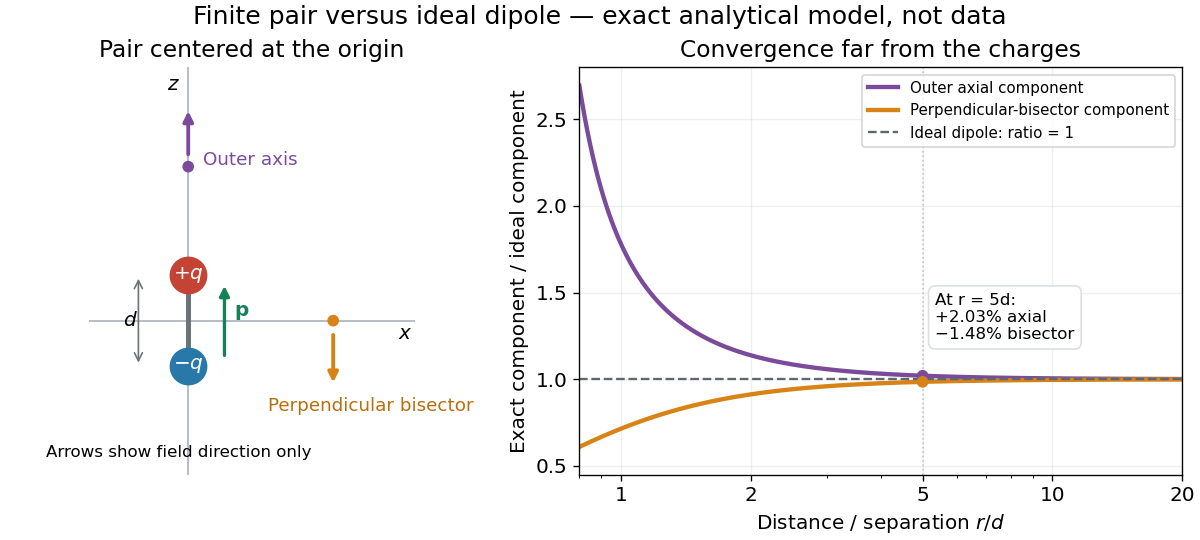
.Place the pair's midpoint at the origin and write , where is vacuum permittivity. By superposition principle and Coulomb's law, its exact electric potential away from the two point charges isFor , retain the first nonzero term of a Taylor series. The electric potential and its negative gradient becomeHere and the products in parentheses are dot products. These are exact exterior formulas for the ideal electric dipole and distant approximations for a finite pair. The electric field on the outer axis points along with magnitude ; on the perpendicular bisector it points opposite with magnitude . This directional structure is what a scalar total electric charge misses. [ref]
https://www.feynmanlectures.caltech.edu/II_06.html#Ch6-S2. Feynman, Leighton and Sands, II.6.2: exact pair potential and dipole expansion
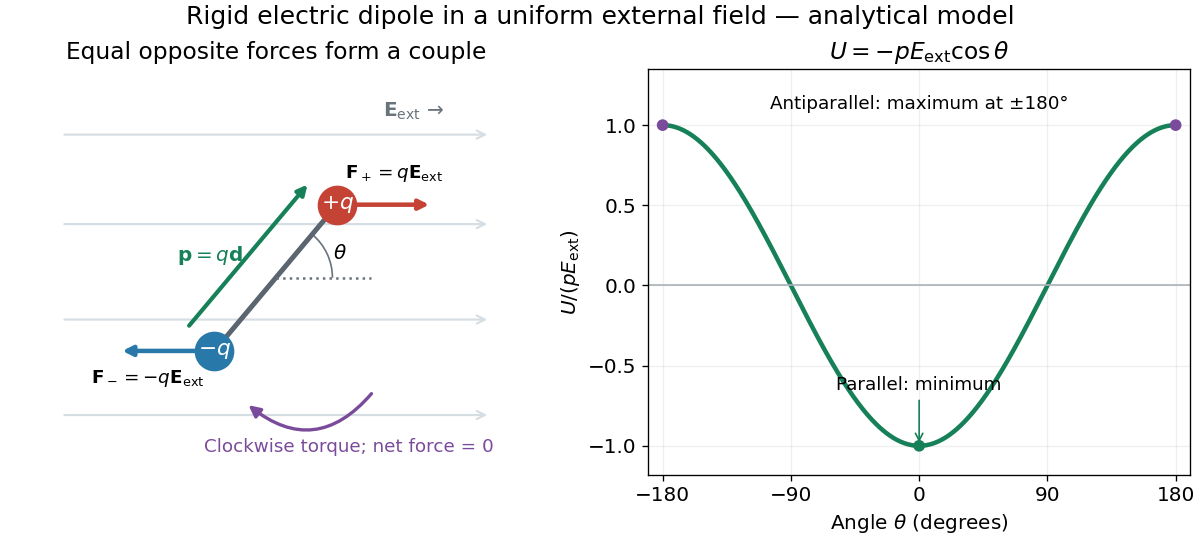
.In a prescribed uniform external electric field , a rigid pair has opposite forces . Its net force is zero, but summing their moments about the midpoint gives the torqueThe cross product makes the torque perpendicular to both the electric dipole moment and the external electric field. If is the angle from to in their plane, the signed turning torque is . It tends to reduce a small positive . [ref]
https://openstax.org/books/university-physics-volume-2/pages/5-7-electric-dipoles. Ling, Moebs and Sanny, University Physics 2, 5.7: forces and torque on a dipole
.The external interaction potential energy, with zero chosen at , isParallel alignment minimizes this potential energy; antiparallel alignment maximizes it even though the torque is zero in both positions. This omits the pair's constant internal binding potential energy and assumes a fixed permanent electric dipole moment. [ref].

A nonuniform external electric field can exert a net force on a neutral electric dipole. Before taking the small-pair approximation, the exact external force is , where is the midpoint. A first-order Taylor series gives, for a fixed electric dipole moment and an external electric field varying slowly across ,in electrostatics. The last equality uses the vanishing curl of the external electric field, with held fixed while differentiating. Thus uniform external electric fields turn a misaligned electric dipole, whereas gradients can also move its midpoint. For example, the local source-free electric field gives , so reversing the electric dipole moment reverses the net force. This stipulated local model has zero divergence and zero curl.
A motivating experiment is Filsinger and colleagues' study of electrostatic deflection of polar molecules. Benzonitrile () in helium expanded from a pulsed valve into vacuum; two 1-mm skimmers narrowed the beam before a 15-cm deflector. A grounded trough and a high-voltage rod produced a vertical electric field gradient. Scanning a focused laser vertically downstream and recording benzonitrile ions from photoionization measured the beam's relative density. With voltage off, the profile spanned about 2 mm; applying voltage shifted and broadened it upwards. At 10 kV, many molecules lay outside the original profile. [ref]
https://pure.mpg.de/pubman/item/item_736019_2/component/file_736018/433451%28filsinger%29.pdf. Filsinger et al., Quantum state selection, alignment, and orientation of large molecules using static electric and laser fields, sections II and III A, figure 3
.Interpretation uses a quantum state's Stark effect energy : gives . States whose energy falls with increasing electric field seek stronger fields. The voltage-off profile controls the mechanical aperture. Inferring state populations needs calculated trajectories, speed distributions and a rotational temperature model; profile displacement alone does not measure a permanent electric dipole moment uniquely. This is an electric Stark effect experiment, with photoionization occurring after deflection. [ref]
https://pure.mpg.de/pubman/item/item_736019_2/component/file_736018/433451%28filsinger%29.pdf. Filsinger et al., section III A: Stark slopes, trajectory modelling and state selection
.For the symmetric finite pair, the first omitted electric multipole expansion term after the electric dipole is third order, so typical relative errors scale as . This stronger error estimate need not hold for an arbitrary neutral molecule with a nonzero electric quadrupole moment. A concrete check for a pair on the axis compares the exact and ideal electric fields at on the positive axis and at on the perpendicular bisector:Both perpendicular-bisector components are negative. At , the ratios are approximately and : errors of and relative to the ideal electric field. The condition concerns observing the pair's own electric field; the separate condition for its external force approximation concerns variation of the applied electric field across the pair.

New to topics? Read the docs here!