Solution
ID: past-exam-of-the-algebra-analysis-and-differential-equations-2-course-of-the-university-of-oxford/2006/differential-equations/7/solution
Past exam of the algebra, analysis and differential equations II course of the University of Oxford 2006 Differential equations 7 Solution by  Codex 0 2026-10-31
Assume the vector field and multiplier are continuously differentiable, as required for Green's theorem and uniqueness of trajectories. A nonconstant periodic trajectory of a planar autonomous system is a simple closed orbit: uniqueness prevents crossings, and one traversal can be taken over its least period. Let be its bounded interior. Along the orbit , , soGreen's theorem identifies this with , which is strictly positive by hypothesis, a contradiction. Thus there is no nonconstant periodic orbit. This standard periodic-orbit criterion does not by itself exclude stationary solutions.
For the first concrete system choose . ThenThere are also no equilibria: requires , but then . Consequently it has no periodic solution, including constant ones.
For the second system the origin is outside the domain of the printed vector field. For ,Thus for an admissible initial point with ,where , . These formulas are valid while , in particular for every . Trajectories rotate counterclockwise, spiral outward when , and inward when , approaching the unit circle. On they give , , a periodic orbit with least period . It is an attracting limit cycle. There is no contradiction with the preceding criterion: this vector field is singular at the origin and has the exhibited closed orbit.
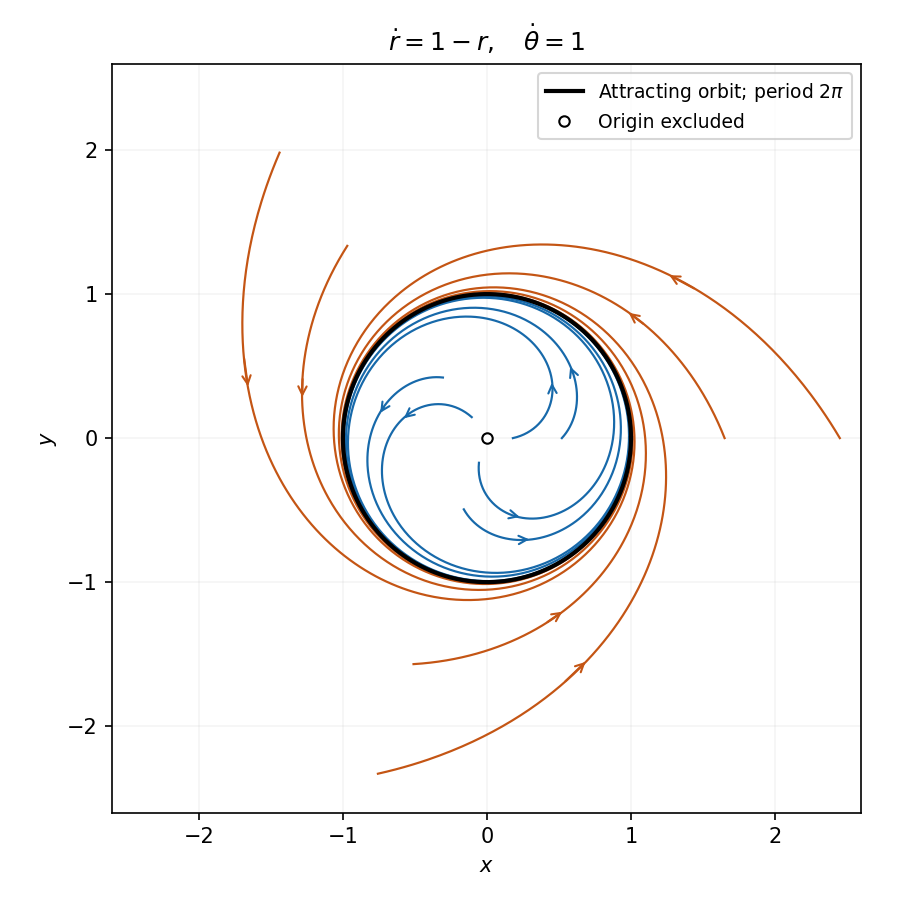
Counterclockwise trajectories approach the attracting unit circle
. Details. 
New to topics? Read the docs here!