Green’s theorem converts circulation around a positively oriented planar boundary into the area integral of scalar curl.
Let be a bounded region in the Euclidean plane whose boundary is a finite union of disjoint, piecewise smooth simple closed curves. Suppose the vector field is continuously differentiable on an open set containing the whole closed region. With positive boundary orientation,The partial derivatives give the scalar curl: the third component of the curl of . For a parametric curve , the boundary line integral has integrand .[ref]
6.4 Green's Theorem. Calculus Volume 3 by Gilbert Strang and others; §6.4, Theorem 6.12, equation (6.13); circulation form and its hypotheses
Positive boundary orientation keeps on the left as one walks along each boundary component: the outer curve is counterclockwise, and curves around holes are clockwise. Every component belongs in the line integral. The vector field must be regular throughout , but need not extend into a hole.[ref]
V5. Simply-Connected Regions. 18.02SC Multivariable Calculus, Fall 2010; V5. Simply-Connected Regions, p. 1, §1, Extended Green's Theorem, equation (1) and subdivision proof
The useful tradeoff is between boundary and interior: integrate tangential components along a curve, or integrate a partial derivative over a region, whichever is simpler. The boundary formula for planar area uses this freedom in the opposite direction, recovering area from a line integral. As a planar case of Stokes theorem, Green theorem also explains why a local curl can determine a complete boundary measurement while leaving room for the global obstruction in Green theorem with holes.
A short proof starts with a rectangle . Add its four positively oriented edge line integrals:The fundamental theorem of calculus turns the differences into integrals of and ; Fubini's theorem then gives the required double integral. On subdividing a region, adjacent edge line integrals cancel because their directions oppose. For curved boundaries, the proof uses pieces bounded by graphs and double integrals; cancellation works the same way. This is the geometric reason only the region's complete boundary survives.[ref]
For a counterclockwise, piecewise smooth simple closed planar curve enclosing , Green's theorem with and gives . The integral is the area of with a sign determined by the traversal direction. For polar coordinates , , differentiation gives , yielding the familiar polar area formula when the curve is traversed once.
Apply Green theorem with and to a positively oriented regular planar region. Since , its area is the displayed line integral. Clockwise orientation changes the sign; holes have the opposite boundary orientation to the outer curve.
Take the vector field . Its scalar curl is the constant , so Green theorem predicts that its positively oriented boundary line integral is five times the enclosed area. This one field makes both a round and a rectangular calculation transparent.
For the circle , choose the counterclockwise parametric equations , . Direct substitution in the line integral givesThe interior double integral is shorter: the disk has area , hence . Reversing the boundary orientation gives .
For the rectangle , traverse its bottom, right, top, and left edges in that order. The four line integrals are respectivelyTheir sum is , agreeing with . In both examples the path geometry changes the separate contributions, while constant curl makes only area matter to the final answer.
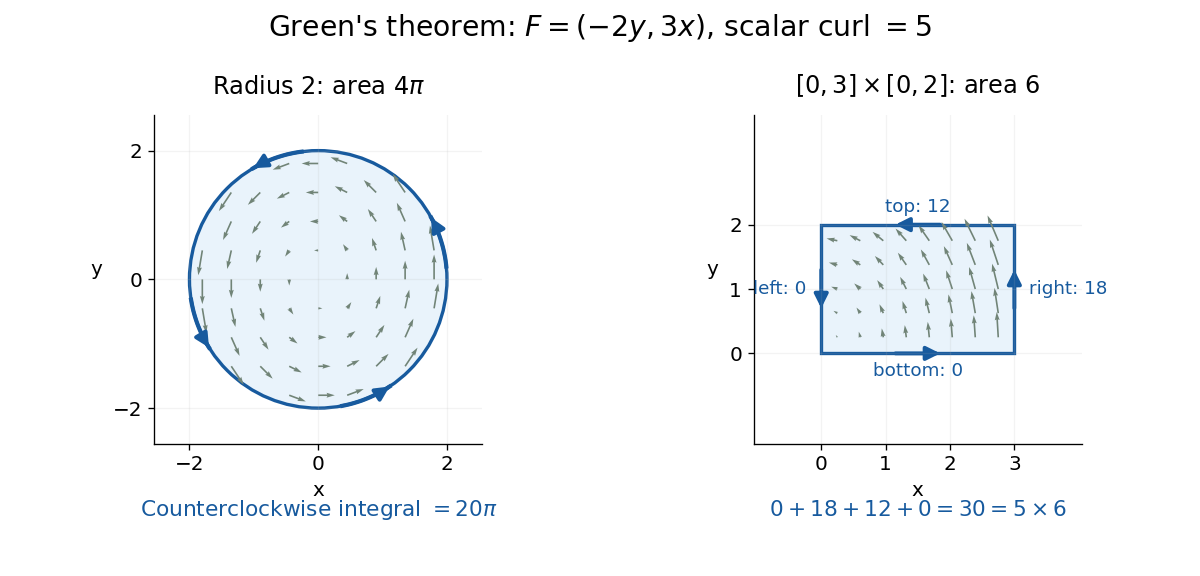
One vector field, two positively oriented boundaries: scalar curl five gives circulation twenty pi around the radius-two circle and thirty around the three-by-two rectangle
. Details. 
On the punctured plane , consider the vector fieldWith , its partial derivatives satisfyThus the field has zero scalar curl everywhere it is defined. Nevertheless, on any counterclockwise circle with ,The radius cancels exactly.
Applying Green theorem to the enclosed disk would be invalid: is undefined at the origin, inside that disk. Zero curl on the path alone is insufficient.[ref]
V5. Simply-Connected Regions. 18.02SC Multivariable Calculus, Fall 2010; V5. Simply-Connected Regions, pp. 1–2, §2: excluded origin prevents filling a closed curve within the field's domain
Now take the annulus . Its positive boundary orientation is counterclockwise on the outer circle and clockwise on the inner circle. The complete boundary line integral is thereforeHere Green theorem applies: an open set containing the closed annulus can avoid the origin. The inner contribution remains even for an arbitrarily small positive inner radius. Decreasing the hole's area does not decrease this line integral.
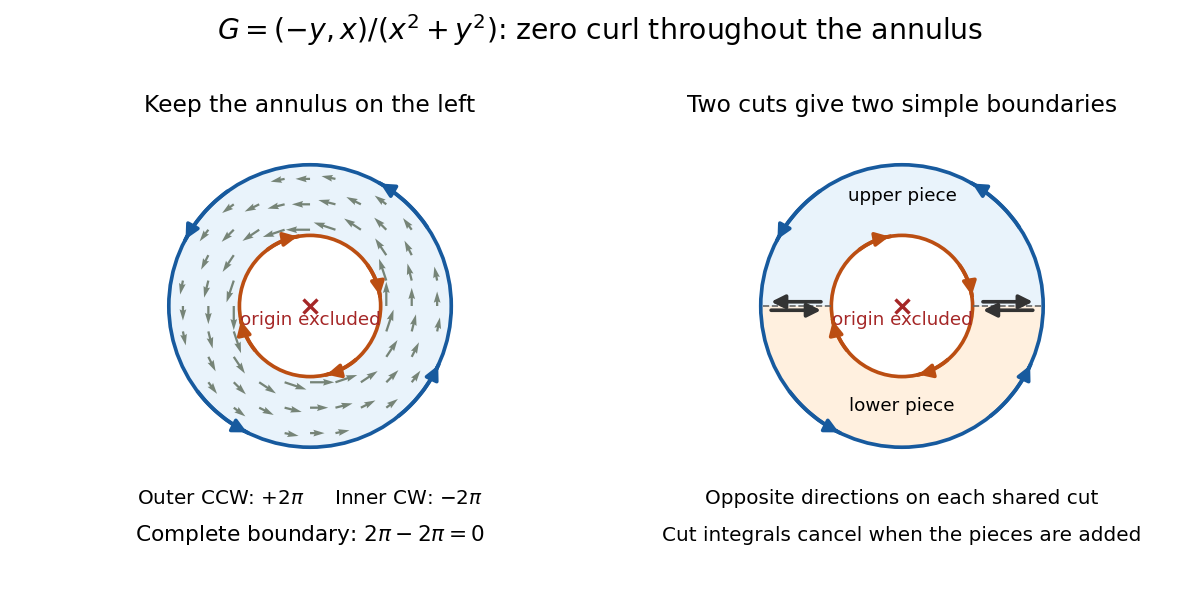
Zero curl away from an excluded origin: the outer circle contributes two pi, the clockwise inner circle minus two pi, and the annulus boundary sum is zero
. Details. 
The cancellation has a useful proof picture. Cut the annulus along two radial segments into two half-annuli. Each piece has a single simple closed curve as its boundary; along each cut, the two induced boundary orientations oppose, so those line integrals cancel when the two applications of Green theorem are added. Only the outer and inner circles remain.[ref]
V5. Simply-Connected Regions. 18.02SC Multivariable Calculus, Fall 2010; V5. Simply-Connected Regions, p. 1, §1, subdivision proof: integrals over cuts cancel in opposite directions
Locally, a choice of angle in polar coordinates has gradient . Globally, following a circle once increases that angle by , so it cannot be a single-valued potential of a conservative vector field on the punctured plane. The nonzero closed-path line integral also rules out such a potential by the fundamental theorem for line integrals.
On a simply connected open region, a continuously differentiable planar vector field with zero scalar curl does have a global potential. The hole is what separates the local derivative condition from the global conclusion.[ref]
V5. Simply-Connected Regions. 18.02SC Multivariable Calculus, Fall 2010; V5. Simply-Connected Regions, pp. 2–3, theorem (3) and Curl Theorem: simply connected domain hypothesis for a global gradient field
Articles by others on the same topic
There are currently no matching articles.