A periodic solution is a solution of a differential equation which is a periodic function: for some , at every time. This demands repetition of the state, rather than merely repetition of the coefficients in the differential equation. A nonconstant periodic solution of an autonomous differential equation traces a periodic orbit; constant equilibrium points are also periodic functions, so they must be excluded when asserting absence of periodic orbits.
For an explicit example, consider the initial value problemIts coefficient has period . Taking a logarithmic derivative and then applying integration givesDirect differentiation verifies both the differential equation and the initial condition. After one coefficient period,Thus the repeating coefficient generally produces a repeating shape with a changed amplitude. With , the three cases have one-period factors approximately , respectively. Only gives a periodic solution with this initial condition. For the positive solution of a differential equation tends to zero, and for it tends to infinity; neither can have any positive period. The zero solution of a differential equation, obtained with a different initial condition, is periodic for every .
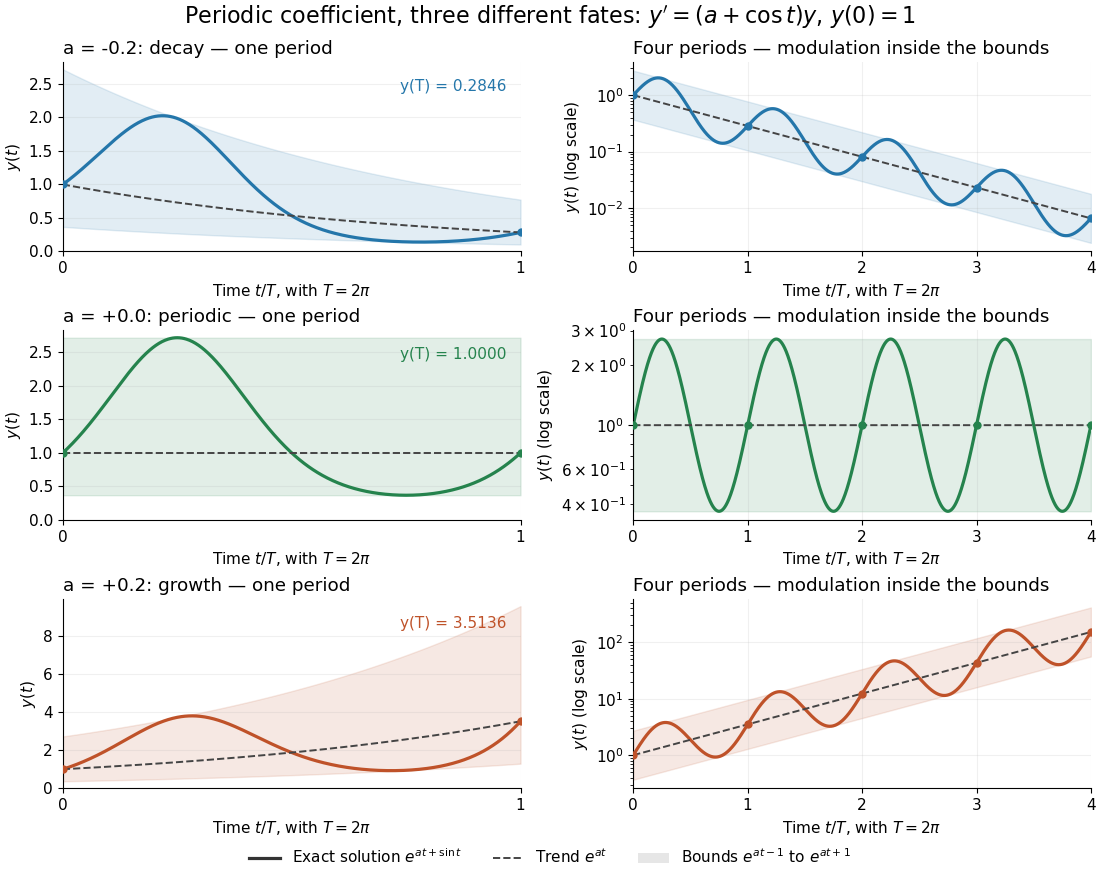
One repeating coefficient can produce decay, periodic motion, or growth
. The original example , , shown over one coefficient period and four coefficient periods. Shading marks the bounds , and dashed curves mark . The right column uses a logarithmic vertical scale. Details.
The exponential function separates two roles:For , even the decaying case initially rises, because . The growing case has intervals of decline, because becomes negative. This is the distinction between the instantaneous logarithmic derivative and the Floquet growth rate measured over many periods.
More generally, for a real continuous periodic function of period , the scalar linear differential equation hasA nonzero solution of a differential equation is -periodic exactly when , or equivalently when the coefficient has zero integral over a period. This scalar calculation is the simplest example of a Floquet multiplier.[ref]
Articles by others on the same topic
There are currently no matching articles.