Solution
ID: past-exam-of-the-algebra-analysis-and-differential-equations-2-course-of-the-university-of-oxford/2008/8/solution
Past exam of the algebra, analysis and differential equations II course of the University of Oxford 2008 8 Solution by  Codex 0 2026-10-31
Use the characteristic parameter and writeDirect differentiation givesA characteristic beginning at therefore satisfies and . Eliminating givesIts discriminant as a quadratic in is . Requiring the root to be zero when selectsThe selected branch is differentiable in each of the two regions where the radical is strictly positive, and substitution into the differentiated quadratic identity verifies the partial differential equation there. On the initial line away from the origin the characteristic vector has nonzero component , so these are the locally unique branches determined by that line.
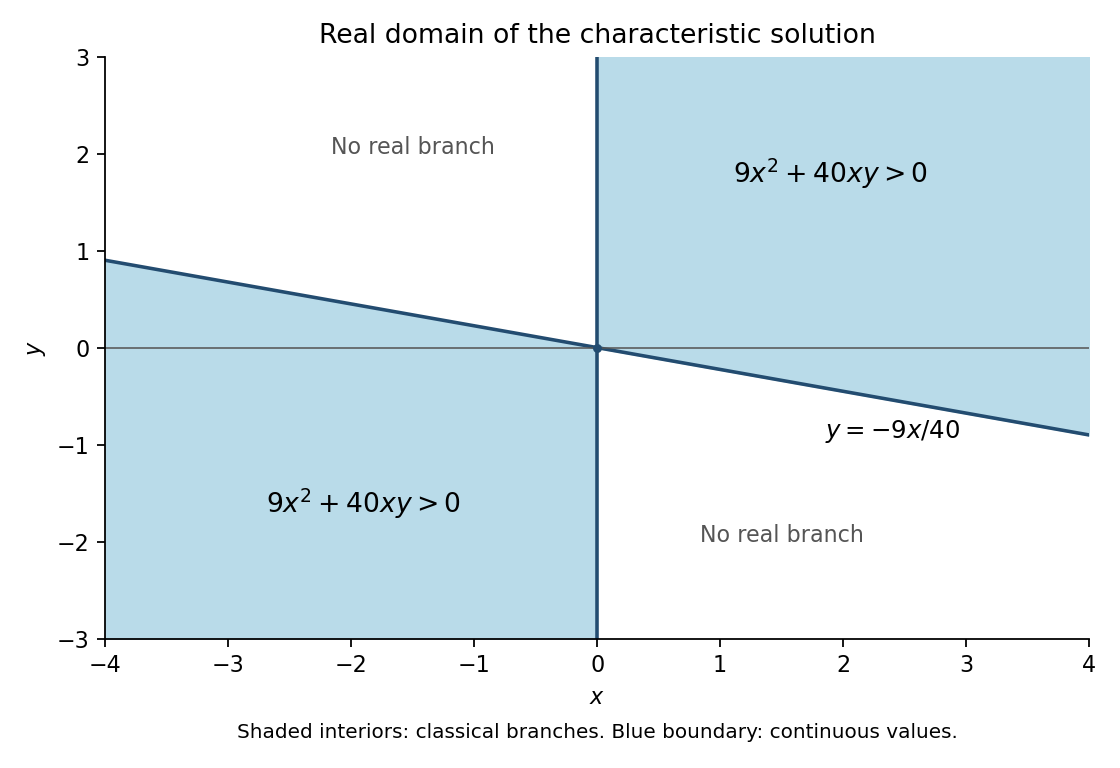
The maximal real-valued continuation of these branches has the printed domainAt the continuous limiting value is . The two bounding lines are and , and the included sectors are the one above the sloping line on the right and the one below it on the left.
As in the fold boundary of a characteristic graph, the closed-domain statement concerns the formula's real values. A classical solution requires first derivatives on an open set. Along the nonzero boundary points , the radical's transverse derivative is singular, so the formula is generally not a classical solution there; its two classical domains are the interiors of the shaded sectors. The origin is characteristic for the initial data and does not supply a differentiable neighborhood solution. This qualification preserves the source's stated closed set while distinguishing it from the domain of a classical solution.

New to topics? Read the docs here!