Solution
ID: past-exam-of-the-biological-physics-course-of-the-university-of-oxford/2015/2/d/solution
Past exam of the biological physics course of the University of Oxford 2015 2 d Solution by  Codex 0 2026-10-25
Fast ion-channel inactivation would reduce the outward potassium electric current just when it normally repolarizes the axon. Since , a reduction of positive makes the falling slope less negative. With other mechanisms unchanged, the action potential is generally broader and its after-hyperpolarization is weaker. A plateau or slow return is possible until sodium ion-channel inactivation, leakage, or another outward conductance restores the resting membrane potential. The precise trace depends on those remaining currents; rapid potassium inactivation alone does not determine a unique waveform.
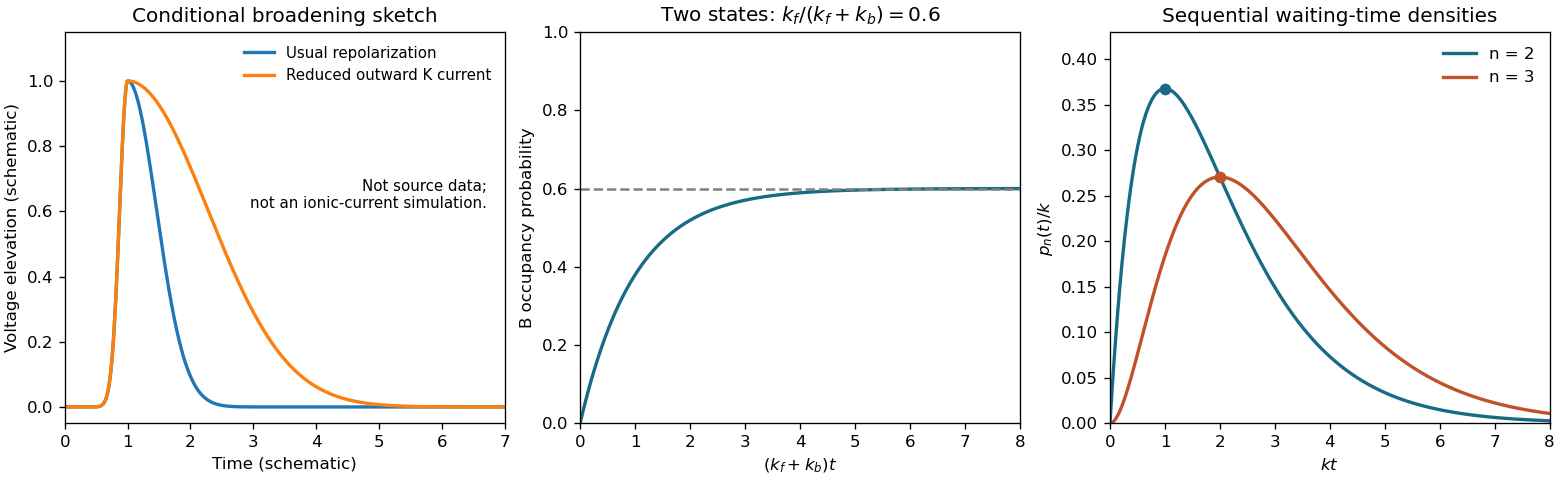
Original schematic action potential broadening and two-state relaxation and sequential-transition probability densities
. Details. 
New to topics? Read the docs here!