A membrane potential is an electric potential difference across a cell membrane. We use the conventionTaking the external electric potential as zero makes mean that the inside is at lower electric potential. “Negative inside” describes a difference, not an absolute electric potential, and does not imply that the entire cytosol has a large net negative electric charge.
Consider a cell membrane permeable only to potassium ions, with higher potassium concentration inside. Diffusion initially favors outward transport. If balancing negative ions cannot follow, that loss of positive electric charge produces a small inner excess of negative electric charge and an outer positive excess. The resulting electric field favors inward potassium transport. At the Nernst equilibrium potential, chemical and electrical contributions to electrochemical potential balance; ions still cross both ways, with zero net transport.[ref]
Ion Channels and the Electrical Properties of Membranes. Molecular Biology of the Cell, 4th edition by Bruce Alberts and others; The Resting Membrane Potential Is Determined Mainly by K+ Leak Channels in Most Animal Cells: selective potassium passage and opposing electrical influence
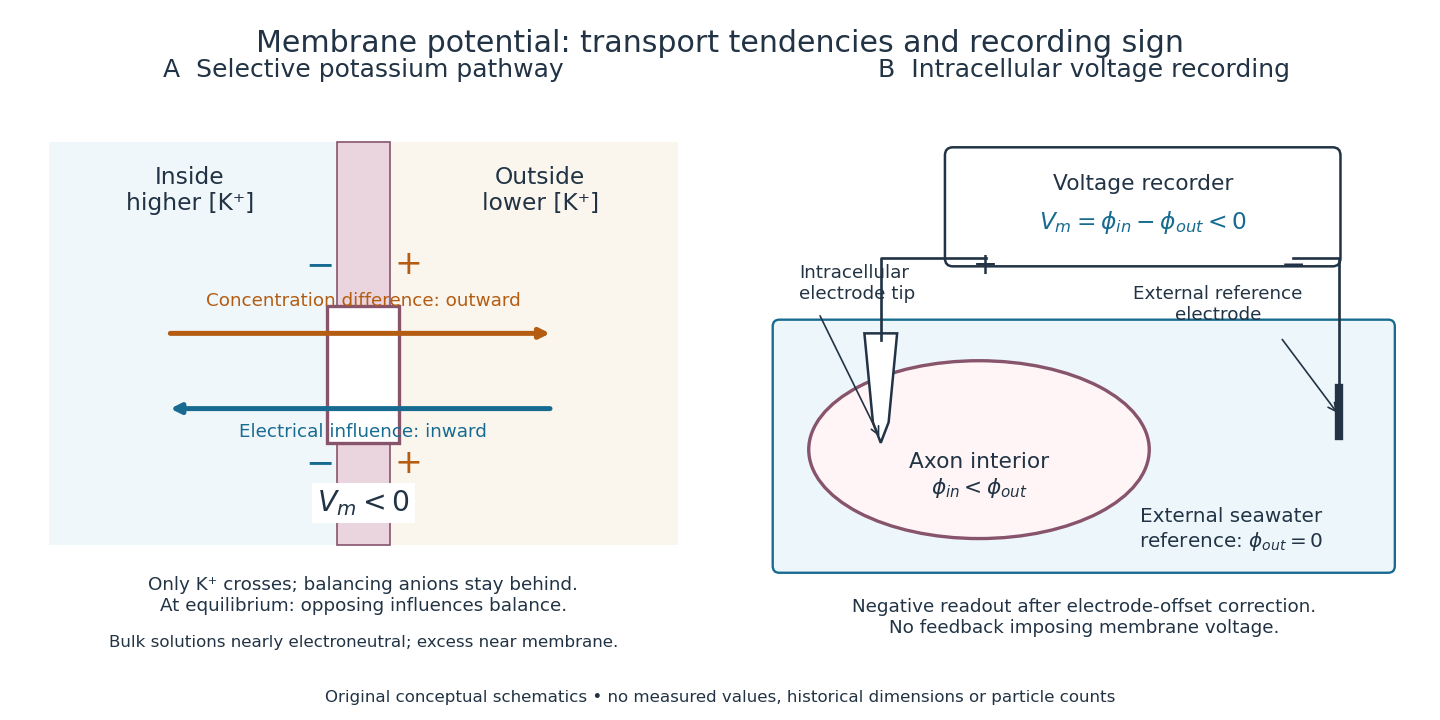
In living biological cells, several ions can permeate and pumps maintain their concentration differences through active transport. Pumps transporting net electric charge also contribute electric current. Thus is a special limit, not a universal rule; membrane potential need not always be negative.[ref]
Ion Channels and the Electrical Properties of Membranes. Molecular Biology of the Cell, 4th edition by Bruce Alberts and others; K+ leak-channel discussion; The Resting Potential Decays Only Slowly When the Na+-K+ Pump Is Stopped; action-potential discussion
The existing reversal potential example shows how opposing electric currents can balance without each ion reaching thermodynamic equilibrium. This makes selective permeability a way to convert chemical differences into electrical signals: changing the available ion channels changes which electrochemical gradients influence the voltage.Return of a depolarized membrane potential toward a more negative value. During an action potential, reduced inward current and increased outward current commonly contribute. It is distinct from hyperpolarization, which takes the membrane beyond its reference resting value.
For an ideal dilute chemical solution, moving one mole of a species with signed ion charge number from outside to inside changes its electrochemical potential byHere is the molar gas constant, the uniform absolute temperature, the Faraday constant, and the concentration. This assumes the same reference chemical potential on both sides. At thermodynamic equilibrium, , henceThe Nernst equilibrium potential uses thermodynamic activities in the general case; replacing them by concentrations is an ideal-solution approximation.
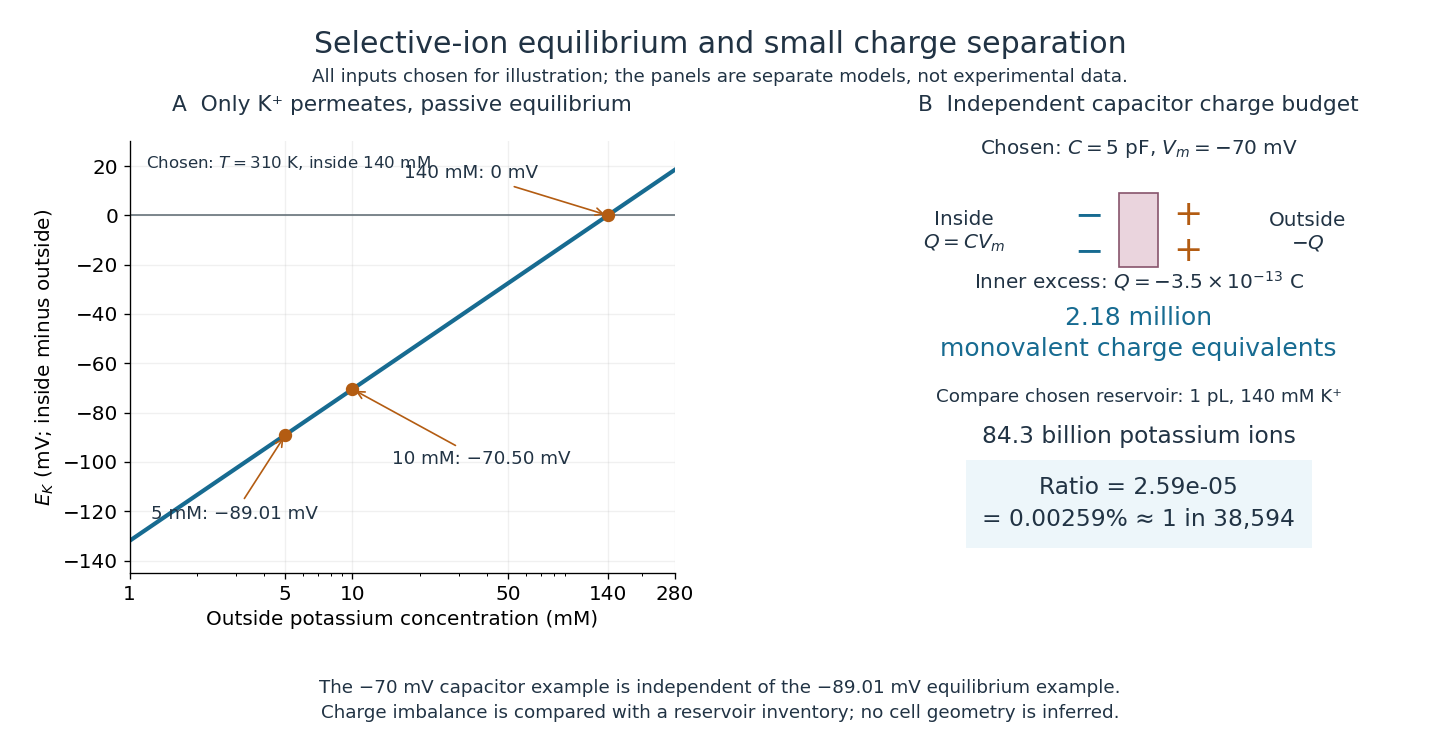
Choose an original passive model: only permeates (), other ions cannot cross, there are no pumps or imposed electric currents, and there is no net water transfer. Stipulate reservoir concentrations and , with , and . Treat reservoir concentrations as effectively unchanged by charging. ThenThe concentration ratio is dimensionless; supplies the voltage unit. At , for inward transport, so outward transport is favored. At it vanishes. A more negative favors inward transport. These sign checks explain the result physically.
Keeping the other chosen inputs fixed, doubling to raises by . Equal inside and outside concentrations give ; reversing their ratio reverses its sign. In finite reservoirs, transport changes both concentrations; the exact final thermodynamic equilibrium must also satisfy material conservation. The fixed-reservoir calculation is useful when only a small fraction of the available ions moves.
A membrane potential can coexist with near electroneutrality in the bulk cytosol and external chemical solution. The small imbalance producing the voltage lies near the cell membrane; most positive and negative electric charges balance in the bulk.[ref]
Ion Channels and the Electrical Properties of Membranes. Molecular Biology of the Cell, 4th edition by Bruce Alberts and others; The Resting Potential Decays Only Slowly When the Na+-K+ Pump Is Stopped; Figure 11-22: minute charge redistribution and interfacial excess
For a separate original capacitor model, choose a total membrane capacitance and . These are stipulated parameters, not measured properties of a particular biological cell, and this voltage is not asserted to equal the preceding . Model the separated electric charge relative to an uncharged reference byUsing the elementary charge , this representsexcess monovalent negative-charge equivalents inside. These can represent a deficit of positive ions, rather than the arrival of that many negative ions.
Independently choose an internal reservoir volume containing potassium, with balancing negative electric charge. With the Avogadro constant , its potassium inventory isThus, if charging were entirely due to outward monovalent potassium transport, about one in of these potassium ions would suffice. This is a comparison with the chosen potassium inventory, not a fraction of all charged particles or a measurement of spatial charge density. No shape, surface area or thickness has been inferred from the chosen capacitance and volume. The calculation illustrates why substantial voltage does not require a strongly charged bulk cytosol.
In 1939, Alan Hodgkin and Andrew Huxley reported intracellular action potential recordings from squid giant axons at Plymouth.[ref]
Action Potentials Recorded from Inside a Nerve Fibre by Alan Hodgkin and Andrew Huxley. Action Potentials Recorded from Inside a Nerve Fibre, Nature 144 (1939), pp. 710–711: inspected publisher abstract, preparation and intracellular recording
Alan Hodgkin's later account describes advancing a capillary electrode from a cut end into intact axon, avoiding scraping the cell membrane. Its Figure 3 uses a seawater-filled capillary internally, with external seawater as zero: the readout is internal relative to external electric potential. This supports a voltage across the surface cell membrane. As a separate ionic control, the account reports that raising external potassium toward its internal concentration reversibly abolished resting voltage; this was later work, not a control asserted for the 1939 recording. Injury and electrode-solution junction potentials limit interpretation. Voltage recording alone does not identify every conducting ion. A voltage clamp additionally uses feedback to impose voltage and measures the required electric current.[ref]
The ionic basis of nervous conduction by Alan Hodgkin. Alan Lloyd Hodgkin, The ionic basis of nervous conduction, Nobel Lecture (11 December 1963), pp. 34–36, Figures 2–3: placement, seawater reference and later potassium control; p. 42: voltage clamp
In the schematic, connect the intracellular electrode to the positive input and the external reference electrode to the negative input of a voltage recorder. After electrode-offset correction, a negative reading means . A useful baseline check is to compare both electrodes in the same external chemical solution before insertion; this is a measurement check, not an additional historical observation claimed here. Swapping inputs reverses the readout sign without changing the biological cell's membrane potential.
For a negative neuronal membrane potential, depolarization raises it toward zero or beyond, making the interior less negative relative to the exterior. This describes a voltage change, not necessarily increased action potential generation; see the depolarizing inhibition example under synaptic potential.
Hyperpolarization makes a neuronal membrane potential more negative relative to the exterior. It is a voltage description; inhibition need not produce hyperpolarization, as shunting inhibition illustrates.
A reversal potential is a membrane potential at which a specified open ion channel, or specified combination of ion channels, carries zero net electric current, with the surrounding conditions fixed; the electric current changes sign across that voltage. Specifying which current matters: an individual ion contribution and a sum of several contributions can reverse at different voltages. Zero net electric current does not mean that all ions have stopped moving. See Purves et al., Neuroscience, 2nd edition (2001): reversal of a mixed-ion channel current.
Throughout these examples, membrane potential is , and conventional current is inward-positive. Positive electric current corresponds to net positive electric charge entering or net negative electric charge leaving. Negative electric current corresponds to the reverse charge transfer. A convenient Ohmic approximation iswhere is the available electrical conductance. For fixed , gives positive electric current, gives zero, and gives negative electric current; the line has slope . If , the modeled pathway carries zero electric current at every voltage: closing it does not locate its reversal potential. 3.1 Synapses (§3.1: conductance-based synaptic current) uses outward-positive ; the formula here reverses that sign to match this wiki's inward-positive convention.
For the stipulated single-pathway example from ion channel, and giveThe open ion channel carries zero net electric current at even though remains positive. Near that point a change of membrane potential changes the electric current, which is why zero current at one voltage does not make an open pathway electrically irrelevant; see shunting inhibition.
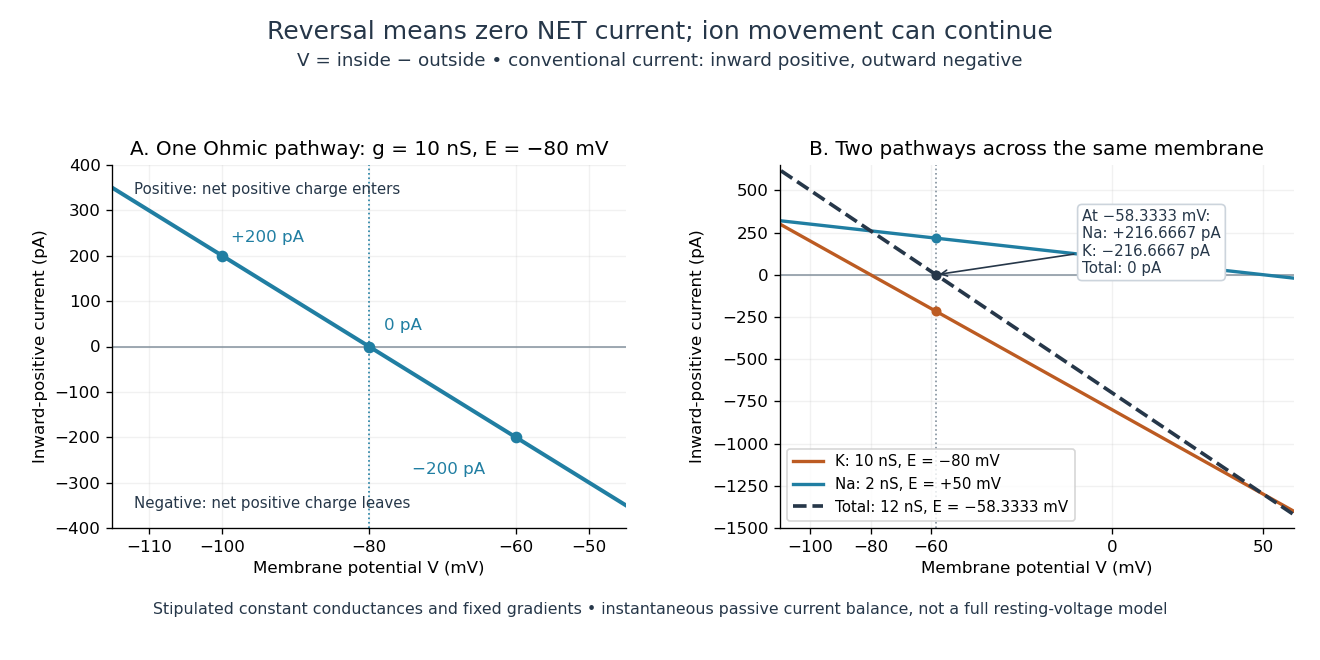
Inward-positive electric current: one reversal and two-channel cancellation
. Original computed curves for stipulated constant electrical conductances and fixed reversal potentials. Left: , . Right: a potassium pathway with , and a sodium pathway with , . Their net electric current vanishes at while both individual electric currents remain nonzero. These are model values, not empirical measurements. Details.For an ion channel passing only one ion species by passive transport, its reversal potential can equal that species' Nernst equilibrium potential, where the chemical and electrical contributions to electrochemical potential balance. At that thermodynamic equilibrium, passage in both directions can continue with no net transport. For an ion channel admitting several ion species, opposing contributions can cancel while each species continues to have net transport. Such a reversal potential is not generally any one species' Nernst equilibrium potential. See the Purves reference above.
To work out that cancellation explicitly, put two Ohmic ion channel populations across the same cell membrane. Stipulate constant electrical conductances and fixed reversal potentials:The potassium and sodium contributions add because both pathways experience the same membrane potential:Thus . This weighted mean follows simply by expanding and regrouping the two current terms; it assumes additive Ohmic contributions and a positive total electrical conductance. At , the inward-positive individual electric currents areThe potassium contribution is outward and the sodium contribution inward. Equal and opposite electric currents give ; neither pathway has stopped transporting its ions. The calculation treats two distinct pathways. Applying it to one mixed-species ion channel would additionally require a justified decomposition into independent Ohmic contributions; a general mixed-channel reversal potential cannot be obtained by assuming those hypotheses silently.
This is an instantaneous balance of the specified passive electric currents. It would be the stationary voltage of a passive capacitance model containing only these constant pathways and no applied electric current, but it is not a complete prediction of a living cell's resting membrane potential. Other electric currents, voltage-dependent gating, and pumps involved in active transport can matter. Pumps that transfer net electric charge are electrogenic and contribute their own electric current. See Purves et al.: functional properties of the sodium/potassium pump.
The toy model holds ion concentrations and therefore the stipulated reversal potentials fixed. Continuing inward sodium and outward potassium transport would change finite reservoirs unless active transport or external control maintained them. Transport can be a small fraction of the reservoir's ions over a short interval, making fixed concentrations a useful approximation; it is not a claim that the reservoirs never change. See Gerstner et al., Neuronal Dynamics (2014), §2.1: equilibrium potentials, channel currents and maintained gradients.
A reversal potential makes the effect of opening an ion channel predictable from the present membrane potential. The same open pathway can carry inward or outward electric current as crosses its reversal potential. The two-pathway example reveals a particularly useful distinction: zero net charge transfer can coexist with continuing exchange of different substances. That distinction connects membrane transport to electric current measurements without mistaking electrical balance for thermodynamic equilibrium.
The Nernst equilibrium potential is the inside-minus-outside membrane potential at which one ion species has equal electrochemical potential on both sides of a cell membrane. At uniform temperature , using the same reference chemical potential on both sides, is the signed ion charge number, the molar gas constant, the Faraday constant, and the dimensionless thermodynamic activity of that ion. For an ideal dilute chemical solution, the activity ratio becomes the concentration ratio. See Purves et al.: the forces that create membrane potentials and the Nernst equation.
The short derivation is to set the outside-to-inside electrochemical potential change from membrane transport to zero: , and solve for . An open pathway carrying only this species by passive transport then has this reversal potential. A balance of several nonzero ion electric currents does not establish this equilibrium condition for each species.
A membrane channel whose opening depends on membrane potential. Regenerative activation and subsequent inactivation or opposing currents help produce an action potential.
Closure of an activation gate when the activating stimulus is removed. It is distinct from ion-channel inactivation, which reduces channel availability while the activating conditions can remain present.
A transient electrical current associated with displacement of voltage-sensor charge during ion channel gating, distinct from current carried through an open permeation pathway. Its voltage dependence and changes following sensor mutations constrain the charge motions that couple membrane potential to opening.
The net displaced electric charge associated with a change in channel conformation, inferred by integrating the ion-channel gating current after subtracting unrelated currents. It is distinct from the electric current itself and from charge carried through the open pore.
A voltage-gated sodium channel couples voltage-sensor movement to a sodium-permeable pore. Activation and inactivation are distinct transitions, and loss of current must be separated from altered expression or membrane delivery.
A voltage-sensing domain changes conformation in response to membrane voltage. Charged residues, often in an S4 helix, redistribute in the electric field and couple to other functional parts of the protein.
A voltage-gated potassium channel couples a voltage-sensing region to a potassium-selective pore. The sensor determines voltage-dependent opening, whereas filter coordination chemistry contributes to which ions permeate.
A voltage-gated calcium channel couples membrane voltage to a calcium-permeable pore. In a pancreatic beta cell, depolarization-dependent calcium entry can connect metabolic sensing to insulin-granule exocytosis.
Ion-channel inactivation is loss of availability for conduction, distinct from simply closing an otherwise activatable ion channel. Recovery depends on channel type and membrane potential; incomplete recovery of sodium-selective voltage-gated ion channels contributes to a neuronal refractory period.
An availability change associated with the outer pore and selectivity filter of certain potassium ion channels. Its kinetics and structural origin differ from ball-and-chain inactivation, although the two processes can interact.
A tethered intracellular particle blocks an open ion channel from the cytoplasmic side. In classical Shaker-type channels the particle is N-terminal: removing it suppresses fast inactivation, while cytoplasmic application of a corresponding peptide can restore block. The pore-blocking mechanism differs from ordinary activation-gate closure.
Two-state ion-channel gating models an individual gate as a random switch between closed and open states. Write for its open probability; this is the in the header equation. An individual gate's state is always closed or open, rather than partly open. A population of identical gates can have a fraction open near , and averaging repeated identically prepared trials estimates the same probability. A finite population's observed fraction fluctuates. See Purves and colleagues, Neuroscience, 2nd edition (2001): Ion Channels Underlying Action Potentials for single-channel steps and their population averages.
At fixed membrane potential , let constant rates govern closed-to-open and open-to-closed transitions respectively, in . This is a two-state continuous-time Markov chain. Over a short interval , an initially closed gate opens with probability , and an initially open gate closes with probability . Gain minus loss gives the deterministic ordinary differential equation for the probability:Here is the fixed-voltage limiting open probability, and is a time constant. The ratio of the rates fixes the limit, while their sum fixes the speed. With initial probability ,For a short derivation, subtract : the deviation obeys , yielding the exponential function. After one time constant, of the initial deviation remains. The solution stays between and , so it remains a valid probability. The rate and time constant formulations are described in Gerstner and colleagues, Neuronal Dynamics, §2.2.2: transition rates and channel kinetics.
For a worked toy condition A, choose and . Then , , andIn a separately prepared condition B, choose , and the same . Now , , and . Condition B approaches a higher limit more quickly. These are two stipulated constant-rate conditions with held fixed in each experiment, not an empirical function relating rates to voltage or a sequential switch between conditions. The initial need not be the limiting probability at the newly imposed voltage.
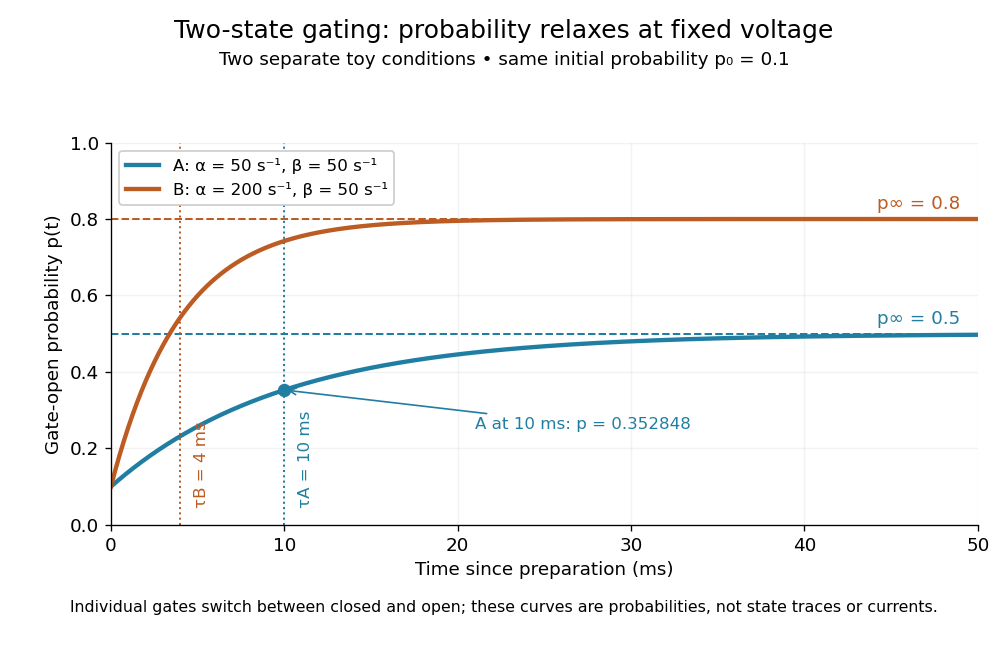
Two-state ion-channel gating: two constant-rate relaxation conditions
. Original computed probability curves, both starting at . Dashed lines show the limiting open probabilities and ; dotted lines mark time constants and . The dot marks condition A at , where . Smooth curves represent open probability or population averages, not an individual gate's random state trace or an ionic electric current. Details.In the Hodgkin-Huxley model, the rates depend on membrane potential: and . Its is the limit for voltage held at that . During an action potential, changing changes the rates and gates feed back onto through ionic electric currents; substituting the present voltage into the constant-rate solution does not solve that coupled system. Gating describes availability of a conducting pathway. Even an open ion channel carries zero net ionic electric current at its reversal potential.
The useful bridge is from abrupt random molecular events to a smooth population prediction. A channel requiring several independent permissive gates in an ion channel has an open probability equal to their product; this can make channel availability much smaller than each gate's availability. The Hodgkin-Huxley model uses and for sodium and potassium electrical conductances, respectively.
Multiplying opening and closing rates by the same factor preserves equilibrium open probability but rescales the relaxation and dwell times. At equal opening and closing rates, and relaxation is twice as fast as the reciprocal mean individual-state dwell. A two-state constant-voltage model cannot alone produce activation followed by inactivation during a maintained step.
A permissive gate allows conduction when it is open. Suppose an ion channel conducts only when all gates are open, where is a positive integer. If the gate-open events are mutually independent events and each has the same open probability at the time considered, thenThis follows from the multiplication rule for independent events. Identical transition rates alone do not guarantee independence: the initial gate states must also be independently prepared, and the model must not couple their transitions. Gates sharing a fluctuating membrane potential can be correlated; the simple product requires an appropriate independence assumption, for example independent gates at an externally fixed voltage.
At , channels requiring permissive gates have open probabilities , and . For four independent gates there are possible open/closed configurations, equally probable at ; only the all-open configuration conducts. Thus is the gate-open probability, while is the whole-channel open probability. Neither is a fractional state of one observed channel. Among independently prepared identical four-gate channels, the expected value of the open count is , although an actual count fluctuates.
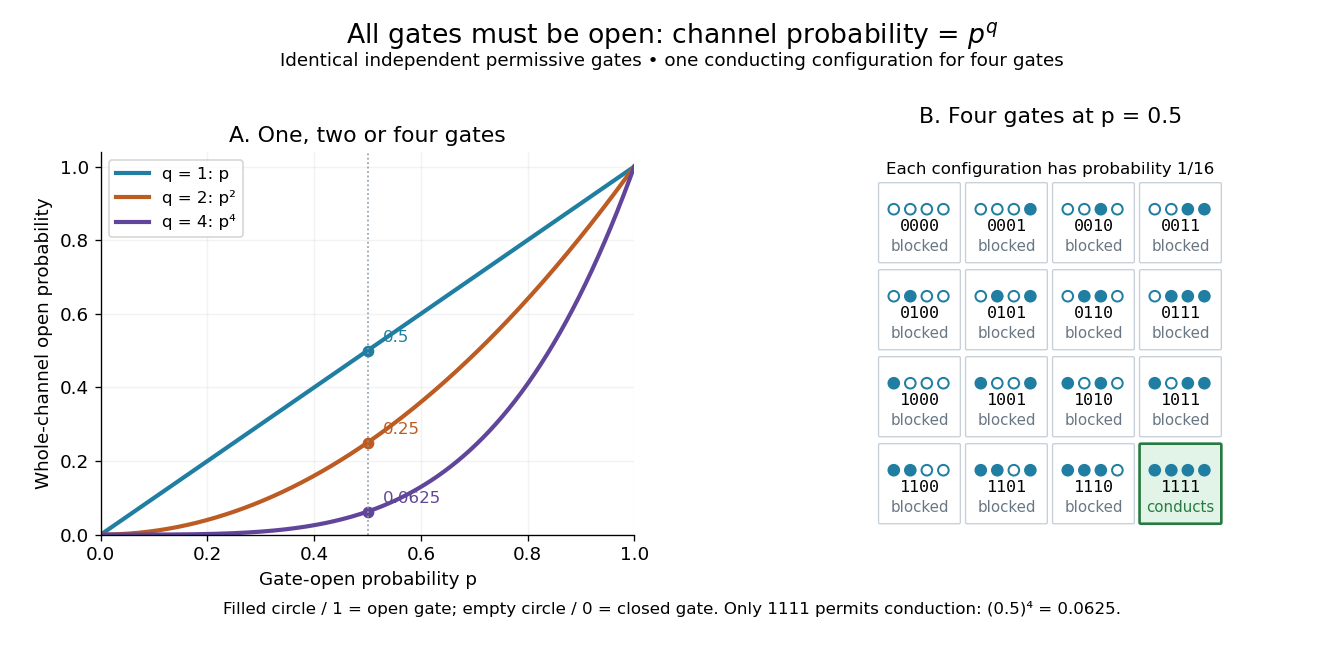
Independent permissive gates in an ion channel: an all-open requirement
. Left: whole-channel open probability for one, two and four identical independent permissive gates. Right: all sixteen configurations of four gates at , each with probability ; filled circles are open gates and empty circles closed gates. Only the highlighted all-open configuration permits conduction. This is an illustrative model, not a molecular structure or an ionic electric current measurement. Details.For unequal independent gate-open probabilities , use rather than . This is the distinction behind the Hodgkin-Huxley model's : and are different activation and inactivation-availability variables, rather than one common . Its uses four identical activation factors. Independence and the all-open requirement are model assumptions; correlated gates or alternative conducting configurations require a different calculation. The simple product is useful because a modest gate-open probability can produce sharply suppressed whole-channel availability without any additional gate interaction.
Articles by others on the same topic



Membrane potential refers to the difference in electric potential across a cell membrane due to the distribution of ions inside and outside of the cell. This difference in charge creates a voltage difference, which is crucial for various cellular functions, including the generation and propagation of electrical signals in neurons and muscle cells. The membrane potential is typically measured in millivolts (mV) and is usually negative in a resting state, often around -70 mV in neurons.