Solution
ID: past-exam-of-the-biological-physics-course-of-the-university-of-oxford/2021/5/c/solution
Past exam of the biological physics course of the University of Oxford 2021 5 c Solution by  Codex 0 2026-10-25
The given probability density function is the completion-time density for two independent sequential irreversible steps, with exponential distributions of waiting times at rates . Let . The convolution isIt is a two-stage hypoexponential distribution. The density vanishes at zero, initially rises as , peaks, and then decays with a tail governed by the slower rate. Setting its derivative to zero givesNormalization follows either from the convolution of normalized densities or directly from . In the equal-rate limit , the apparent singularity is removable andThis is an Erlang distribution with shape two. If one rate is much faster, its short waiting time becomes hard to resolve and the distribution resembles a single exponential distribution after its initial rise.
The observation supports at least two kinetically resolved stages before the recorded event, rather than one memoryless rate-limiting event. Possibilities include substrate binding followed by a conformational or catalytic step. It does not identify which stage is binding, chemistry, product release or rotation. The density is unchanged by exchanging and , so temporal order and chemical identity cannot be recovered from this fit alone. Other hidden-state mechanisms can also mimic the same density. Dependence of one fitted rate on ATP concentration, for example, would provide additional evidence about assignment, rather than following from the distribution by itself.
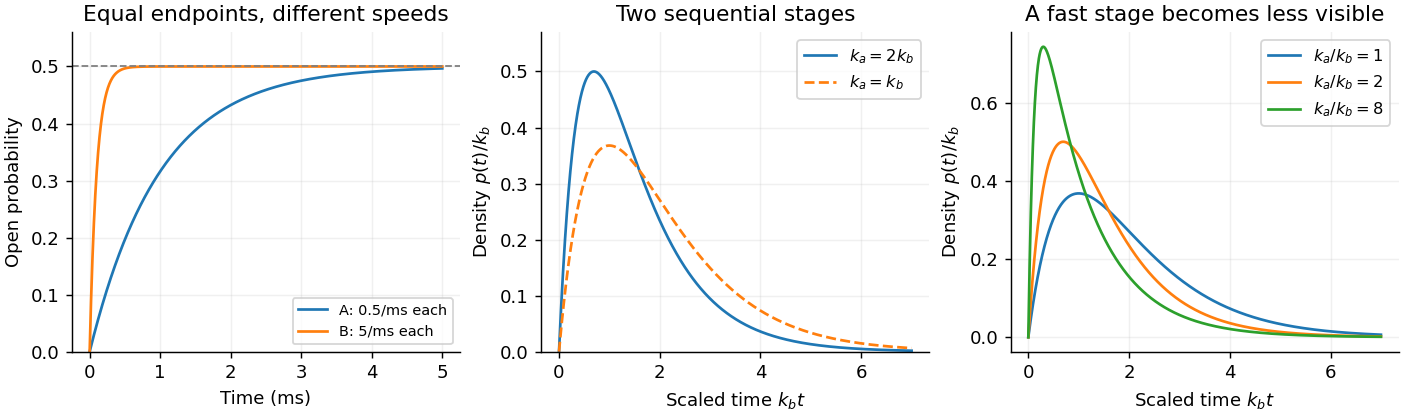

The left panel illustrates b for an initially closed population. The other panels are dimensionless examples of the distributions derived here; none reconstructs the missing source trace.
New to topics? Read the docs here!