Two-state ion-channel gating models an individual gate as a random switch between closed and open states. Write for its open probability; this is the in the header equation. An individual gate's state is always closed or open, rather than partly open. A population of identical gates can have a fraction open near , and averaging repeated identically prepared trials estimates the same probability. A finite population's observed fraction fluctuates. See Purves and colleagues, Neuroscience, 2nd edition (2001): Ion Channels Underlying Action Potentials for single-channel steps and their population averages.
At fixed membrane potential , let constant rates govern closed-to-open and open-to-closed transitions respectively, in . This is a two-state continuous-time Markov chain. Over a short interval , an initially closed gate opens with probability , and an initially open gate closes with probability . Gain minus loss gives the deterministic ordinary differential equation for the probability:Here is the fixed-voltage limiting open probability, and is a time constant. The ratio of the rates fixes the limit, while their sum fixes the speed. With initial probability ,For a short derivation, subtract : the deviation obeys , yielding the exponential function. After one time constant, of the initial deviation remains. The solution stays between and , so it remains a valid probability. The rate and time constant formulations are described in Gerstner and colleagues, Neuronal Dynamics, §2.2.2: transition rates and channel kinetics.
For a worked toy condition A, choose and . Then , , andIn a separately prepared condition B, choose , and the same . Now , , and . Condition B approaches a higher limit more quickly. These are two stipulated constant-rate conditions with held fixed in each experiment, not an empirical function relating rates to voltage or a sequential switch between conditions. The initial need not be the limiting probability at the newly imposed voltage.
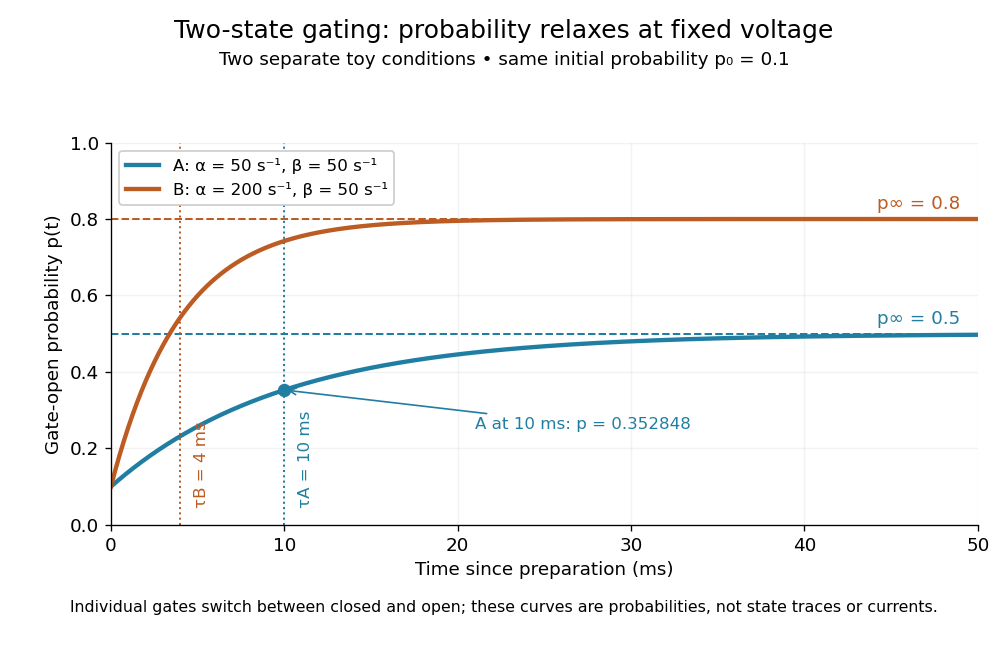
Two-state ion-channel gating: two constant-rate relaxation conditions
. Original computed probability curves, both starting at . Dashed lines show the limiting open probabilities and ; dotted lines mark time constants and . The dot marks condition A at , where . Smooth curves represent open probability or population averages, not an individual gate's random state trace or an ionic electric current. Details.
In the Hodgkin-Huxley model, the rates depend on membrane potential: and . Its is the limit for voltage held at that . During an action potential, changing changes the rates and gates feed back onto through ionic electric currents; substituting the present voltage into the constant-rate solution does not solve that coupled system. Gating describes availability of a conducting pathway. Even an open ion channel carries zero net ionic electric current at its reversal potential.
The useful bridge is from abrupt random molecular events to a smooth population prediction. A channel requiring several independent permissive gates in an ion channel has an open probability equal to their product; this can make channel availability much smaller than each gate's availability. The Hodgkin-Huxley model uses and for sodium and potassium electrical conductances, respectively.
Multiplying opening and closing rates by the same factor preserves equilibrium open probability but rescales the relaxation and dwell times. At equal opening and closing rates, and relaxation is twice as fast as the reciprocal mean individual-state dwell. A two-state constant-voltage model cannot alone produce activation followed by inactivation during a maintained step.
A permissive gate allows conduction when it is open. Suppose an ion channel conducts only when all gates are open, where is a positive integer. If the gate-open events are mutually independent events and each has the same open probability at the time considered, thenThis follows from the multiplication rule for independent events. Identical transition rates alone do not guarantee independence: the initial gate states must also be independently prepared, and the model must not couple their transitions. Gates sharing a fluctuating membrane potential can be correlated; the simple product requires an appropriate independence assumption, for example independent gates at an externally fixed voltage.
At , channels requiring permissive gates have open probabilities , and . For four independent gates there are possible open/closed configurations, equally probable at ; only the all-open configuration conducts. Thus is the gate-open probability, while is the whole-channel open probability. Neither is a fractional state of one observed channel. Among independently prepared identical four-gate channels, the expected value of the open count is , although an actual count fluctuates.
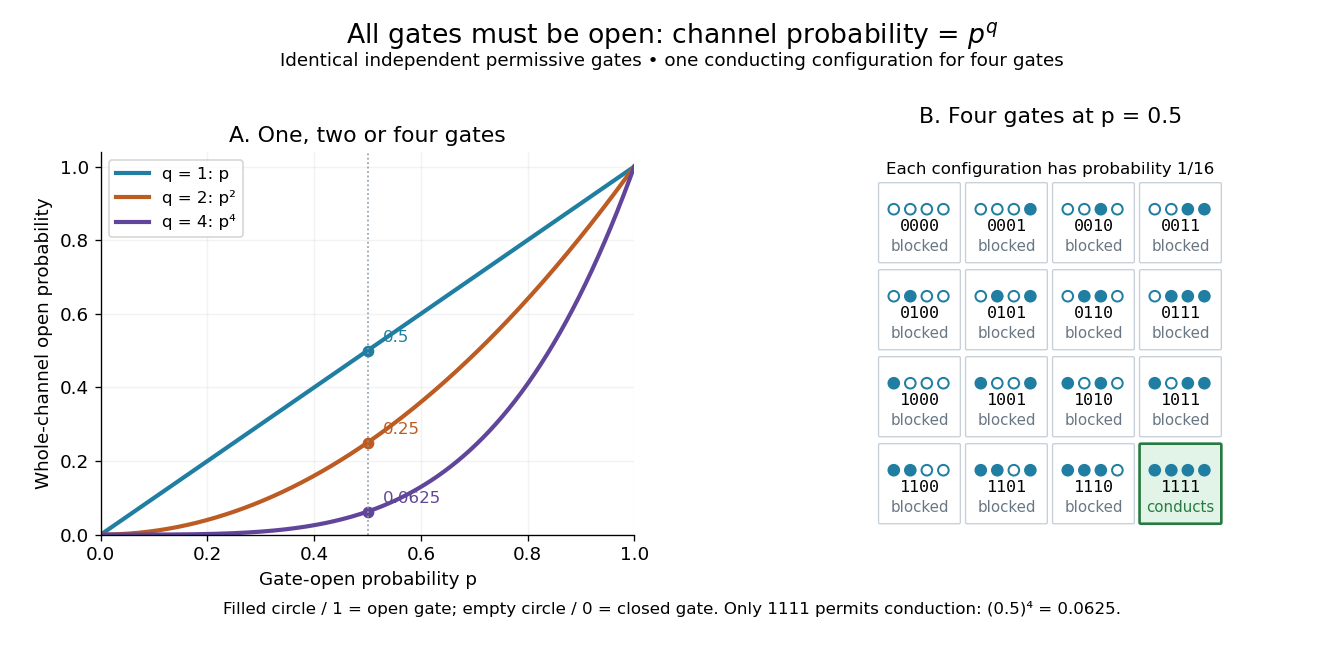
Independent permissive gates in an ion channel: an all-open requirement
. Left: whole-channel open probability for one, two and four identical independent permissive gates. Right: all sixteen configurations of four gates at , each with probability ; filled circles are open gates and empty circles closed gates. Only the highlighted all-open configuration permits conduction. This is an illustrative model, not a molecular structure or an ionic electric current measurement. Details.
For unequal independent gate-open probabilities , use rather than . This is the distinction behind the Hodgkin-Huxley model's : and are different activation and inactivation-availability variables, rather than one common . Its uses four identical activation factors. Independence and the all-open requirement are model assumptions; correlated gates or alternative conducting configurations require a different calculation. The simple product is useful because a modest gate-open probability can produce sharply suppressed whole-channel availability without any additional gate interaction.
Articles by others on the same topic
There are currently no matching articles.