Solution
ID: past-exam-of-the-chemistry-b-course-of-the-university-of-cambridge/2021/paper-1/b2/b/solution
Past exam of the chemistry B course of the University of Cambridge 2021 Paper 1 B2 b Solution by  Codex 0 2026-10-20
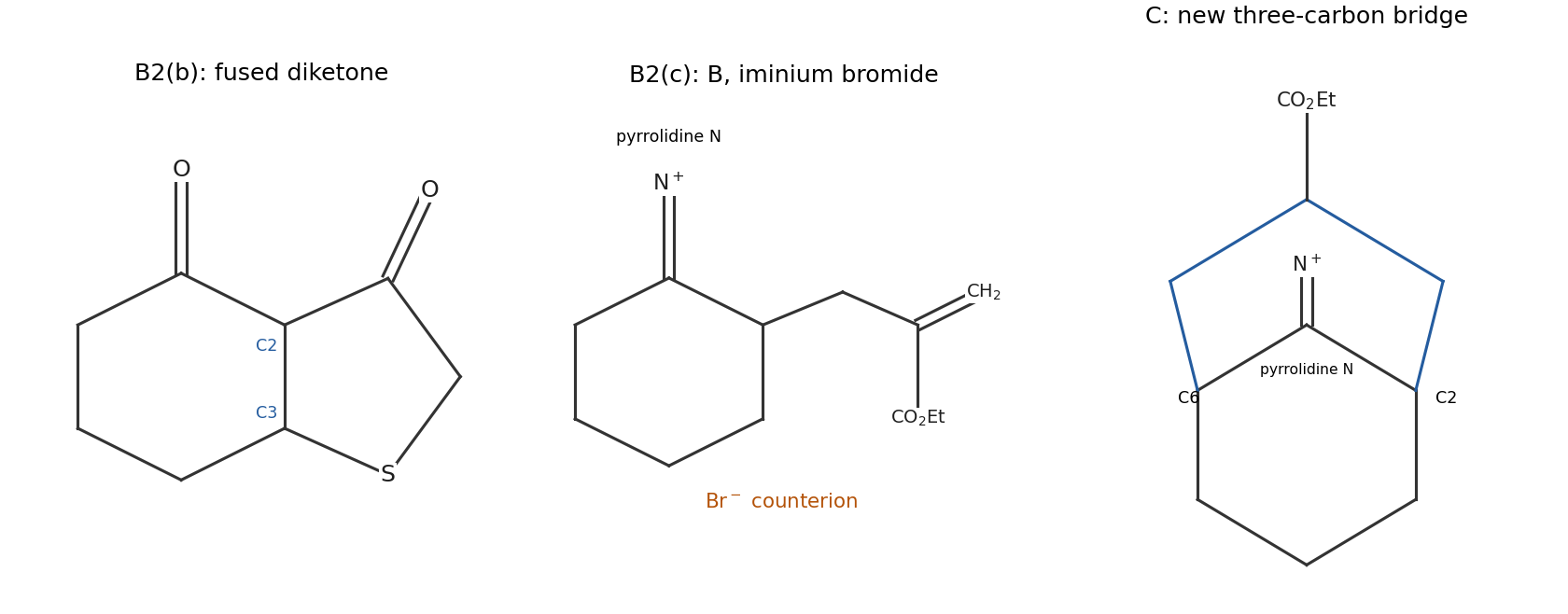
A is a fused five-/six-membered bicyclic diketone containing sulfur. To specify its structure unambiguously, retain the cyclohexanone numbering C1=O, C2 and C3 for the original alkene. Add the five-membered ringThe original C1 ketone remains, and the former methyl-ester carbonyl becomes the second ketone. The product is drawn in the first panel below.
methoxide first deprotonates the thiol. The soft thiolate attacks the beta carbon C3 in a Michael addition, shifting the enone electrons onto oxygen. The resulting enolate is nucleophilic at C2. It then attacks its tethered ester carbonyl intramolecularly, forming a five-membered ring through a tetrahedral intermediate. Collapse expels methoxide. proton transfers and work-up give the neutral bicyclic beta-diketone.
The initial 1,4 addition followed by intramolecular Claisen acylation explains the regiochemistry: it connects C3 to sulfur and C2 to the ester carbonyl, giving a favorable five-membered closure. Addition to the original ketone would not give this same enolate-and-ester arrangement. The net loss of methanol from the combined starting materials gives the observed formula.

New to topics? Read the docs here!