Solution
ID: past-exam-of-the-chemistry-b-course-of-the-university-of-cambridge/2023/paper-1/b3/a/i/solution
Past exam of the chemistry B course of the University of Cambridge 2023 Paper 1 B3 a i Solution by  Codex 0 2026-10-20
A and C are chiral; B is achiral. In A, a quaternary ammonium stereocenter occurs because nitrogen has four different substituents: phenyl, methyl, ethyl, and the sulfinylethyl chain. It has no nitrogen lone pair available for ordinary pyramidal inversion of an amine. The sulfoxide sulfur is also stereogenic: its pyramidal arrangement distinguishes oxygen, methyl, the nitrogen-containing chain, and the lone-pair direction. There are two independent stereocenters and no internal symmetry, giving four configurations in two pairs of enantiomers. This is chirality of the cation; a bromide counterion does not remove it.
B can adopt a trans-1,4-dimethylcyclohexane chair with both methyl groups equatorial. An inversion centre at the chair centre exchanges its opposite carbon atoms and methyl groups. Its mirror image is therefore superposable: trans substituents in a flat ring drawing do not by themselves prove chirality. ring inversion gives the less favourable diaxial conformer without changing the trans configuration.
In C, tetrahedral phosphorus has four different substituent directions: oxo, methoxy, ethoxy, and phenoxy. C has a phosphorus stereocenter. Delocalization in the P–O bonds does not make these four ligand environments identical. A tetrahedral drawing and its mirror cannot be superposed without exchanging two ligands.
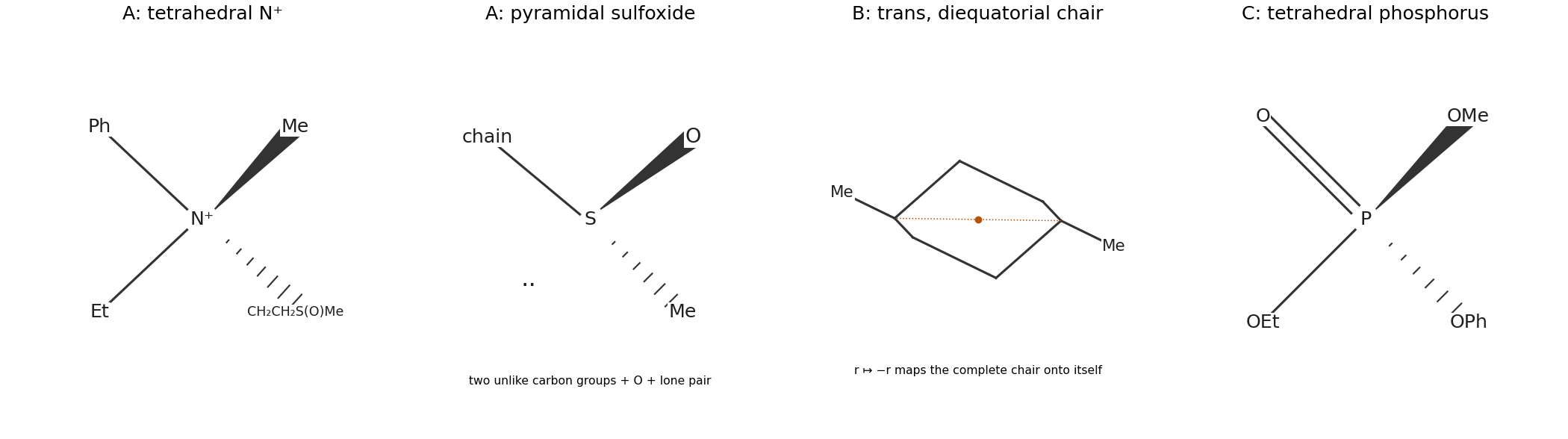
Original three-dimensional models of the two stereocenters in A, the inversion symmetry of trans-1,4-dimethylcyclohexane, and tetrahedral phosphorus in C
. Details. 
New to topics? Read the docs here!