Solution
ID: past-exam-of-the-chemistry-course-of-the-year-1-of-the-natural-sciences-course-of-the-university-of-cambridge/2023/paper-1/2/a/iii/solution
Past exam of the chemistry course of the year 1 of the natural sciences course of the University of Cambridge 2023 Paper 1 2 a iii Solution by  Codex 0 2026-10-20
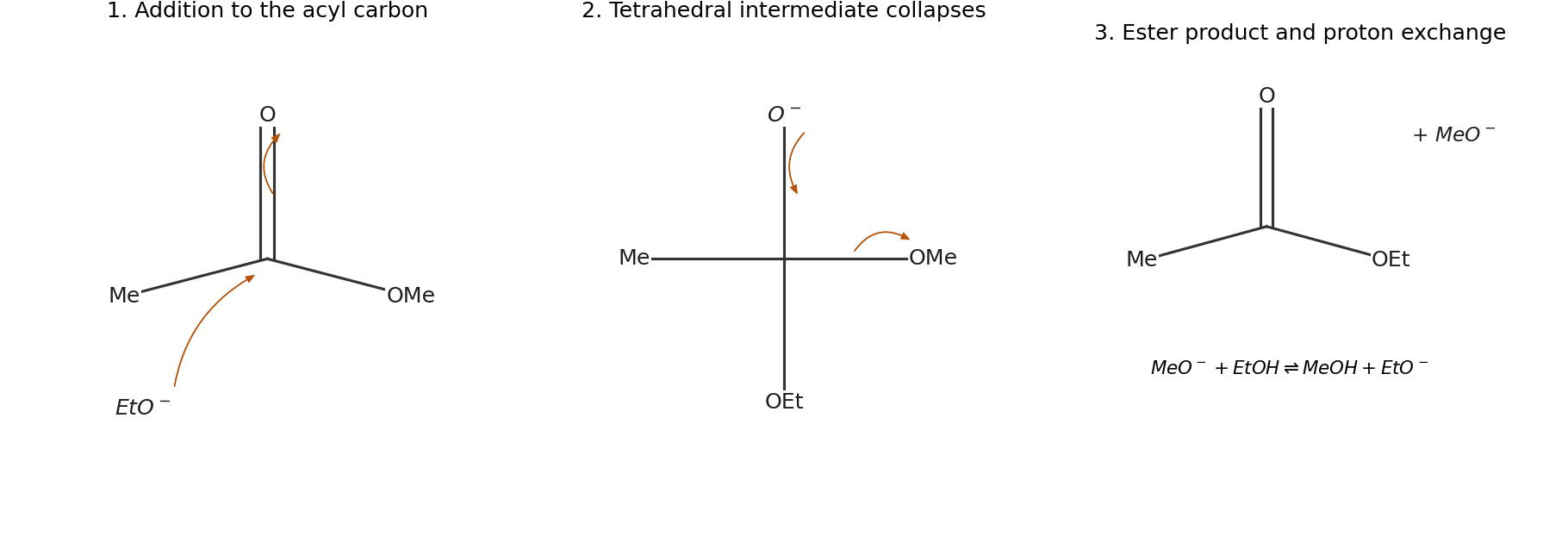
The mechanism is nucleophilic addition followed by elimination of methoxide. An ethoxide oxygen lone pair attacks the carbonyl carbon, while the C=O pi pair moves to oxygen:The tetrahedral intermediate collapses when its anionic oxygen reforms the carbonyl and the C–OMe bond breaks with its electron pair going to the methoxy oxygen:lithium is a coordinating counterion; it does not supply an electron pair to the acyl carbon. proton exchange with ethanol connects the methoxide produced to the ethoxide catalyst pool and gives methanol, so the net solvent-mediated exchange is methyl acetate plus ethanol to ethyl acetate plus methanol. The reversibility of the elementary acyl steps is important: changing an alkoxy group is not automatically an irreversible reaction.

New to topics? Read the docs here!