Solution
ID: past-exam-of-the-chemistry-course-of-the-year-4-of-the-natural-sciences-course-of-the-university-of-cambridge/2022/paper-2/section-a/18/a/solution
Past exam of the chemistry course of the year 4 of the natural sciences course of the University of Cambridge 2022 Paper 2 Section A 18 a Solution by  Codex 0 2026-10-20
A is poly(norbornene); B is the corresponding sequential block copolymer with a methyl-ester-substituted second block. The process is ring-opening metathesis polymerization. Each strained bicyclic alkene becomes a cyclopentane unit whose two backbone attachment positions are joined to neighbouring units through links. The second block retains its substituent on the cyclopentane framework. Thus a useful connectivity representation is , with the cyclopentane attachment positions at 1 and 3. This representation specifies connectivity rather than a single backbone alkene geometry.
The ruthenium alkylidene reacts with a monomer alkene through a metallacyclobutane, then fragments with the other pair of bonds broken. A new ruthenium alkylidene remains at the growing end, allowing propagation and then addition of the second monomer. Relief of the bicyclic monomer's ring strain supplies the principal enthalpic driving force; the loss of monomer translational entropy opposes polymerization. Sequential addition yields blocks only if the first population of active ends survives until the second addition.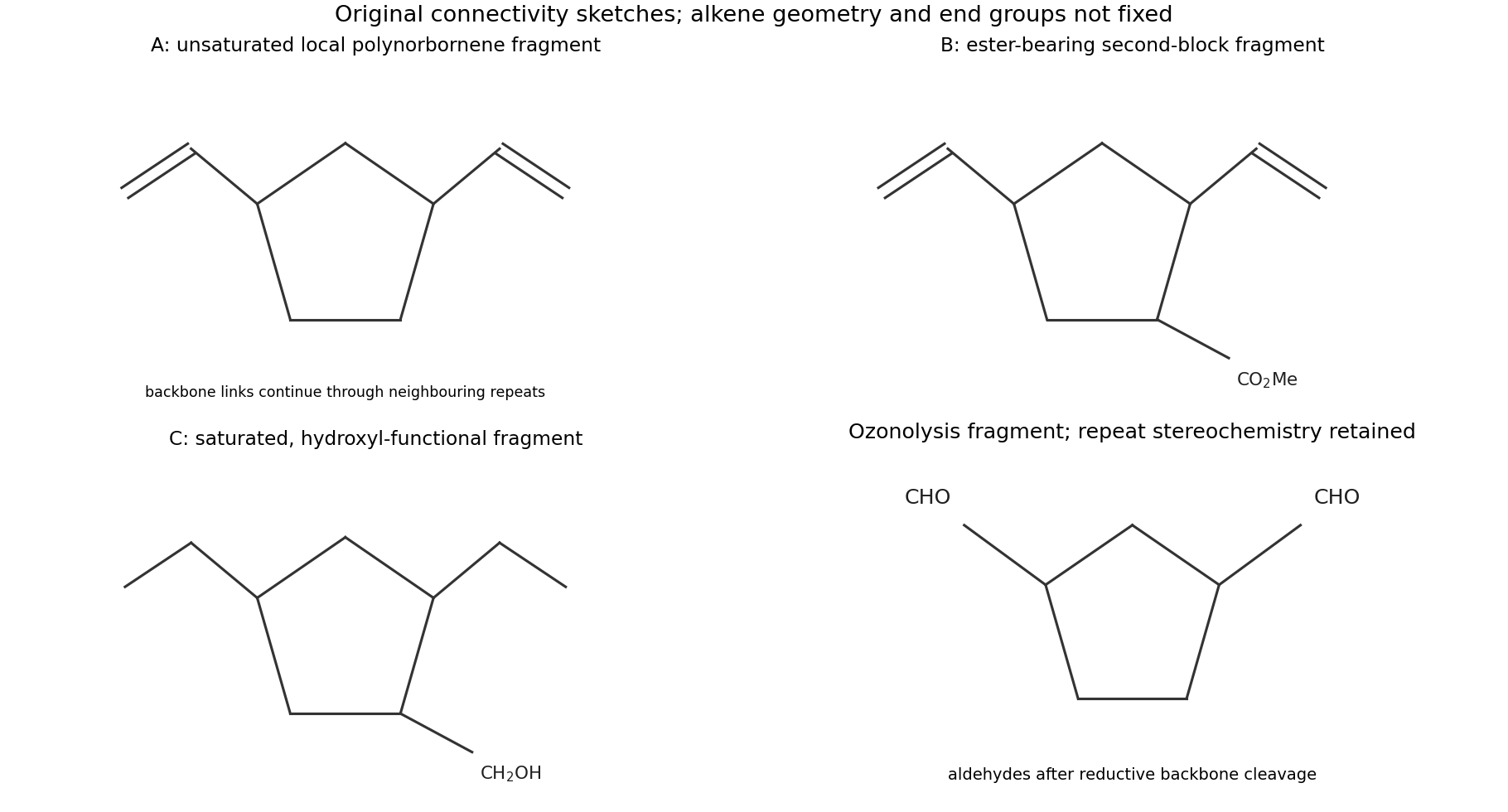
Figure 1.
Original polymer connectivity fragments and the reductive ozonolysis product
. Details. 
New to topics? Read the docs here!