Polymerization converts a monomer, or a mixture of monomers, into a polymer: repeated chemical reactions establish a connected molecular chain or network. The central question is how connections form, not merely whether a material becomes solid. Joining small molecules can produce a thread that can be handled, while the individual molecules remain invisible. See IUPAC, Basic Definitions of Terms Relating to Polymers, definition 2.2.
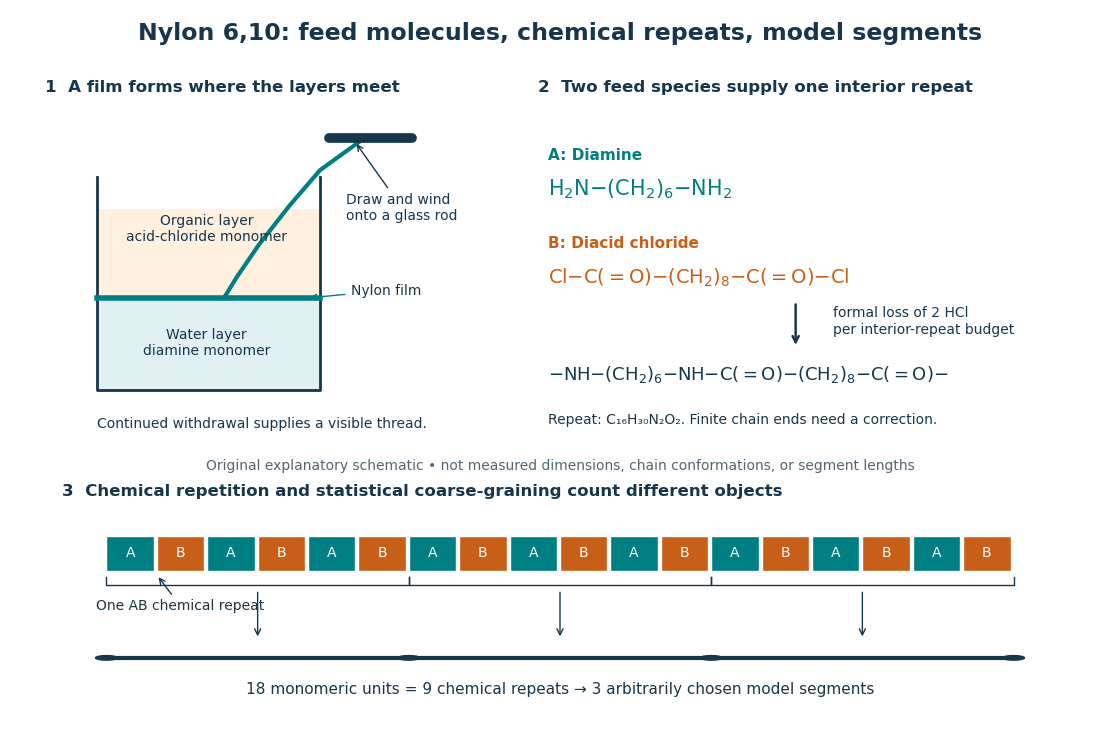
From two liquid layers to a Nylon 6,10 thread: monomers, a constitutional repeating unit, and statistical segments
. Original schematic of the authored UCSB polymerization demonstration described below. Chemical formulas identify the actual reactants and interior repeat; colored blocks identify their contributions. The lower coarse-graining sketch deliberately groups three repeats per model segment. Shapes, sizes, and that grouping are illustrative, not measured molecular geometry or a fitted Kuhn length. Details.
In step-growth polymerization, complementary reactive groups on monomers and on shorter or longer chains can react with one another. A two-unit chain can join a three-unit chain to make a five-unit chain; growth does not require a specially active end to add only free monomers. An example is the Nylon 6,10 reaction of with : each amine end can form an amide connection with an acid-chloride end, with formal elimination of . Both reactants have two suitable ends, allowing repeated joining. See Paula Hammond, MIT 10.569 lecture 2: step-growth joining and Hammond, lecture 5, p. 4: acid chloride–amine reaction.
In chain-growth polymerization, a monomer reacts with an active site on a growing chain, and the growth step regenerates an active site. Schematically, , where counts incorporated monomeric units and the star denotes reactivity rather than a particular electric charge. Ethene forming polyethylene is an example: the double chemical bond is converted into single chemical bonds as the carbon backbone grows. Initiation creates the active chains; subsequent reactions can deactivate them or transfer reactivity to another molecule. See IUPAC: chain polymerization and John McMurry, Organic Chemistry, 31.1: chain growth. Whether growth is stepwise or carried by an active site is a different question from whether small byproducts are released: chain-growth polymerization can also release them.
A motivating experiment: drawing nylon from a liquid interface. Feldwinn's UCSB demonstration places of an aqueous chemical solution of hexamethylenediamine, , in a beaker, then gently adds of sebacoyl chloride, , in an organic solvent. The procedure specifies hexane; other parts of that handout list cyclohexane. The layers remain separate. The instructor catches material at their interface with tweezers and winds it slowly onto a glass rod; the handout reports continued spooling of Nylon 6,10. It specifies freshly prepared acid-chloride chemical solution and washing the thread before touching it. These are observations and conditions of a supervised laboratory demonstration, not measurements of chain lengths. See Feldwinn, UCSB Demonstration Library, Demo 044, pp. 1–3.
The mechanistic interpretation is that the monomers encounter one another near the interface, where amide connections produce the film; withdrawing it exposes a region where more material can form. An authored research demonstration independently reports a rapidly formed interfacial film collapsing into a thread on withdrawal, using cyclohexane and an aqueous chemical solution containing potassium hydroxide. See Polymer Day: Outreach Experiments for High School Students, Journal of Chemical Education (2017), nylon demonstration. This is the striking observation: a thread much longer than the beaker can emerge because material is continually supplied to the formation region, rather than because a pre-existing thread was hidden in the liquid.
Useful proposed controls, not results reported in those demonstrations, omit one monomer at a time while retaining the same solvents, liquid amounts, and pulling procedure. The prediction is loss of a renewable drawable Nylon 6,10 film; merely finding cloudiness would not establish polymerization, since other chemical reactions, including acid-chloride hydrolysis, can occur. See McMurry, 21.4: competing acid-chloride hydrolysis. Stopping and restarting withdrawal would probe renewal at the interface. Even successful drawing does not measure the degree of polymerization, establish a chain-length probability distribution, or prove the entire growth mechanism. Chemical identification and a molecular-size measurement would be needed for those stronger conclusions. These controls and limits are inferences from the setup, not invented experimental data.
Why almost complete reaction matters in step growth. For ideal linear step-growth polymerization, assume exactly two reactive groups per starting molecule, equal numbers of complementary groups, only joining of different chains, no rings, no branching, and no loss of chain material. Let count starting monomer molecules, including both reactant species, and let be the fraction of either type of reactive group consumed. There are initially groups of each type, so connections reduce the number of chain-bearing molecules to ; the count excludes small byproducts but includes unreacted monomers. The number-average degree of polymerization, measured in monomeric units, is thereforeThus , , and give , , and . Losing the last fraction of unreacted groups matters enormously. See Hammond, lecture 3: balanced step-growth conversion. This counts residues of both feed species; a Nylon 6,10 interior constitutional repeating unit contains two such monomeric units.
For an feed with initial reactive-group counts, put and now let denote the fraction of the limiting groups consumed. Under the same linear, no-ring assumptions, and , givingFor , even complete consumption of gives . Stoichiometry controls chain length as well as yield. See Hammond, lecture 2, pp. 2–3: stoichiometric imbalance. The liquid-interface demonstration is not a homogeneous, balanced reactor, so its thread length cannot be inserted into this formula as a molecular chain length.
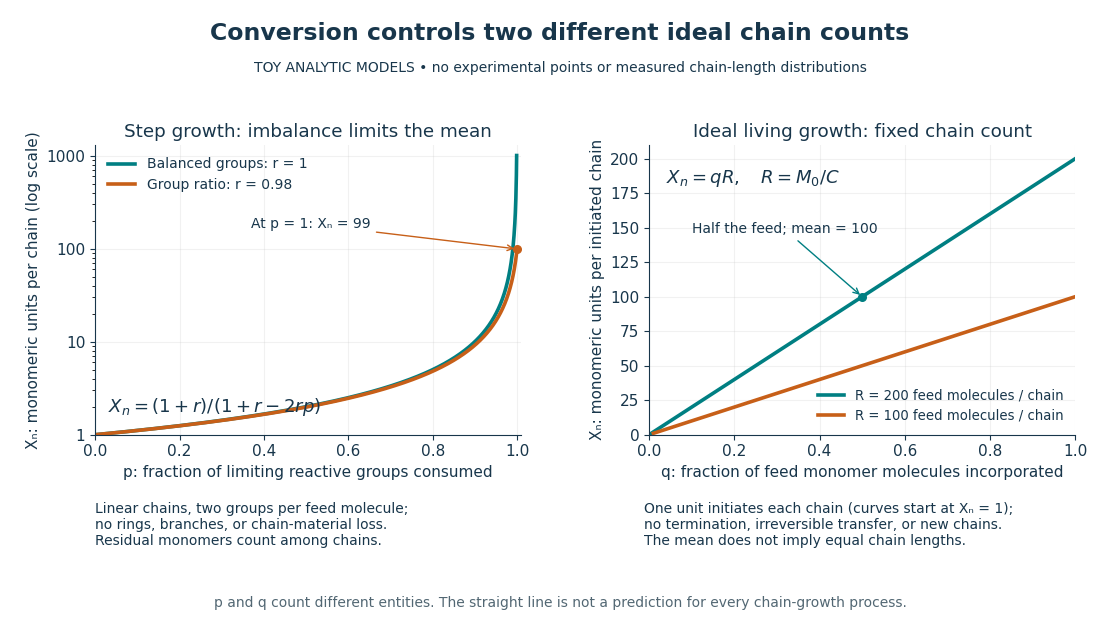
Two ideal degree of polymerization counts: late growth in step-growth polymerization and fixed-chain growth in ideal living polymerization
. Toy analytic curves, not measured data. Left: , with the limiting-group conversion and the initial reactive-group ratio. Right: , with the fraction of feed monomer molecules incorporated and their initial number per initiated chain. The two horizontal axes count different entities; the right plot represents a special ideal model, not all chain-growth polymerization. Details.
A contrasting chain count. In ideal living polymerization, assume no chain termination or irreversible chain transfer, all chains initiated before the counted growth, one chain per effective initiator, a fixed chain count , and every consumed monomer molecule incorporated into those chains. If is the initial number of feed monomer molecules and their incorporated fraction, conservation gives in monomeric units, excluding initiator fragments. For , incorporating half the feed gives . If initiation consumes one monomer molecule per chain, the fixed-chain interval starts at , rather than . See Hammond, lecture 21, p. 1: ideal living-chain count. The mean does not imply identical chain lengths. Living polymerization does not require reversible loss of monomers; the defining absence of chain termination and irreversible chain transfer is explained in Devon Shipp, IUPAC Polymer Education workshop, Radical Polymerizations II, slide 50. Ordinary chain-growth polymerization with new chains, termination, or transfer need not follow the straight line.
The useful connection is between local chemistry and a macroscopic material: selecting reactive ends and their proportions controls connectivity, while the resulting polymer's conformation is a separate problem described by models such as the freely jointed chain or Gaussian chain. Formation of chemical bonds, the count of monomeric units, and the count of statistical segments must be kept distinct.
The number of reactive connections available on a monomer under a specified polymerization chemistry. One-functional units can terminate chains, two-functional units can build chains, and higher functionality can produce branching and networks.
A chemical event preventing further growth of a polymer chain. Monofunctional end-capping units can reduce attainable chain length in a condensation system.
Formation of a polymer by opening cyclic monomers and linking the resulting units. The repeat-unit inventory can be retained without eliminating a small molecule in each propagation step.
Chain growth by successive olefin metathesis steps that open cyclic alkenes. Relief of ring strain can offset the loss of monomer translational entropy.
The Cossee-Arlman mechanism propagates a polymer through alkene coordination followed by insertion into a metal–carbon bond. Repetition extends the metal-bound chain. Regioselectivity controls monomer connectivity; it does not by itself specify tacticity.
In step-growth polymerization, suitable reactive groups on molecules of different chain lengths can join. The linear count and its assumptions are given in polymerization.
A one-unit monomer, a two-unit chain, and a twenty-unit chain can all be joining partners if their functional groups are compatible and accessible. Schematically, : the subscripts count monomeric units, and end-group chemistry is suppressed. In chain-growth propagation, by contrast, requires a free monomer and a polymerization-active site. An arbitrary pair of existing chains is not a propagation pair in that mechanism. The practical consequence of step-growth polymerization is that most monomers can have joined something while the average chain is still short.
Whether a joining step releases a small molecule is a separate question. Polycondensation releases small products during the joining chemistry, as in the Nylon 6,10 demonstration in polymerization. Polyaddition joins suitable chains without that elimination: reacting a diol with a molecule bearing two isocyanate groups can build a polyurethane. Thus step-growth polymerization and polycondensation are not synonyms.[ref]
IUPAC Compendium of Chemical Terminology, fifth edition (Gold Book) by International Union of Pure and Applied Chemistry. polyaddition, P04720, definition and note 1; polycondensation, P04722, definition and growth-step equation; source recommendation p. 2307
Use an ideal feed in which every starting molecule has exactly two suitable functional groups: either one and one , or two groups mixed with two groups. Only an – pairing can form a joining chemical bond. Assume no loss of feed-derived material, no splitting of chains, no competing consumption of the counted functional groups, no branching, and no cyclization in step-growth polymerization. Linear here describes connectivity; a chain can bend in space. Small byproducts of polycondensation do not enter the chain-bearing molecule count.
Let count all initial feed molecules, the number of intermolecular joins, and all remaining chain-bearing molecules, including unreacted monomers. Each join turns two molecules into one, so exactly. If chain contains feed-derived monomeric units, conservation gives . Consequently the number-average degree of polymerization isThis is a count of both feed species' monomeric units, rather than a count of interior constitutional repeating units. For chemistry an interior repeat often contains two feed-derived units, as explained in monomer. Equal functional group reactivities are not needed for this bookkeeping at a specified ; predicting a time course or a chain-length probability distribution requires additional assumptions.
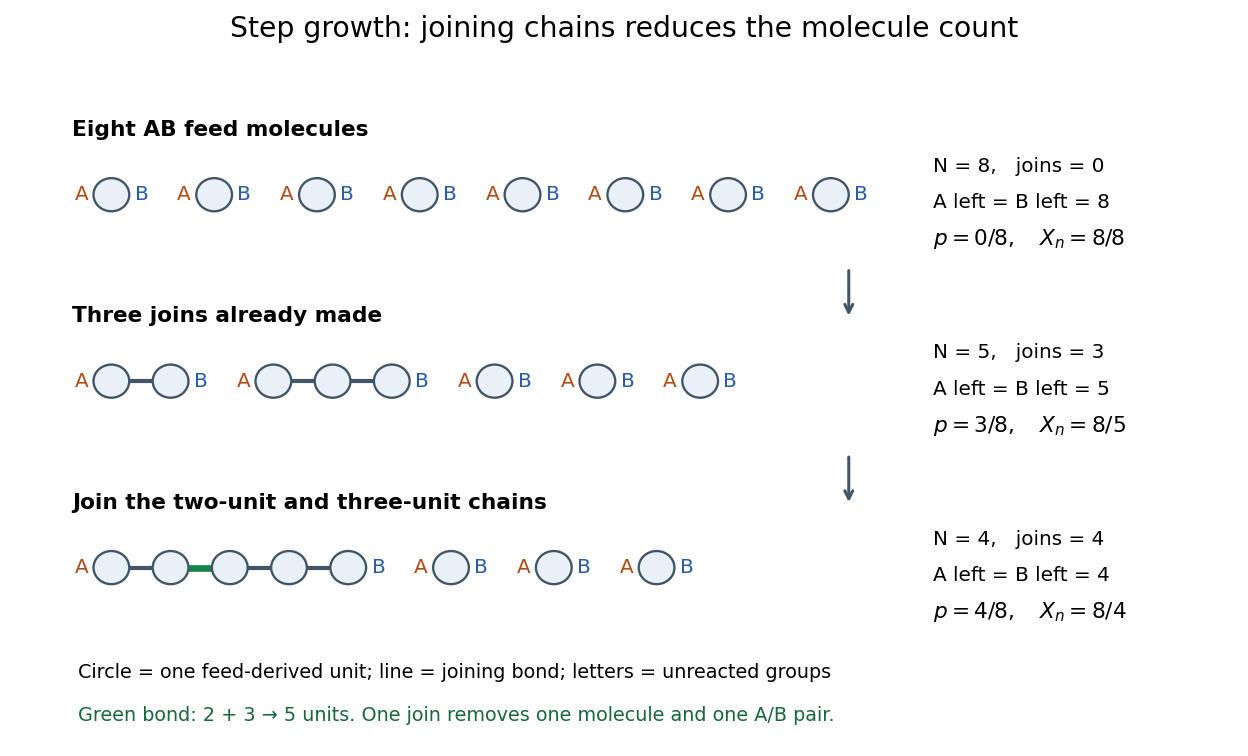
Exact step-growth polymerization count: joining a two-unit chain to a three-unit chain consumes one pair of functional groups
. Original stipulated eight--molecule example. Circles are feed-derived monomeric units, lines joining chemical bonds, and letters the surviving functional groups. Internal and groups have already reacted and are not drawn. The depicted layouts are schematic connectivity, not molecular geometry or sampled experimental chains. Details.
For the figure's eight feed molecules, three joins can give lengths , so and . Joining the first two chains gives : the incorporated total stays eight, becomes four, and . A graph makes the bookkeeping visible: each starting monomer molecule is a vertex of a graph, and each intermolecular joining chemical bond connects two previously distinct connected components of a graph. The connected pieces are the counted molecules.
In a balanced bifunctional feed there are initially groups and groups. Define the functional-group conversion in step growth by : the reacted fraction of either group type. Each join consumes one of each. Therefore . In the eight- example, three joins give and four give . In the latter state only three of eight starting monomer molecules remain isolated: their disappearance fraction is , different from . Neither this group-based nor disappearance of isolated monomers is the incorporated-feed fraction in the ideal living polymerization count.
With unequal initial counts , this article always uses , the conversion of the limiting groups. The reacted fraction of groups is , where . The fraction of all initial functional groups consumed is . At nonzero conversion these three fractions coincide only at . Naming the measured group type prevents an apparently correct equation from using the wrong conversion.
The balanced Carothers equation follows immediately from linear step-growth molecule count and functional-group conversion in step growth:The same Carothers equation extends to unequal group counts once the limiting-group convention is specified.[ref]
Generalization of the Carothers equation for linear step growth polymers by Emilio Meaurio. Introduction, equations (1)–(6): Carothers equation, end-group count and limiting- conversion
For an original balanced feed of monomer molecules, , , and intermolecular joins give , , and . The remaining counts are , , and , hence number-average degree of polymerization values , , and . The last thirty joins quadruple the average even though they consume only another of the initial groups of either type. These are exact synthetic counts, not experimental measurements.
The derivative explains the sensitivity: near , an absolute conversion uncertainty of changes the predicted degree of polymerization substantially. The exact balanced values at and are approximately and , instead of . An instrument reporting rounded “complete conversion” cannot distinguish those chain lengths. In a finite no-ring system, even one chain retains two ends; the maximum is and . The formal divergence at is a large-system limit, not an infinite chain in a finite flask.
For a strictly bifunctional feed, label the limiting functional groups , set , and define as in functional-group conversion in step growth. The initial molecule count is , and each intermolecular join consumes one and one . ThusThis version of the Carothers equation uses limiting-group conversion, not the fraction of all groups reacted.[ref]
As an original finite example, mix monomer molecules with monomer molecules. Then and . At , joins leave molecules, giving . At , joins leave five chains and ten unreacted groups; every chain has two ends, and . Continuing to wait cannot remove the missing- constraint within this model.
For , complete limiting-group conversion gives the ceiling . Reaching a target therefore requires , even before considering incomplete conversion. For , . Equality requires ; any lower conversion demands closer balance. The imbalance is measured relative to the initial number of groups, not relative to the total number of groups. A monofunctional impurity changes the initial groups-per-molecule count, so it cannot be inserted into this strictly bifunctional formula by retaining an unexamined .
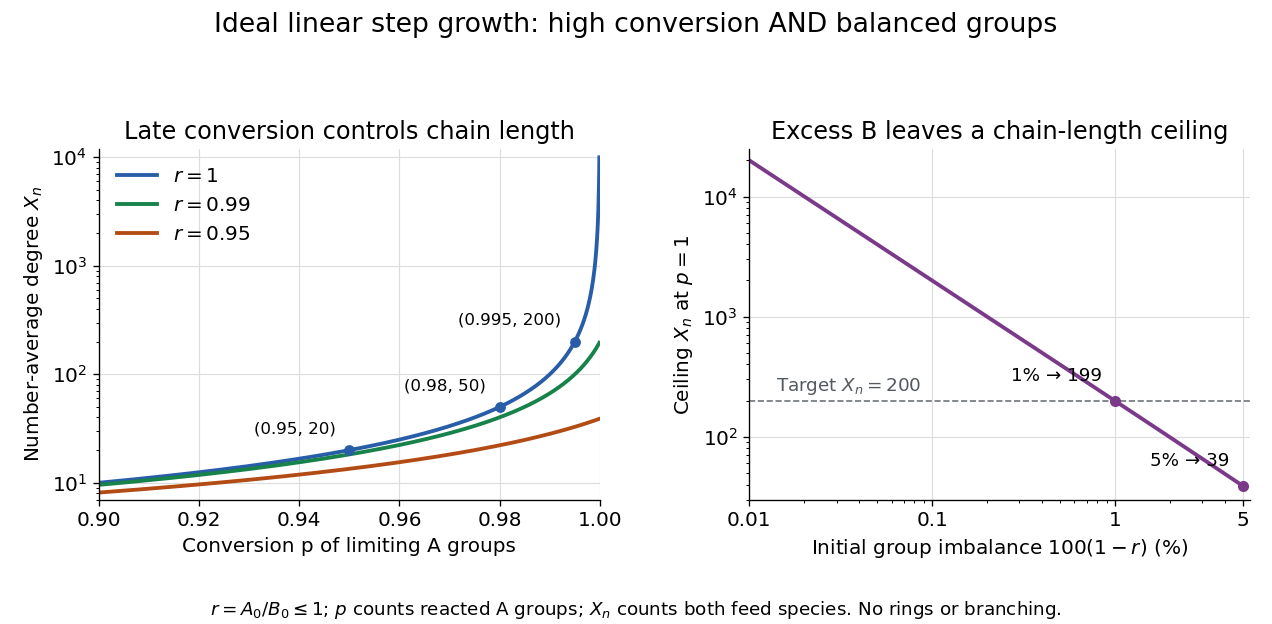
Carothers equation sensitivity to limiting-group conversion and initial stoichiometric imbalance in step growth
. Original analytic model curves with logarithmic vertical axes. Left: and the balanced example points. Right: versus , the initial excess- fraction relative to . These are ideal linear no-ring calculations, not fits to the polyurethane study. Details.
In cyclization in step-growth polymerization, compatible functional groups on the same chain react and close it into a ring. They consume groups without merging two molecules. If ring-closing events and intermolecular joins occur in an otherwise balanced bifunctional feed, the group conversion is , while . ThusFor example, an dimer can close its remaining and ends: two group pairings have occurred among two starting monomer molecules, giving , but the resulting single cyclic molecule has only two monomeric units. This counterexample shows exactly where the linear Carothers equation fails. Rings have no chain ends, so counting every chain-bearing molecule as two ends also fails.
Polyaddition is step-growth polymerization by joining reactions without elimination of small molecules. Compatible functional groups on different chain lengths remain eligible to join; the word addition alone does not imply chain-growth polymerization.[ref]
An experimental comparison joined a two-ended diol chain, HOPCLOH, with a bifunctional isocyanate, at reported isocyanate-to-diol ratio . The researchers used oven-dried round-bottom flasks and an IKA RET magnetic hotplate with a metal carrier. They varied solvent, concentration, reaction temperature ( or ), and duration ( or ).[ref]
Experimental Design (2⁴) to Improve the Reaction Conditions of Non-Segmented Poly(ester-urethanes) (PEUs) Derived from α,ω-Hydroxy Telechelic Poly(ε-caprolactone) (HOPCLOH) by Jaime Maldonado-Estudillo and others. sections 2.1 and 2.3: flask, heating apparatus and varied conditions
A Bruker NMR spectroscopy instrument measured residual hydroxy group-adjacent signal relative to an ester signal. Independently, size-exclusion chromatography used ResiPore columns at , a refractive-index detector, and polystyrene calibration. Figure 8 reports sharply increasing apparent number-average molar mass beyond the reported conversion . A deliberately water-exposed isocyanate comparison reproduced a infrared spectroscopy band assigned to urea-containing products. The authors warn that tiny residual NMR spectroscopy signals reduce integration precision.[ref]
Experimental Design (2⁴) to Improve the Reaction Conditions of Non-Segmented Poly(ester-urethanes) (PEUs) Derived from α,ω-Hydroxy Telechelic Poly(ε-caprolactone) (HOPCLOH) by Jaime Maldonado-Estudillo and others. sections 3.2–3.3; Figure 3 discussion of the water comparison; section 5.1 and Figure 8: independent conversion and GPC readouts and low-signal limitation
The inference is increasing chain size alongside depletion of reactive groups, consistent with step-growth polymerization. It is not an exact measurement of in the toy model. The feed contains already extended diol chains: counting their constituent repeat units differs from counting each feed molecule as one unit. Their varying molar masses, calibration against a different polymer, residual starting material, and competing chemical reactions further obstruct a direct conversion-to- substitution. Report which functional groups the conversion readout measures before comparing it with stoichiometric imbalance in step growth.
Useful proposed controls, distinct from the reported water comparison, are pre-reaction spectra and matched mixtures omitting each joining partner in turn. Keep solvent, heating, and signal normalization matched. Disappearance of an isocyanate signal in the omitted-diol control would reveal competing consumption rather than establish chain joining. Agreement between residual-group and independently calibrated chain-size readouts is stronger evidence than calculating both quantities from the same Carothers equation.
Polycondensation is step-growth polymerization in which joining reactions eliminate small molecules. Its chain-bearing molecule count excludes those byproducts; otherwise two chains joining while releasing one small product would misleadingly appear to conserve the counted population.[ref]
IUPAC Compendium of Chemical Terminology, fifth edition (Gold Book) by International Union of Pure and Applied Chemistry. polycondensation, P04722, definition and growth-step equation
Formation of Si–O–Si linkages from silanol groups, with elimination of water or another small molecule according to the reacting functional groups.
The functionality in polymerization is the number of reactive functional groups on a molecule for the specified joining chemistry. The linear step-growth molecule count assumes for every feed molecule. A diol supplies two hydroxy groups in the polyurethane example; an impurity supplying only one suitable group can cap a chain. A group count must reflect the selected chemical reaction, not simply every chemically recognizable group in the molecule.
Gelation is formation of an extended connected network. In step-growth polymerization, feed molecules with functionality in polymerization above two can introduce branching and permit gelation. The linear step-growth molecule count's two-ended-chain interpretation and bifunctional Carothers equation must not silently be applied to such networks. Each join between distinct connected pieces still reduces their count by one, but neither that identity nor average size alone specifies the onset of gelation.
In chain-growth polymerization, each growth step joins a monomer to a reactive site on a polymer chain and regenerates that reactive site. This is the precise mechanistic restriction in IUPAC's definition: growth occurs exclusively through these monomer–chain-site reactions. The word chain refers to the succession of site-regenerating chemical reactions. It does not merely mean that the product looks like a long chain. Chain-growth initiation starts this succession; chain-growth propagation continues it; chain-growth termination and chain transfer in chain polymerization can change its fate.[ref]
IUPAC Compendium of Chemical Terminology, fifth edition (Gold Book) by International Union of Pure and Applied Chemistry. chain polymerization, C00958, definition and notes 1–2; source recommendation p. 2306
The contrast with step-growth polymerization concerns the permitted joining partners. There, suitable reactive groups can join two existing chains, for example a two-unit chain and a three-unit chain. In chain-growth propagation, a free monomer adds to a polymerization-active site. Release of a small byproduct is a separate classification question: IUPAC explicitly allows condensative chain polymerization.[ref]
IUPAC Compendium of Chemical Terminology, fifth edition (Gold Book) by International Union of Pure and Applied Chemistry. chain polymerization, C00958, notes 3–6
The useful consequence is that a few growing chains can incorporate many monomer molecules while much of the feed remains unreacted. Their degree of polymerization depends on how those units are shared among chains, as finite chain-growth bookkeeping makes explicit.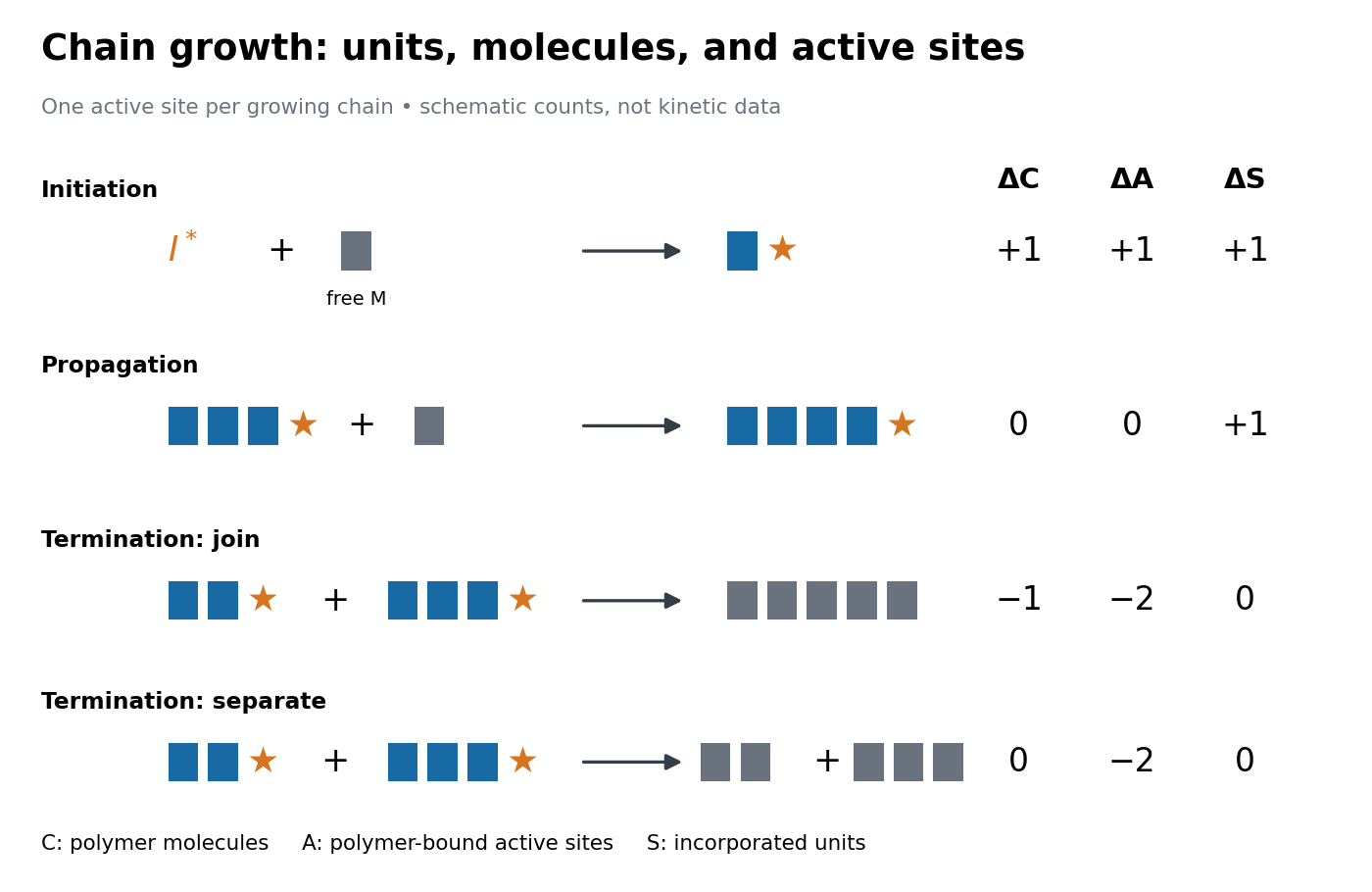

Chain growth in which the catalyst remains associated with a newly formed chain end between coupling events.
Chain growth by successive monomer coordination and migratory insertion at a metal-bound active site.
A chain-growth polymerization whose propagating active centres are free radicals. Initiation creates active chains, propagation adds monomers while regenerating an active centre, and termination or transfer changes the population of growing chains.[ref]
IUPAC Compendium of Chemical Terminology, fifth edition (Gold Book) by International Union of Pure and Applied Chemistry. radical polymerization, term R05075: radical kinetic-chain carriers
Radical polymerization in which growing chain ends reversibly exchange between active radicals and dormant species. Keeping the active-radical concentration small can reduce bimolecular termination and narrow the molar mass distribution. Termination and chain transfer may still occur, so reversible deactivation alone does not guarantee ideal living polymerization.
Controlled radical polymerization based on reversible trapping of growing radicals by a nitroxide, forming dormant alkoxyamines. Initiation and end-group retention must be controlled to obtain predictable chain length.
A polymerization-active site is the reactive location that enables the next chain-growth propagation step. In the schematic is one free monomer molecule, is the chain's degree of polymerization in incorporated monomeric units, and the star marks the polymerization-active site. The site's reactive character survives the growth step, although the chemical atoms carrying it can change. The star is not an extra unit, a literal particle, or necessarily a positive or negative electric charge. Actual reaction mechanisms can involve an unpaired electron, a cation, an anion, or a metal-associated site; the abstract notation does not identify which. [ref]
31.1 Chain-Growth Polymers. John McMurry, Organic Chemistry, §31.1: successive reactive intermediates and radical, cationic and anionic initiation
For bookkeeping below, each linear active chain has exactly one polymerization-active site. This is a stipulated model, not a property of every chain polymerization: a chain can have several reactive sites, and a reversibly inactive chain can remain capable of future growth. Count currently active sites separately from all chains capable of later reactivation.
Chain-growth initiation creates a chain capable of chain-growth propagation. WriteThis schematic includes the first incorporated monomeric unit; any preceding production of is a separate step. If counts polymer molecules, counts polymer-bound polymerization-active sites, and counts incorporated monomeric units, this event changes by . The free was excluded from , so this does not assert creation of reactivity from nothing. An initiator feed amount need not equal the number of successful chains: the efficiency of forming productive chains and the number of initiating species per initiator matter. [ref]
In the one-site linear model, chain-growth propagation changes by : one monomer molecule is consumed, one monomeric unit is incorporated, and the polymerization-active site is regenerated. Thus longer chains do not imply more active sites. Repeated chain-growth propagation can increase substantially with unchanged. This is a material count; it supplies no universal time dependence or empirical chemical kinetics formula.
Chain-growth termination removes the ability of a reactive chain carrier to continue the succession of growth steps.[ref]
IUPAC Compendium of Chemical Terminology, fifth edition (Gold Book) by International Union of Pure and Applied Chemistry. termination, T06274, definition; source recommendation p. 1173
Two illustrative outcomes have different molecule counts:The first joins the two chains into one inactive polymer molecule. The second leaves two inactive polymer molecules, as can occur when one chain end transfers hydrogen to the other instead of their ends joining. End-group chemistry is suppressed in these unit-count symbols; they are not complete molecular formulas. Losing two polymerization-active sites does not mean losing two chains or any incorporated monomeric units. A temporarily inactive, reactivatable site must not be counted as irreversible chain-growth termination.In chain transfer in chain polymerization, a growing chain can lose its polymerization-active site while another molecule acquires reactivity. In a common atom-transfer picture, the old chain becomes inactive and the new carrier can initiate further chain-growth propagation.[ref]
IUPAC Compendium of Chemical Terminology, fifth edition (Gold Book) by International Union of Pure and Applied Chemistry. chain transfer, C00963, definition and subsequent-polymerization example; source recommendation p. 1094
The number of reactive carriers can survive even though the identity of the growing chain changes. If the new carrier successfully starts a new chain, increases; a fixed active-carrier count therefore does not imply a fixed polymer molecule count. Whether transfer is irreversible, reversible, or involves an already existing chain matters for the final bookkeeping.Stipulate a feed of exactly monomer molecules, four successfully initiated linear chains, one polymerization-active site per chain, no chain transfer in chain polymerization, no loss of incorporated units, and no further chain-growth initiation. Count only initiated chains in ; exclude unreacted monomers. Assume each consumed monomer molecule contributes exactly one monomeric unit. With incorporated feed fraction , the number-average degree of polymerization is the counting identityThis is conditional conservation bookkeeping, not a universal empirical law. Immediately after chain-growth initiation, the four lengths are , so and . Stipulate twelve subsequent chain-growth propagation events, three on each chain: the lengths become , giving , and . Sixteen units have been incorporated, while twenty-four free monomer molecules remain. The chain-length assignment is deliberately chosen, not a prediction of equal growth in an experiment.
The defining idealization of living polymerization excludes chain-growth termination and irreversible chain transfer in chain polymerization. Fast, effective chain-growth initiation is an additional condition behind a nearly fixed growing-chain population, not a guarantee contained in the name alone.[ref]
IUPAC Compendium of Chemical Terminology, fifth edition (Gold Book) by International Union of Pure and Applied Chemistry. living polymerization, L03597, definition and initiation/propagation comparison; living polymer, LT07156, definition specifies irreversible transfer
If all four chains in finite chain-growth bookkeeping remain active, completing the feed keeps and gives . Stipulate six further additions to each chain, obtaining . Other allocations with the same total also satisfy : living does not mean identical lengths.Alternatively, stipulate that the first two length-four chains undergo chain-growth termination without joining, while the other two each receive twelve more monomer molecules. The final lengths are , with . The mean degree of polymerization is still , but two chains have stopped and two carry the remaining growth. The population variance of lengths is , compared with zero in the deliberately equal living allocation. These are synthetic populations, not measured molecular distributions and not a claim that all terminating processes are broader than all living processes. Indeed, assigning all twenty-four remaining additions to one still-active chain gives the living allocation , with the same mean but variance . Comparable start times and opportunities for chain-growth propagation are extra assumptions behind an expectation of more uniform lengths.
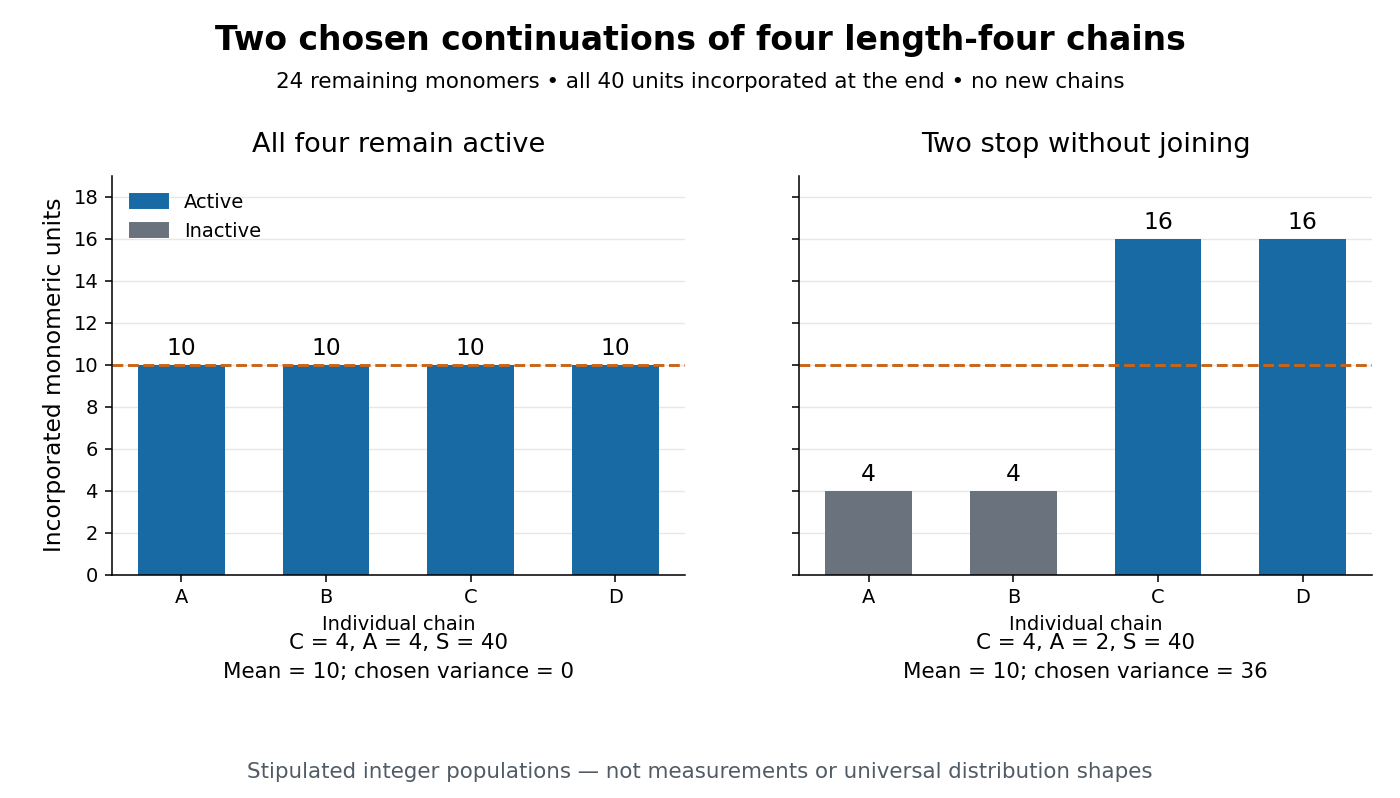

If the two terminated length-four chains instead join, their inactive product has length eight; with the same remaining additions the final lengths are . Now , , and . Thus chain-growth termination can change both which chains grow and which chains enter the denominator. Continuing chain-growth initiation, inefficient initiation, chain transfer in chain polymerization, and reactivation require their own counts. Predicting an entire length distribution additionally needs a specified reaction mechanism and growth statistics. A measured mean alone cannot establish living polymerization.
NMR monitoring of chain polymerization uses nuclear magnetic resonance signals to follow monomer and other distinguishable chemical species. In a proton experiment, suitable signal integrals can track changes in their relative amounts. Disappearance of a monomer signal is a consumption readout; it is not a direct count of polymerization-active sites. Overlapping signals, baseline errors and competing chemical reactions can obstruct the inference. A pre-reaction reference and independent product characterization make the consumption interpretation stronger.
Size-exclusion characterization of chain polymers separates dissolved chains using porous columns and records an elution signal. Calibrating that separation against appropriate standards supplies a size-related estimate of molecular masses. Detector response and calibration must accompany any claimed molecular distribution: an elution trace is not automatically a histogram of molecule counts or degree of polymerization. Similar signals can conceal chemically different chain populations, while a shift toward larger apparent size alone does not show that every chain retained a polymerization-active site.
A simple route to deuterated polystyrene block copolymers by reverse iodine transfer polymerisation by Trevor Gavin Wright and Harald Pasch (2015, Experimental section, pp. 3237–3238) provides a concrete study of consumption and chain products. The authors used a valve-sealed J Young tube, freeze–pump–thaw preparation and argon. NMR monitoring of chain polymerization compared a reference with spectra acquired at every fifteen minutes for twenty-four hours. Their formulation contained an azo initiating reagent, molecular iodine and a vinyl monomer. Companion flask syntheses used stirring and a heated silicone-oil bath.
The authors followed initiating and transfer-agent signals; Figure 3 reports a transfer-agent signal rising during induction and then falling as polymerization proceeds. Their size-exclusion characterization of chain polymers used porous columns, refractive-index detection and polystyrene calibration. These distinct consumption and size readouts concern transfer-mediated chemistry; they do not establish strict living polymerization. [ref]
A simple route to deuterated polystyrene block copolymers by reverse iodine transfer polymerisation by Trevor Gavin Wright and others. Wright and Pasch, pp. 3237–3239: Experimental section, Analyses and Figure 3
Useful proposed controls, rather than reported measurements, are a matched mixture omitting the initiating reagent, an unheated mixture, and a repeat of the complete formulation. Keep monomer amount, solvent, tube preparation and acquisition conditions matched where possible. The unheated comparison needs a readout that does not itself initiate polymerization; placing it in the hot probe would defeat that control. A mixture omitting iodine asks a different question: it changes chain transfer in chain polymerization and induction chemistry, so it is not necessarily a no-polymerization control. Record the pre-reaction baseline and compare crude material with isolated product; isolation can selectively remove shorter chains. These comparisons help separate initiation-dependent monomer consumption from signal drift and unrelated chemical reactions.
The mechanistic inference is deliberately limited. Consumption plus independently characterized larger chain products supports polymerization; evidence of an induction stage helps test a proposed reaction mechanism. Neither readout directly counts stars in , proves the absence of chain-growth termination, nor recovers every chain length. A chain-extension test would probe retained growth capability, but even a successful extension would not by itself establish that all original chains extended. No measured molecular distribution is reconstructed here. IUPAC cautions that reversible deactivation can produce living-like behaviour even when some termination occurs.[ref]
IUPAC Compendium of Chemical Terminology, fifth edition (Gold Book) by International Union of Pure and Applied Chemistry. reversible-deactivation radical polymerization, 08916, notes 2 and 4: living terminology and remaining active/dormant population
Living polymerization is chain-growth polymerization without chain termination or irreversible chain transfer. A linear mean degree of polymerization versus feed conversion additionally needs the fixed-chain assumptions in polymerization; reversibility of monomer addition is not required. See Shipp, IUPAC workshop, slide 50.
Articles by others on the same topic
There are currently no matching articles.