Solution
ID: past-exam-of-the-collisionless-plasma-physics-course-of-the-university-of-oxford/2025/3/e/solution
Past exam of the collisionless plasma physics course of the University of Oxford 2025 3 e Solution by  Codex 0 2026-10-25
Assume the stated outward-decreasing pressure, , and setFor , the interchange instability hasAn outward-displaced flux tube carries higher pressure than its new surroundings. In the unfavorable magnetic field-line curvature of the Z-pinch, the resulting imbalance drives it farther outward. Parallel variation bends field lines, and magnetic tension supplies the stabilizing term. The fastest local interchange is at , with ; this endpoint is understood as the limit of the stated Alfvénic ordering. There is no leading dependence once .
For , the two real frequencies are : the displacement oscillates as a curvature-modified Alfvén wave. At , the leading equation is , so the marginal solutions are a constant and a term linear in time; neglected corrections determine finer behavior. For a favorable reversed pressure gradient, , this drive is stabilizing.
The leading dispersion relation is the same in ideal magnetohydrodynamics. Its adiabatic law gives ; the compressive part is smaller than the steep-gradient advection by or , giving the same leading . Relaxing those orderings introduces compression, field-strength and field-length changes, and pressure anisotropy; the drift-kinetic equation can then introduce parallel kinetic phase mixing and Landau damping. At larger plasma beta, coupling to compressive branches matters; if pressure anisotropy develops, mirror instability and firehose instability may also become relevant. These are possibilities beyond the derived leading equation, not additional roots already established here.
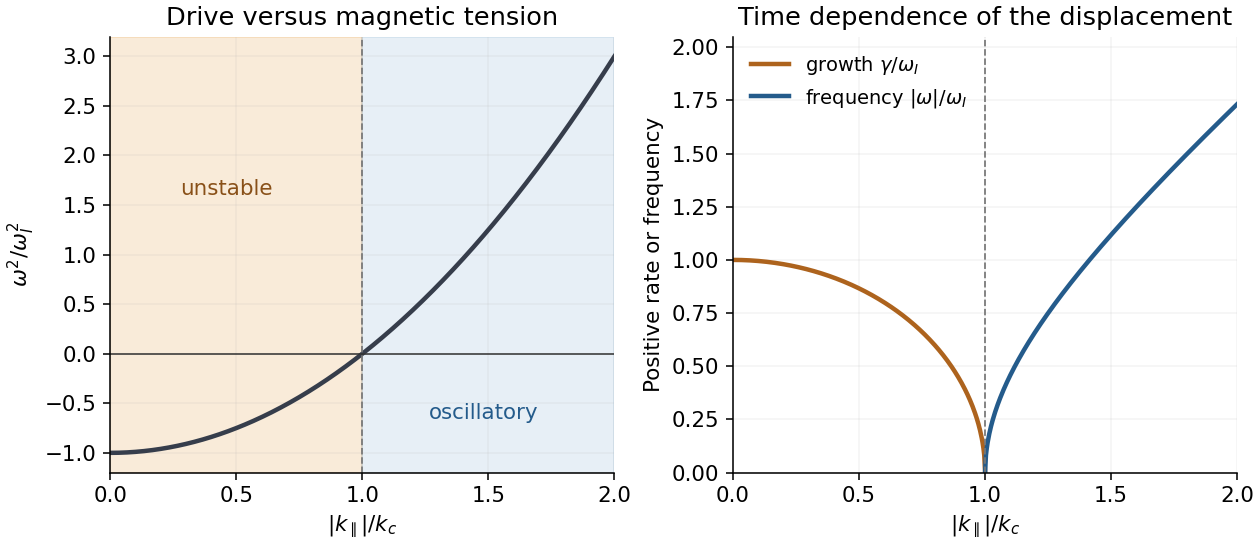
Magnetic tension stabilizes the local interchange instability above its critical parallel wavenumber
. Details. 
New to topics? Read the docs here!