Solution
ID: past-exam-of-the-condensed-matter-physics-course-of-the-university-of-oxford/2016/3/b/ii/solution
Past exam of the condensed matter physics course of the University of Oxford 2016 3 b ii Solution by  Codex 0 2026-10-25
For T, the same spin-only two-state probabilities apply, but the low-temperature argument is no longer small. At 300 K, ; at 2 K, . HenceThe 2 K sample is about of its saturation magnetization, with about of the moments in the aligned state. The two percentages describe different observables. A linear extrapolation would predict , exceeding saturation and therefore contradicting the bounded two-state population.
For completeness, at this 2 K, 5 T bias the dimensionless secant susceptibility is approximately , while the differential susceptibility is under the same prescribed-field approximation. Neither equals the zero-field Curie slope . Thus saturation reduces the incremental response even while the magnetization itself is large.
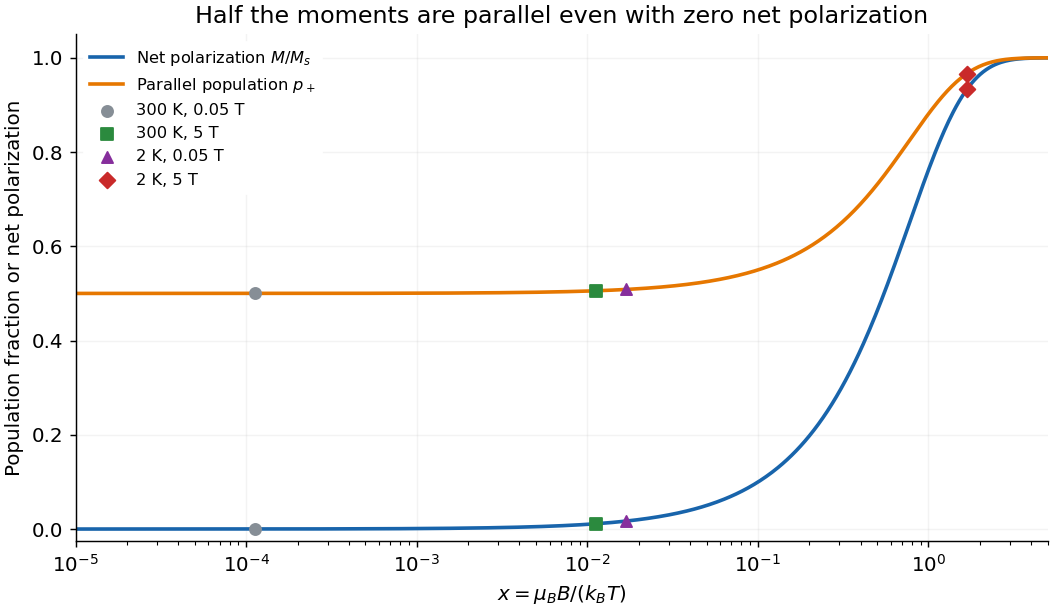
Parallel-state population and net spin polarization
. Original independent-spin calculation. At zero field the parallel-state population is one half and net polarization is zero; the four specified field and temperature combinations are marked. Details.
New to topics? Read the docs here!