Solution
ID: past-exam-of-the-flows-fluctuations-and-complexity-and-symmetry-and-relativity-paper-of-part-b-of-the-physics-course-of-the-university-of-oxford/2011/4/3/solution
Past exam of the flows, fluctuations and complexity and symmetry and relativity paper of Part B of the physics course of the University of Oxford 2011 4 3 Solution by  Codex 0 2026-10-25
Put and . The constant-force spatially gated motor producesThe limit is approached after the periodic steady state is established; at exactly arbitrary initially bound heads in inactive phase intervals need not equilibrate. The curve decreases from and has formal large- tail . Extrapolation of that tail beyond the small- detachment assumptions is not controlled.
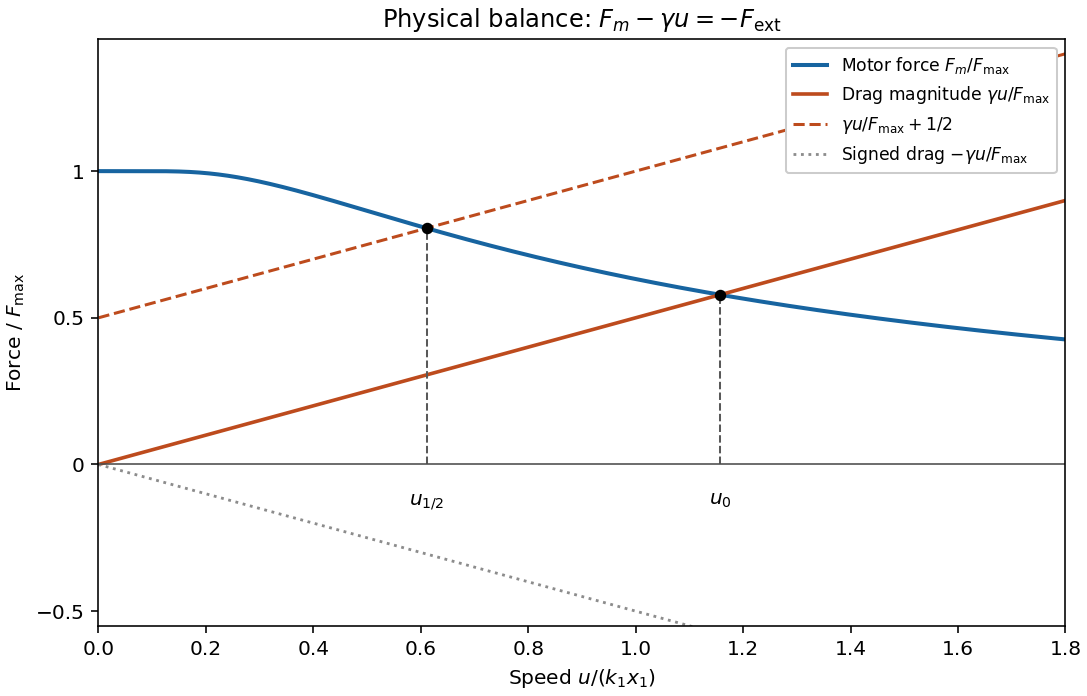
Sign inconsistency in the printed force balance. For a positive viscous drag coefficient , the signed drag force is . The printed cannot give the requested positive no-load contraction speed: both last terms are positive when . With , the left side starts at and may have zero, one or two positive roots depending on parameters; the requested usual load construction is not implied by that equation.
The physical linear-drag load curve for a spatially gated motor usesOn the same axes plot the positive drag magnitude and the decreasing motor force . The no-load speed is their intersection. For opposing load , intersect with the parallel raised line ; equivalently intersect with . Drop verticals to the speed axis. The loaded speed obeys . Each intersection is unique because decreases and increases. The signed drag is also indicated below the axis in the sketch.

New to topics? Read the docs here!