Solution
ID: past-exam-of-the-fluids-and-waves-course-of-the-university-of-oxford/2017/3/c/solution
Past exam of the fluids and waves course of the University of Oxford 2017 3 c Solution by  Codex 0 2026-10-31
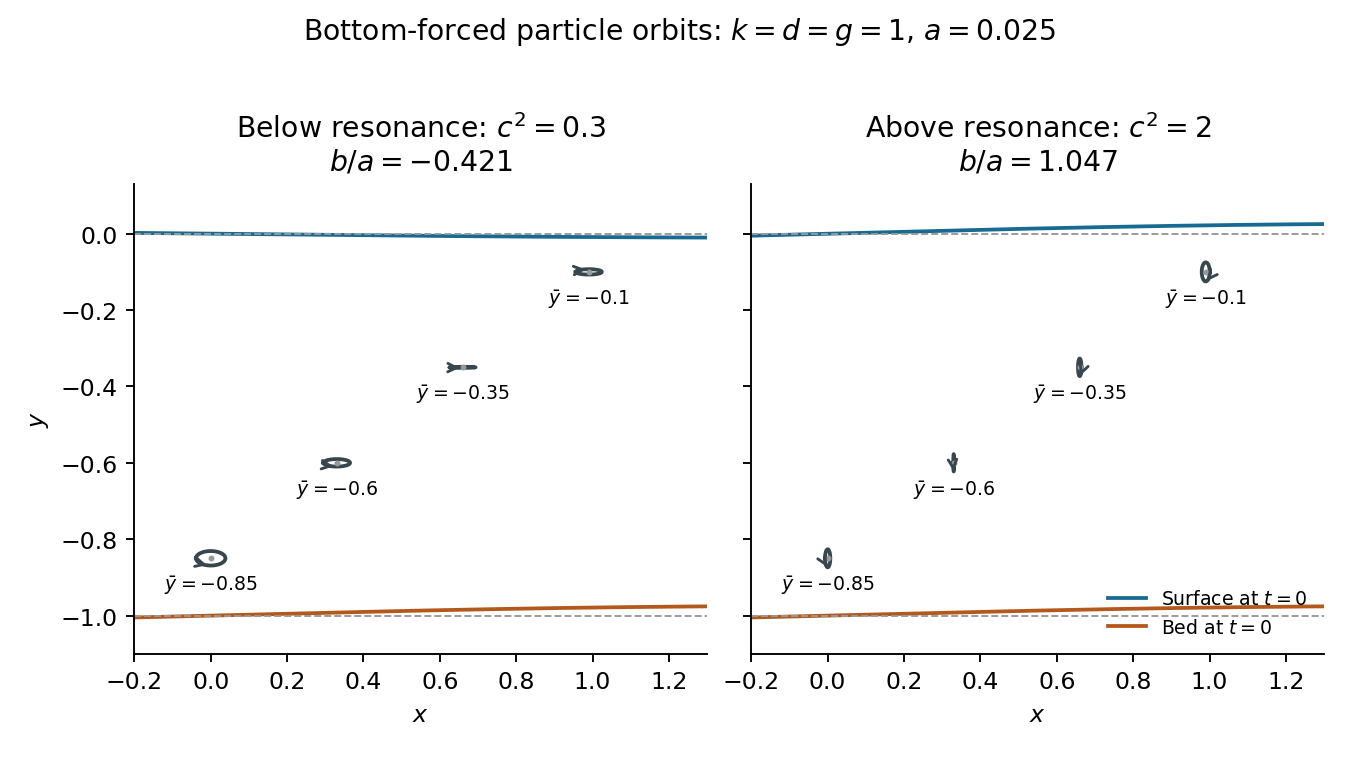
Consider the nonresonant traveling forced solution, with and . Put , , where is the mean position of a fluid element. At linear order, evaluate the velocity field at this mean position: substituting into its spatial arguments would change the already first-order velocity only at second order. With , differentiation of the velocity potential givesSince , integration, with zero mean displacements, yieldsIf both coefficients are nonzero, eliminating the wave phase proves that the pathline is an ellipse:Its principal axes of an ellipse are horizontal and vertical, with respective semi-axesThus the full axis lengths are and . The signed coefficients also determine the direction of traversal. The useful checks and reproduce the vertical displacements of the free surface and bottom.
To identify the major axis without comparing the two expressions separately, use :Consequently the major axis is horizontal if and vertical if ; equality gives circles. If or vanishes at a particular depth, the first-order orbit degenerates to a line segment. These are linearized particle orbits of a bottom-forced gravity wave, not exact closed trajectories at all orders: a higher-order calculation may introduce a mean drift.

New to topics? Read the docs here!