Solution
ID: past-exam-of-the-frontiers-of-observational-astrophysics-course-of-the-university-of-cambridge/2015/paper-1/3/a/solution
Past exam of the frontiers of Observational Astrophysics course of the University of Cambridge 2015 Paper 1 3 a Solution by  Codex 0 2026-10-20
Stellar reflex motion. A planet and its host orbit their common barycentre. The star's line-of-sight velocity shifts its absorption lines by at low speeds. A time series can be fitted withHere is true anomaly, the argument of periastron and an arbitrary systemic velocity offset. At small companion mass and known stellar mass, the orbit supplies , not the true planet mass without an inclination constraint. Long monitoring helps distinguish a reproducible Keplerian signal from stellar oscillations, magnetic activity, spots and instrumental trends.
The Lick reference-cell implementation. Starlight passes through a temperature-controlled cell of molecular iodine before entering the Hamilton high-resolution echelle spectrograph. The cell imprints a dense pattern of reference absorption lines on the stellar spectrum, predominantly in the approximately – interval. These lines share the same exposure and downstream optical path as the stellar light. A calibrated high-resolution Fourier-transform iodine spectrum and an iodine-free stellar template allow the wavelength solution and instrumental line-spread function to be fitted along with the stellar Doppler shift. The method corrects shifts and line-shape changes that a separate calibration exposure would not necessarily follow.[ref]
Precision Radial Velocities with an Iodine Absorption Cell by Geoffrey W. Marcy and R. Paul Butler. Marcy and Butler (1992), sections 3–4, printed pages 271–274: Hamilton setup, iodine wavelength interval, templates and in-situ instrumental profile
A useful forward model for one short spectral segment isfollowed by pixel integration, continuum scaling and a fitted wavelength calibration. Here is the intrinsic stellar spectrum, the cell transmission and the instrumental line-spread function. The spectra multiply before convolution; simply dividing a recorded blended spectrum by the laboratory iodine spectrum is not equivalent to this model. The iodine pattern is stationary in the observatory frame while stellar lines move relative to it. Separate spectral segments accommodate wavelength dependence of the instrumental profile.
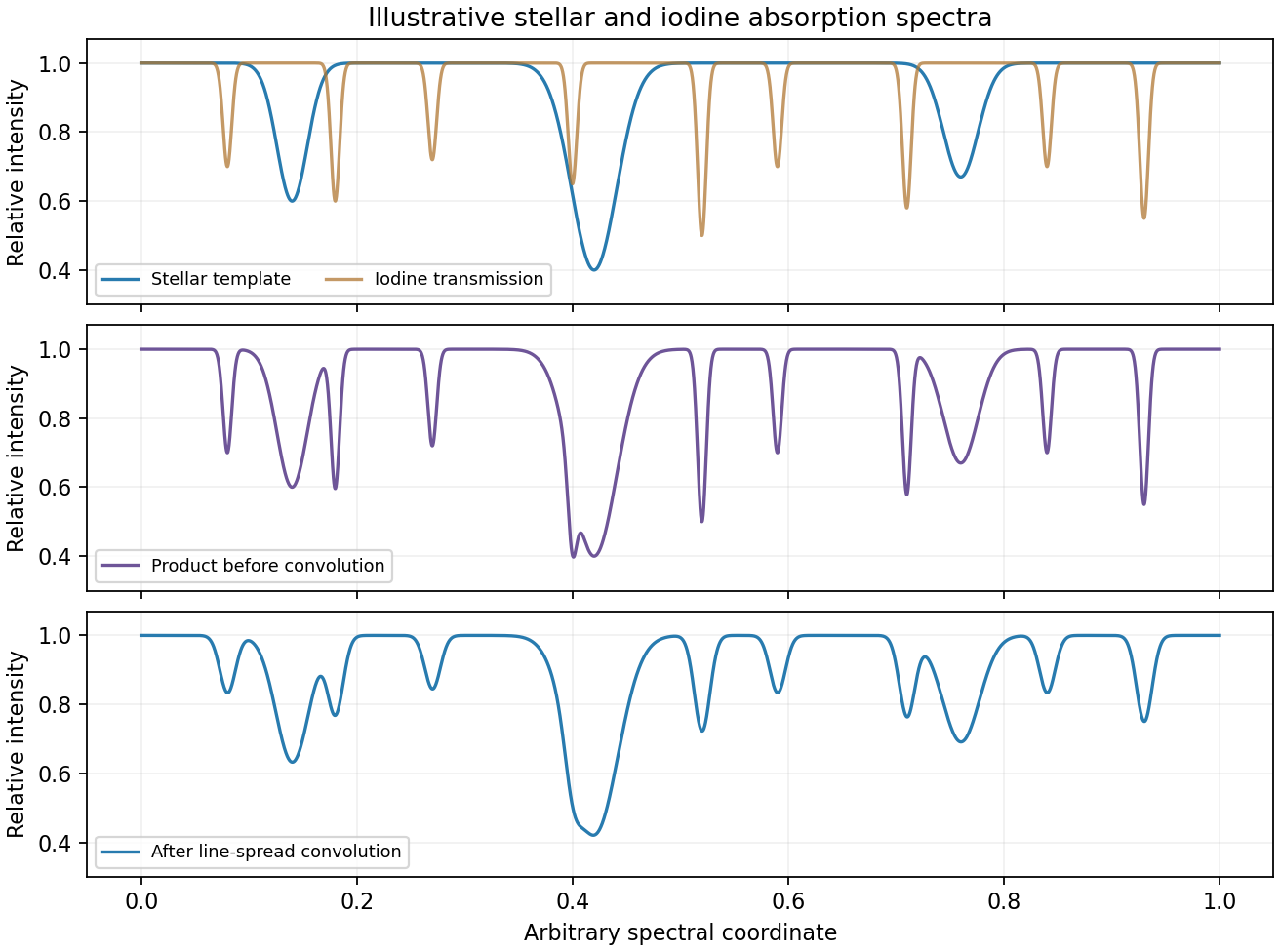
Original synthetic iodine-cell forward model showing multiplication before instrumental convolution; all line positions and strengths are illustrative
. Details. 
Earth's rotational and orbital velocities must then be removed with a barycentric correction using accurate timing, ideally weighted by photon arrival rate. Many stellar lines constrain a shift smaller than one instrumental resolution element; spectral resolution alone is not the velocity error. Photon statistics, template quality, instrumental-profile modelling and intrinsic stellar variability limit the precision. The method measures changes relative to a template and does not by itself provide a perfectly absolute centre-of-mass velocity. No particular discovery, modern precision floor or historical observing performance is assumed here.
New to topics? Read the docs here!