Solution
ID: past-exam-of-the-gauge-field-theory-course-of-the-university-of-cambridge/2012/paper-1/1/a/solution
Past exam of the gauge field theory course of the University of Cambridge 2012 Paper 1 1 a Solution by  Codex 0 2026-10-20
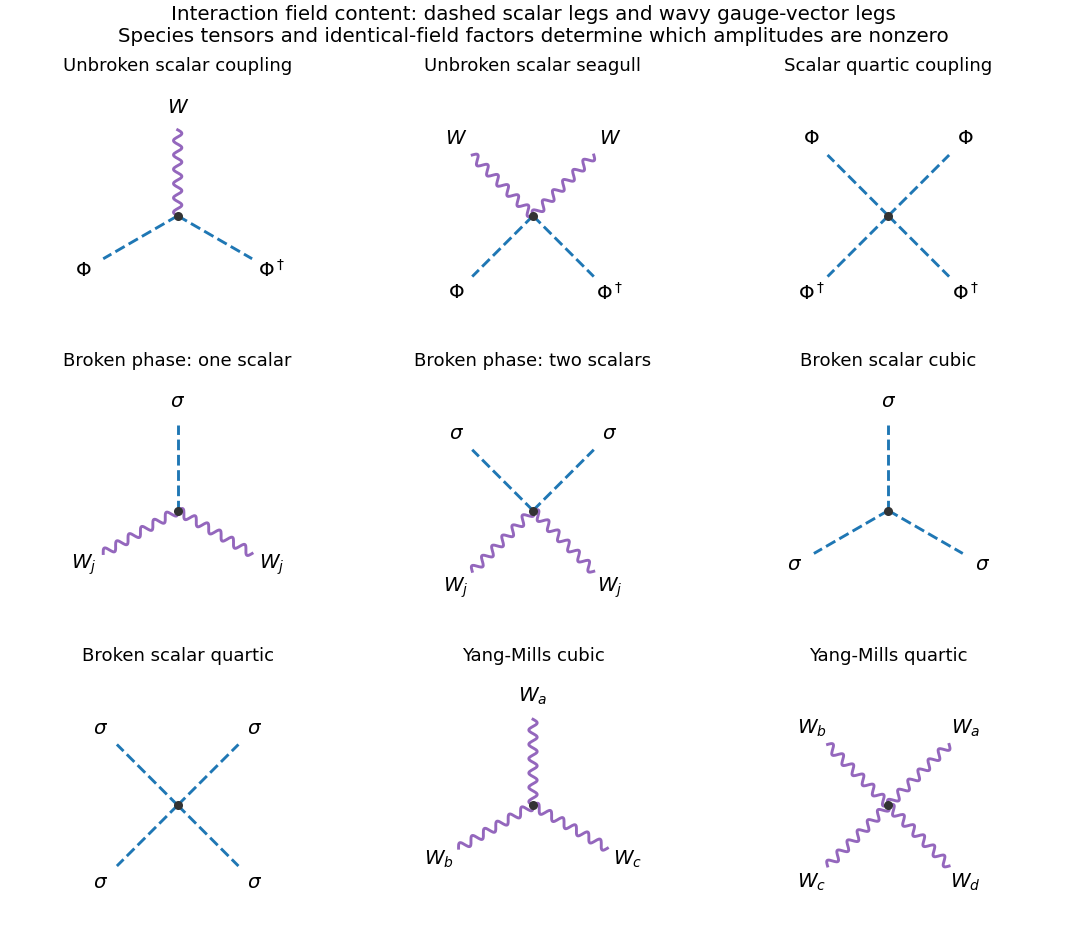
Assume so that the Higgs potential is bounded below, and work at tree level in four spacetime dimensions with metric . For , the minimum is . The quadratic terms describe three massless gauge bosons and two complex scalars of mass , equivalently four real scalar degrees of freedom. These are the perturbative particle masses about this vacuum, without a claim about the nonperturbative asymptotic spectrum of an interacting non-Abelian theory.
Expanding the gauge covariant derivative with gives the interaction termsIn the second term, the antisymmetric part of vanishes against the symmetric gauge-field product. The corresponding Feynman diagram vertices have one vector and a scalar–antiscalar pair, two vectors and a scalar–antiscalar pair, or four scalar legs with two particles and two antiparticles. The first vertex carries a momentum difference from its derivative. The Pauli matrix in it determines which doublet components couple; the two-vector scalar vertex is proportional to . There is no cubic scalar interaction about the zero-field vacuum.

New to topics? Read the docs here!