Solution
ID: past-exam-of-the-general-relativity-and-cosmology-course-of-the-university-of-oxford/2016/1/solution
Past exam of the general relativity and cosmology course of the University of Oxford 2016 1 Solution by  Codex 0 2026-10-25
Constants and radial motion. Write and . A Schwarzschild black hole has spherical symmetry, so its conserved angular momentum fixes an orbital plane through the centre. A rotation of the angular coordinates puts any nonradial orbit in the equatorial plane. A radial orbit can also be placed in such a plane. This is a choice of coordinates, not a restriction on the possible orbital inclinations.
The quadratic geodesic Lagrangian, with a dot denoting differentiation with respect to the satellite's proper time, isThe last equality is four-velocity normalization, imposed after deriving the Euler-Lagrange equations. The cyclic coordinates give independent conserved specific Killing energy and angular momentum:Here is the conserved energy per unit rest energy and has dimensions of angular momentum per unit mass. Substituting them in the normalization condition givesThe two signs of distinguish outgoing and ingoing branches; the expression must be nonnegative on the allowed radial interval.
For a nonradial orbit, put . Since , the radial equation becomesDifferentiating and extending continuously through isolated radial turning points givesA circular solution can equivalently be obtained directly from the radial geodesic equation, avoiding division by everywhere on that special orbit.
Circular launch and the station's clock. For the orbit equation givesThe static astronaut measures circumferential proper length and station proper time . Thus the Schwarzschild circular-orbit local speed and return time areThis is a local speed measured with the astronaut's clock, not the satellite's proper velocity . After one azimuthal revolution the circular satellite meets the fixed station again. For comparison, the satellite's own elapsed proper time would instead be .
A static station requires ; a timelike circular satellite requires , since the local circular speed must be below . The circular orbit is stable only for , marginal at , and unstable for . Thus a request for a robust near-circular trajectory implicitly needs more than merely placing the station outside the horizon.
Slightly changing the launch speed. In the stable, bound regime, a small tangential increase makes the launch point a pericentre; a small decrease makes it an apocentre, provided the perturbed orbit remains outside its plunge separatrix. In either case the orbit is a precessing rosette, not an exactly closed Newtonian ellipse. For an explicit first-order description write and . ThenThe tangential launch gives . At the station, , so and . ThereforeThis perturbative expression also requires the resulting radial excursion to be small compared with ; close to the innermost stable orbit, alone does not ensure that.
The Schwarzschild launch-orbit recurrence needs care when deciding whether a collision is inevitable. The satellite returns to radius once per radial cycle, after an azimuthal advance approximately . It returns to the station's exact point only if an integer number of radial cycles also gives an integer number of azimuthal revolutions. Rational gives an exact return; an irrational ratio gives arbitrarily close approaches but no exact post-launch return for ideal point objects. At , for example, the linearized ratio is , illustrating why precession alone does not prove an exact collision. For generic bound orbits the dense recurrence eventually threatens any station and satellite of nonzero size; a resonant closed rosette returns exactly. A small speed adjustment is therefore not a robust permanent collision-avoidance manoeuvre for a bound satellite.
There is no unconditional collision conclusion without specifying the regime. An unstable circular orbit cannot support the small bounded oscillations used above. In particular, near the circular specific energy is already ; a small positive speed increment can send the satellite outward on an unbound escape orbit, with no subsequent return to . Such an escape is a different way to avoid a future encounter. Radiation reaction and manoeuvres have been excluded throughout the ideal test-particle calculation.
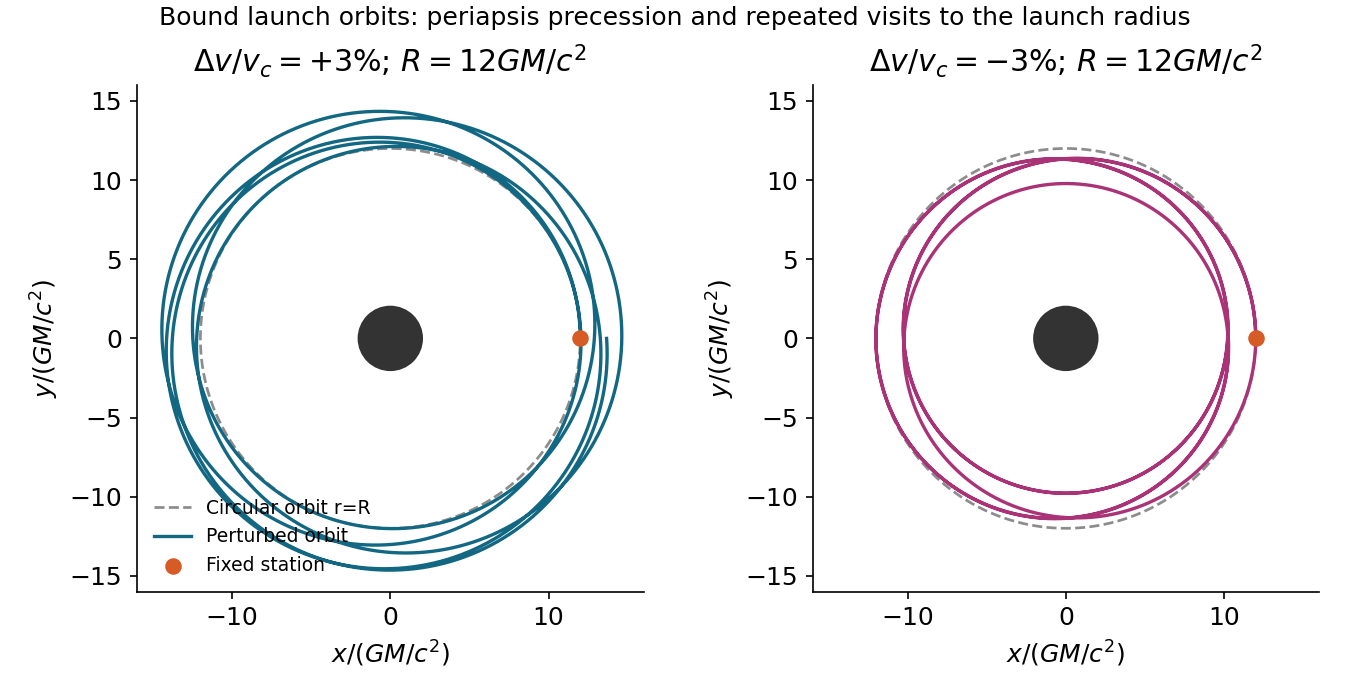
Bound Schwarzschild trajectories after small positive and negative tangential launch-speed changes
. Details. 
New to topics? Read the docs here!