Solution
ID: past-exam-of-the-general-relativity-and-cosmology-course-of-the-university-of-oxford/2017/3/c/solution
Past exam of the general relativity and cosmology course of the University of Oxford 2017 3 c Solution by  Codex 0 2026-10-25
Take the real physical wave and write . The specified amplitude has zero trace, so its metric perturbation equals its trace-reversed metric perturbation. It is in transverse-traceless gauge:to first order. Assume the freely falling particles are initially at rest in these coordinates. Since and in coordinates ,The geodesic equations therefore admitUniqueness preserves these initial conditions. Thus the coordinate locations remain fixed; this conclusion does not apply to arbitrary initially moving particles.
Coordinate position is not measured separation. In the central observer's local orthonormal frame in spacetime, and in the long-wavelength limit appropriate to a small detector, the transverse physical separations areto first order. In particular the two principal semiaxes of the ring areFor a point at angular position the radial displacement isThe freely falling ring in transverse-traceless gauge alternates between ellipses elongated in the and directions. Its area is unchanged to first order. This is the plus gravitational wave polarization; the axes exchange their roles after half a period.
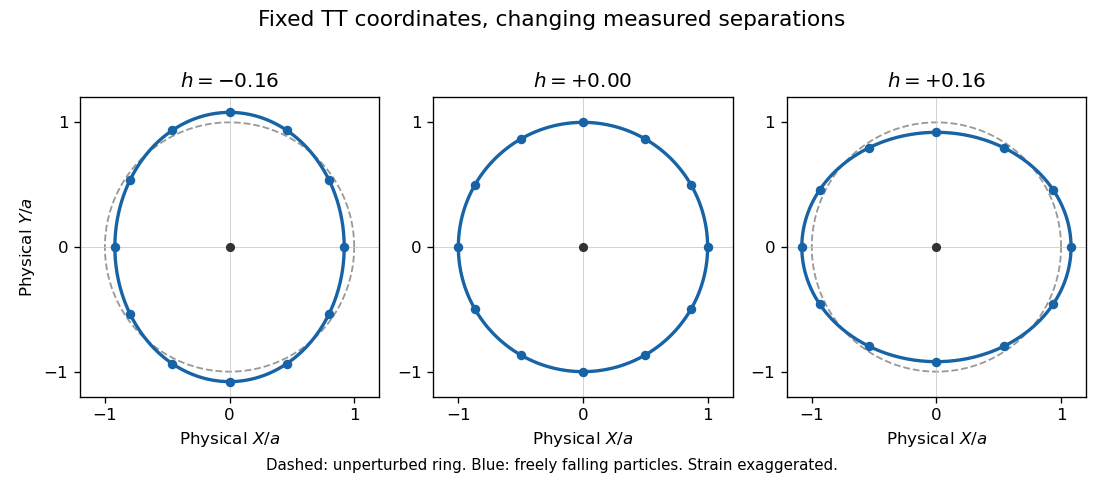

An observer at the center detects these changing distances, for example by exchanging light signals with the particles. Equivalently geodesic deviation gives the local tidal accelerationto the same order. There is physical relative motion and nonzero Riemann curvature tensor, even though the selected coordinate positions are constant. For a detector comparable to a wavelength, its light-travel-time response must be included rather than treating all distances as simultaneously measured local lengths.
New to topics? Read the docs here!