For a torsion-free connection, the commutator of coordinate covariant derivatives vanishes on a scalar field and acts on a vector field through the displayed Riemann curvature tensor. On a covector field it instead gives . The curvature commutator is a tensor derivation, so each index of a general tensor contributes independently with the corresponding sign. Including the lower derivative index in the second covariant derivative is essential for this identity.
For a vector field , the tensorial second derivative is . With and geometric torsion tensor , antisymmetrization givesThis follows by subtracting the two definitions and using . By contrast, the directional operator commutator subtracts no derivative-index connection and obeys . On scalars the directional commutator is , while the tensorial Hessian commutator is . Distinguishing these objects prevents an apparent contradiction when a scalar Hessian has an antisymmetric part despite commuting coordinate vector fields.
Definitions of the Riemann curvature tensor can differ by an overall sign, independent of the metric signature. Reversing that definition reverses the Ricci tensor, Ricci scalar and Einstein tensor, as well as the curvature side of the geodesic deviation identity and the Palatini identity. A derivation must choose the contraction and derivative ordering explicitly before combining formulas from different conventions. Changing a metric signature alone is a separate operation.
For a Levi-Civita connection, a contravariant rank-two tensor satisfies without itself being symmetric. The Ricci identity gives their difference as , which vanishes because the Ricci tensor is symmetric. Zero torsion alone for a general affine connection does not ensure this symmetry.
With convention , and , normal coordinates giveat their center. Symmetry of the metric and commutation of second derivatives prove pair exchange. The opposite curvature convention changes the formula's overall sign but preserves all these algebraic symmetries.
The first Bianchi identity follows by applying cyclic curvature commutators to the gradient of an arbitrary scalar field: its symmetric Hessian makes the third-derivative terms cancel, leaving . For the second Bianchi identity, write the vector-bundle derivative as , so . The operator Jacobi identity gives the cyclic sum of equal to zero. Restoring the connection terms on the two curvature-form indices gives precisely : the additional terms cancel because the connection is torsion-free and curvature is antisymmetric in its first pair.
For a torsion-free linear connection on a manifold, the commutator of two covariant derivatives obeys the tensor-product Leibniz rule: mixed first-derivative terms cancel after antisymmetrizing. It vanishes on scalar fields, so ; its action is therefore pointwise tensorial. Its vector action defines the Riemann curvature tensor. Applying the commutator to a scalar contraction proves that every covariant tensor index contributes minus the corresponding curvature action, while every contravariant index contributes plus. Torsion-free does not by itself imply metric compatibility.
In dimension three the Riemann curvature tensor is , where is the Schouten tensor. Consequently every three-dimensional Ricci-flat Riemannian manifold is a flat Riemannian manifold. The implication fails in higher dimensions.
The Kretschmann scalar is the scalar tensor contraction of two copies of the Riemann curvature tensor. In Schwarzschild spacetime, with metric coefficient and , it is . Divergence of this scalar along a curve approaching a proposed regular point proves that there is no twice continuously differentiable, nondegenerate metric extension through that point: such an extension would have continuous finite curvature components and hence a finite scalar contraction. This gives a coordinate-independent test of a curvature singularity. Boundedness of this single scalar does not prove regularity.
For a rank-two covariant tensor, the derivative commutator contributes one curvature action on each index:
For a family of affinely parametrized geodesics with tangent and connecting field , the Jacobi equation in the convention used here isIt describes the relative acceleration produced by spacetime curvature.
Here describes an infinitesimal separation and the covariant derivatives compare it in a frame transported along the reference geodesic. The Riemann curvature tensor thus becomes something measured with neighboring trajectories. The Newtonian version follows by differentiating gravitational acceleration with respect to position. In the exterior of a spherical mass, let be radial separation and separation in either transverse direction. Newton's law of universal gravitation givesThe upper particle falls less strongly than the lower one, stretching their radial separation; side-by-side particles accelerate toward converging radial directions, compressing their transverse separation. See Oregon State's derivation of tidal acceleration.
For a spherical Earth model with , and , a one-metre radial separation gives ; a one-metre transverse separation gives . Initially comoving particles therefore change separation after one second by approximately : micrometres radially or micrometres transversely. This short-time calculation holds the reference radius fixed to leading order. Its beauty is that common falling motion drops out, leaving a measurable stretching pattern that reveals curvature.
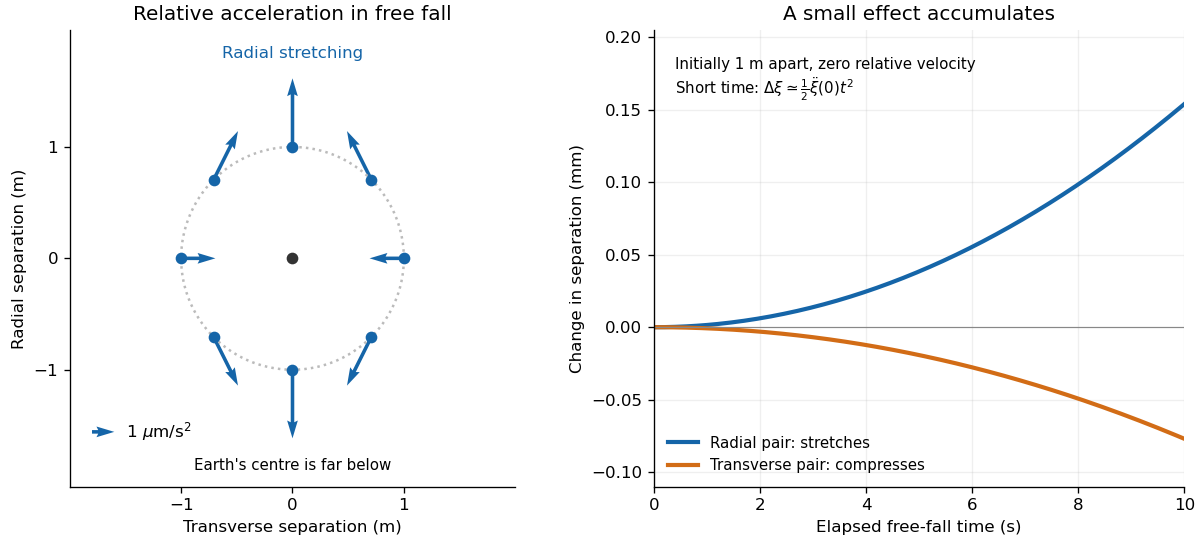
Radial stretching and transverse compression in a small freely falling laboratory near Earth's surface
. Details. The relative acceleration of neighboring freely falling bodies is measured by geodesic deviation, comparing their infinitesimal separation in a parallel transport frame along a reference timelike geodesic with tangent . With defined by the covariant derivative commutator, it has the displayed form. In the Newtonian limit the corresponding tidal tensor is the spatial gradient of the gravitational acceleration. A single freely falling body can remove local gravitational acceleration by its frame choice, whereas relative tidal acceleration measures curvature.
Use signature , and . For a weak stationary metric, the Christoffel symbol satisfies to first order. Differentiation gives the displayed Riemann curvature tensor component; products of connections are second order. For it is . Its radial eigenvalue is negative and its transverse eigenvalues positive, giving radial stretching and transverse compression in the geodesic deviation equation with a positive curvature term on the left.
The geodesic deviation equation makes the relative gravitational acceleration proportional to the separation and a typical Riemann curvature tensor component . Thus tidal acceleration vanishes as at fixed bounded curvature. A uniform electric field can give different accelerations at the same point, independently of separation. Relative tidal changes accumulated over a fixed long time need not vanish as a fraction of the initial separation; a local spacetime experiment must control its duration as well as its spatial size.
In constant sectional curvature , a deviation vector orthogonal to a unit timelike geodesic obeys , where . Therefore is constant, since its derivative is . Its squared length satisfies . In four spacetime dimensions, .
In a parallel-propagated orthonormal frame, orthogonal geodesic deviation in constant sectional curvature reduces to three scalar equations . For , : generic initial data grow exponentially, but the pure decaying mode is a counterexample to universal growth. Initially comoving neighbors have . For , , so the deviation is bounded and oscillatory. Simultaneous focusing requires compatible vector initial data and is not automatic for every oscillatory solution.
For a geodesic variation of unit timelike geodesics, proper time normalization holds across the entire variation: . Metric compatibility and then give . Consequently an initially orthogonal deviation vector stays orthogonal. The common normalization is essential: an arbitrary family of affinely parametrized curves with different tangent norms does not imply this conclusion.
A Jacobi field is the infinitesimal connecting vector between neighboring members of a one-parameter family of geodesics. It satisfies the geodesic-deviation equation along the reference geodesic.
For , every Jacobi field with is uniquely of the formDifferentiate the geodesic variation in to obtain the formula. Uniqueness of the Jacobi equation with prescribed initial value and derivative shows that all such fields are obtained. A nontrivial field vanishing at therefore corresponds to a nonzero vector in the kernel of , giving the conjugate point criterion.
For the Riemann curvature tensor convention , define . Curvature pair interchange makes this operator self-adjoint. If , then . The Jacobi field equation is . The operator is and is likewise self-adjoint; this sign distinction matters when testing curvature inequalities.
For a Lie group with a bi-invariant Riemannian metric, vary by conjugation: . Its Jacobi field is . If is central, all these fields vanish at both endpoints. Their space has dimension , since the kernel is the centralizer of an element of a Lie algebra.
In dimension , along a nonconstant geodesic, such a Jacobi field is determined injectively by , which lies in the -dimensional normal space. On the round unit sphere the geodesic from a point to its antipode, parametrized with speed on , has fields for all parallel normal fields , attaining the bound. For a constant geodesic the endpoint-vanishing Jacobi field space is zero.
Use the sequential convention and define by . The symmetric Hessian of a scalar field gives symmetry in , but the curvature commutator on a covariant tensor gives . Averaging the three distinct permutations yields . Thus a scalar's third covariant derivative is not generally totally symmetric.
For the Levi-Civita connection, the cyclic covariant derivative of curvature vanishes: . Contracting this identity gives the contracted Bianchi identity.
The Weyl tensor is the completely trace-free part of the Riemann curvature tensor. In four dimensions,
In four spacetime dimensions, relative to a timelike unit normal , define , with the chosen spacetime metric volume tensor. This is the dual tidal part of the Weyl tensor. Normal contractions vanish by curvature and volume-tensor antisymmetry. Its sign depends on the specified orientation and dualization convention.
Relative to a timelike unit normal , the electric part is . It describes the tidal component of the Weyl tensor measured by that observer. Antisymmetry in each curvature pair makes it spatial in both slots; pair symmetry and vanishing traces make it symmetric and trace-free.
Every contraction of the Weyl tensor vanishes. Contracting its first and third indices directly cancels the Ricci and scalar-curvature terms; antisymmetry in each pair and symmetry under exchanging the two pairs reduce all other contractions to this one or make them vanish immediately.
Every conformally flat metric in dimension at least four has identically zero Weyl tensor. The Weyl tensor is the obstruction to local conformal flatness in dimensions at least four.
For dimension , the Schouten tensor packages the Ricci tensor and scalar curvature in the trace part of the Riemann curvature tensor. In dimension three it is , and the full Riemann curvature tensor is reconstructed from it.
The algebraic symmetries of the Riemann curvature tensor leave only one independent curvature component in two dimensions and forceConsequently the Einstein tensor vanishes identically.
With no cosmological term, the two-dimensional Einstein field equations reduce identically on the geometric side to . They impose and supply no local metric dynamics; the Einstein-Hilbert action is topological.
For the Levi-Civita connection, the second Bianchi identity gives . Applying another covariant derivative and the contracted Bianchi identity reduces its divergence to a commuting scalar Hessian plus curvature commutators on the Ricci tensor. The latter are the difference of symmetric tensors: a square of the Ricci tensor and , which is symmetric in by curvature pair exchange and Ricci symmetry. Both differences vanish. This identity does not require vacuum field equations and is independent of the overall curvature sign convention.
The Einstein tensor isThe contracted Bianchi identity and metric compatibility give
, ensuring compatibility of the Einstein equations with covariant stress-energy conservation.
, ensuring compatibility of the Einstein equations with covariant stress-energy conservation.
For , the nonzero connection coefficients areWith and
, direct substitution into the mixed-tensor covariant derivative gives zero.
, direct substitution into the mixed-tensor covariant derivative gives zero.
The vacuum equation with positive cosmological constant gives
. Its expanding flat-slicing solution is
. Its expanding flat-slicing solution is
In a spatially flat universe dominated by a positive constant energy density , the Friedmann equations give . On the expanding branch , so the scale factor doubles after . This concerns a linear length scale; the enclosed physical volume grows by a factor of eight over the same interval.
A pseudo-Riemannian manifold has constant sectional curvature when . In dimension , its Ricci tensor and scalar are and .
In dimension greater than two, if sectional curvature is pointwise independent of the two-plane, the contracted Bianchi identity forces that curvature to be constant on each connected component.
The positive-definite specialization is Schur's lemma.
In a Ricci-flat spacetime, the Penrose wave equation is a nonlinear covariant wave equation for the Riemann tensor. Its principal part is and its lower-order terms are quadratic contractions of curvature.
Articles by others on the same topic


The Riemann curvature tensor is a fundamental object in differential geometry and mathematical physics that measures the intrinsic curvature of a Riemannian manifold. It provides a way to describe how the geometry of a manifold is affected by its curvature. Specifically, it captures how much the geometry deviates from being flat, which corresponds to the geometry of Euclidean space.