For a family of affinely parametrized geodesics with tangent and connecting field , the Jacobi equation in the convention used here isIt describes the relative acceleration produced by spacetime curvature.
Here describes an infinitesimal separation and the covariant derivatives compare it in a frame transported along the reference geodesic. The Riemann curvature tensor thus becomes something measured with neighboring trajectories. The Newtonian version follows by differentiating gravitational acceleration with respect to position. In the exterior of a spherical mass, let be radial separation and separation in either transverse direction. Newton's law of universal gravitation givesThe upper particle falls less strongly than the lower one, stretching their radial separation; side-by-side particles accelerate toward converging radial directions, compressing their transverse separation. See Oregon State's derivation of tidal acceleration.
For a spherical Earth model with , and , a one-metre radial separation gives ; a one-metre transverse separation gives . Initially comoving particles therefore change separation after one second by approximately : micrometres radially or micrometres transversely. This short-time calculation holds the reference radius fixed to leading order. Its beauty is that common falling motion drops out, leaving a measurable stretching pattern that reveals curvature.
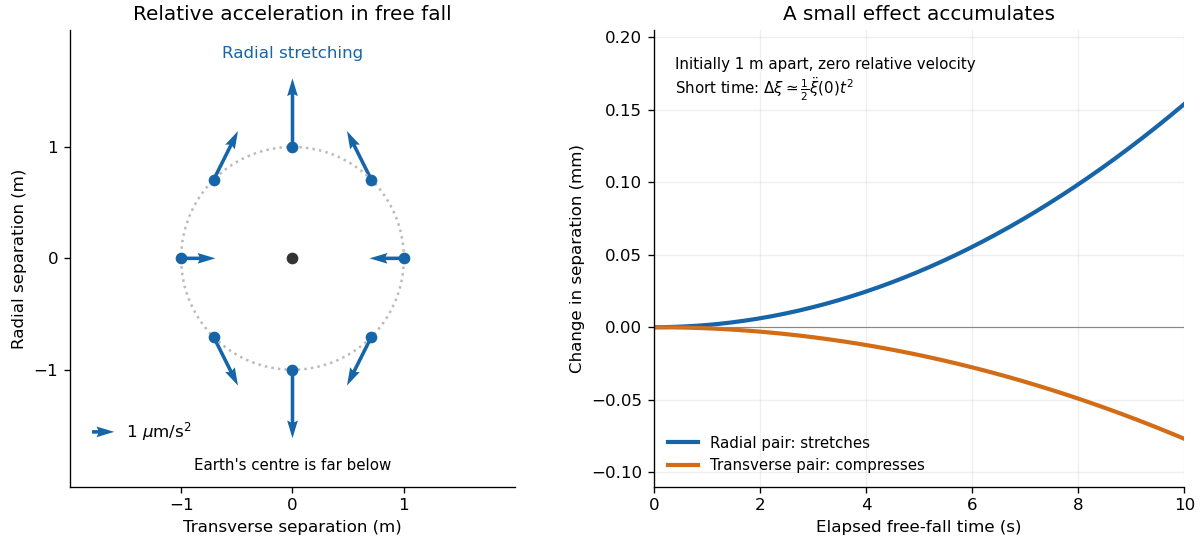
Radial stretching and transverse compression in a small freely falling laboratory near Earth's surface
. Details. The geodesic deviation equation makes the relative gravitational acceleration proportional to the separation and a typical Riemann curvature tensor component . Thus tidal acceleration vanishes as at fixed bounded curvature. A uniform electric field can give different accelerations at the same point, independently of separation. Relative tidal changes accumulated over a fixed long time need not vanish as a fraction of the initial separation; a local spacetime experiment must control its duration as well as its spatial size.
In constant sectional curvature , a deviation vector orthogonal to a unit timelike geodesic obeys , where . Therefore is constant, since its derivative is . Its squared length satisfies . In four spacetime dimensions, .
In a parallel-propagated orthonormal frame, orthogonal geodesic deviation in constant sectional curvature reduces to three scalar equations . For , : generic initial data grow exponentially, but the pure decaying mode is a counterexample to universal growth. Initially comoving neighbors have . For , , so the deviation is bounded and oscillatory. Simultaneous focusing requires compatible vector initial data and is not automatic for every oscillatory solution.
For a geodesic variation of unit timelike geodesics, proper time normalization holds across the entire variation: . Metric compatibility and then give . Consequently an initially orthogonal deviation vector stays orthogonal. The common normalization is essential: an arbitrary family of affinely parametrized curves with different tangent norms does not imply this conclusion.
A Jacobi field is the infinitesimal connecting vector between neighboring members of a one-parameter family of geodesics. It satisfies the geodesic-deviation equation along the reference geodesic.
For , every Jacobi field with is uniquely of the formDifferentiate the geodesic variation in to obtain the formula. Uniqueness of the Jacobi equation with prescribed initial value and derivative shows that all such fields are obtained. A nontrivial field vanishing at therefore corresponds to a nonzero vector in the kernel of , giving the conjugate point criterion.
For the Riemann curvature tensor convention , define . Curvature pair interchange makes this operator self-adjoint. If , then . The Jacobi field equation is . The operator is and is likewise self-adjoint; this sign distinction matters when testing curvature inequalities.
For a Lie group with a bi-invariant Riemannian metric, vary by conjugation: . Its Jacobi field is . If is central, all these fields vanish at both endpoints. Their space has dimension , since the kernel is the centralizer of an element of a Lie algebra.
In dimension , along a nonconstant geodesic, such a Jacobi field is determined injectively by , which lies in the -dimensional normal space. On the round unit sphere the geodesic from a point to its antipode, parametrized with speed on , has fields for all parallel normal fields , attaining the bound. For a constant geodesic the endpoint-vanishing Jacobi field space is zero.
Articles by others on the same topic


Geodesic deviation refers to the phenomenon in general relativity that describes how nearby geodesics—paths followed by free-falling particles—diverge or converge due to the curvature of spacetime. In a curved spacetime, even if an object starts out on a geodesic (which is the generalization of a straight line in curved space), the path of that object may not remain parallel to the path of a nearby object over time.