Solution
ID: past-exam-of-the-introduction-to-schemes-course-of-the-university-of-oxford/2021/1/c/solution
Past exam of the introduction to schemes course of the University of Oxford 2021 1 c Solution by  Codex 0 2026-10-25
The immersions and gluing. For , the prime ideals of the localization are and . Inverting gives , sois an open immersion sending the generic point to the generic point. For , , and take to be the identity. Identify each pair of these open subschemes using the identity of . The identities compose to the identity on every triple overlap, so gluing of schemes along open subschemes applies. No finiteness of the family is required.
The resulting scheme has one common generic point and a distinct closed point for every positive prime number . Its affine open subschemes , for , intersect pairwise in . A subset is open precisely when its intersection with every is open. In the two-point topological space , the open subsets are , and . Consequentlywhere is any subset of the positive prime numbers, including the empty subset.
The canonical morphism. The ring homomorphisms give morphisms of schemes agreeing on the overlaps, hence a morphism of schemes . By uniqueness of the structure morphism, this is the required map. Contraction of prime ideals givesThese are all points of , each exactly once, so is a bijection. It is continuous because its restrictions to the open cover are continuous; explicitly, every nonempty open subset of is the complement of a finite collection of closed points, whose inverse image is one of the .
Sections on every open. For any , the sheaf gluing axiom on the cover of by and the with identifieswhere the intersection over the empty set is . Indeed, a section on is an element of ; restrictions to every overlap are its inclusion into . Compatibility means that all these elements are the same rational number. In lowest terms , this rational number lies in the intersection exactly when no prime number in divides . Equivalently, this is the integer localization at a set of primes obtained by inverting all positive prime numbers outside .
Now let be nonempty and open. Its finite complement consists of ; put , with for an empty complement. Then andThe equality follows by the denominator criterion above. The map is this same equality of subrings of , so it is a ring isomorphism. Over the empty open subset both rings of sections are the zero ring. These identifications respect every restriction map. Thus the precise comparison of structure sheaves isHere “over every open set” refers to an open subset of the target and its inverse image. The preceding intersection formula additionally describes the sections on every open subset of , including ones whose images are not open in the target.
Topology and finiteness. The singleton is open in , but is not open in : a nonempty open subset there contains all but finitely many of the infinitely many closed points. Therefore is not a homeomorphism, despite being a continuous bijection and giving the indicated isomorphism of structure sheaves after direct image.
The open cover of has no finite subcover, because belongs only to . Thus is not a quasi-compact scheme, and part (a) rules out an affine scheme. Each is a Noetherian ring, being a localization of the Noetherian ring . Hence the form an affine open cover by spectra of Noetherian rings, proving that is a locally Noetherian scheme. A Noetherian scheme is a quasi-compact scheme, so
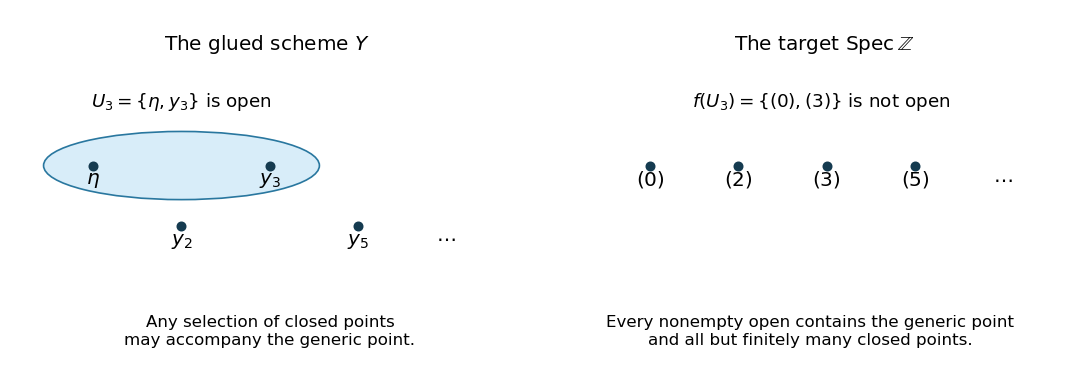
Gluing the local spectra retains every closed point but permits more open subsets
. Details. 
New to topics? Read the docs here!