Solution
ID: past-exam-of-the-mathematical-methods-ii-course-of-the-university-of-oxford/2018/8/solution
Past exam of the mathematical methods II course of the University of Oxford 2018 8 Solution by  Codex 0 2026-10-25
The gradient is , so the real stationary points are and . The Hessian matrix is diagonal, with entries and . At the origin it has opposite-sign eigenvalues, giving a saddle point. At each of the other two stationary points it is negative definite, giving strict maxima of value . These are also the global maxima, sinceThere are no local minima, and the function is unbounded below. The zero contour has two lobes touching at the saddle; positive contours are closed curves around the maxima.
Under the stated change of variables,Inside the resulting circular cap the constraint is automatic. Comparing its circle and horizontal boundary givesHere is the positive half-width used in the source figure, independent of the pulse-height notation in the preceding question. The Jacobian determinant is in the chosen quadrant, so the integral is one-quarter of the circular segment area:
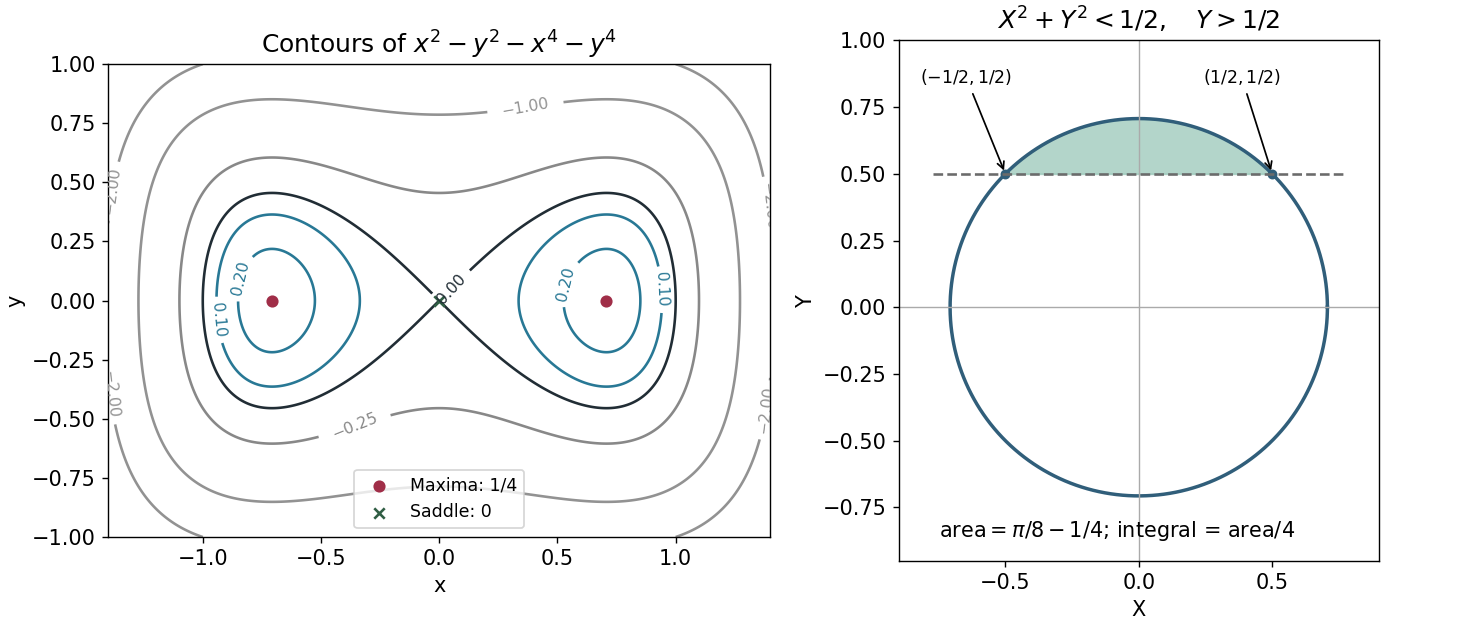
The contours, maxima and saddle, and the circular cap produced by the change of variables
. Details. 
New to topics? Read the docs here!