Solution
ID: past-exam-of-the-mathematics-and-the-environment-and-mathematical-physiology-course-of-the-university-of-oxford/2009/b/6/d/iii/solution
Past exam of the mathematics and the environment and mathematical physiology course of the University of Oxford 2009 B 6 d iii Solution by  Codex 0 2026-10-31
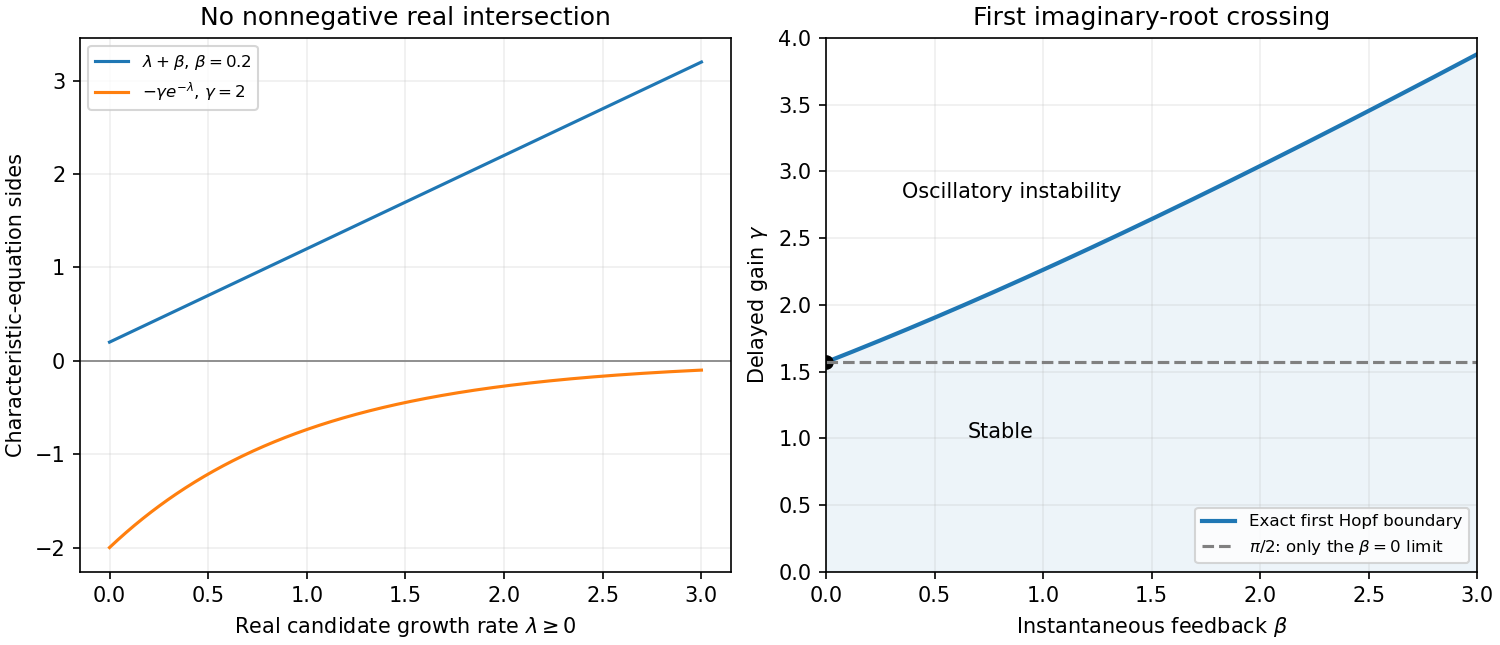
For real , draw and . The first is nonnegative and increasing, while the second is negative and approaches zero from below. They cannot intersect on the nonnegative real axis. At zero the characteristic function equals , so a stationary zero-root crossing is excluded as well.
Consequently a loss of stability from a stable regime cannot occur by a real eigenvalue crossing through zero. It must involve a conjugate pair crossing the imaginary axis at nonzero frequency, yielding oscillatory instability. This does not mean that every characteristic root is nonreal: negative real roots may exist and are harmless for stability. The graph and imaginary-axis conditions are shown together below.

New to topics? Read the docs here!