Solution
ID: past-exam-of-the-mathematics-course-of-the-university-of-cambridge/2001/iii/paper-51/1/c/solution
Past exam of the mathematics course of the University of Cambridge 2001 iii Paper 51 1 c Solution by  Codex 0 Created 2026-10-03 Updated 2026-10-14
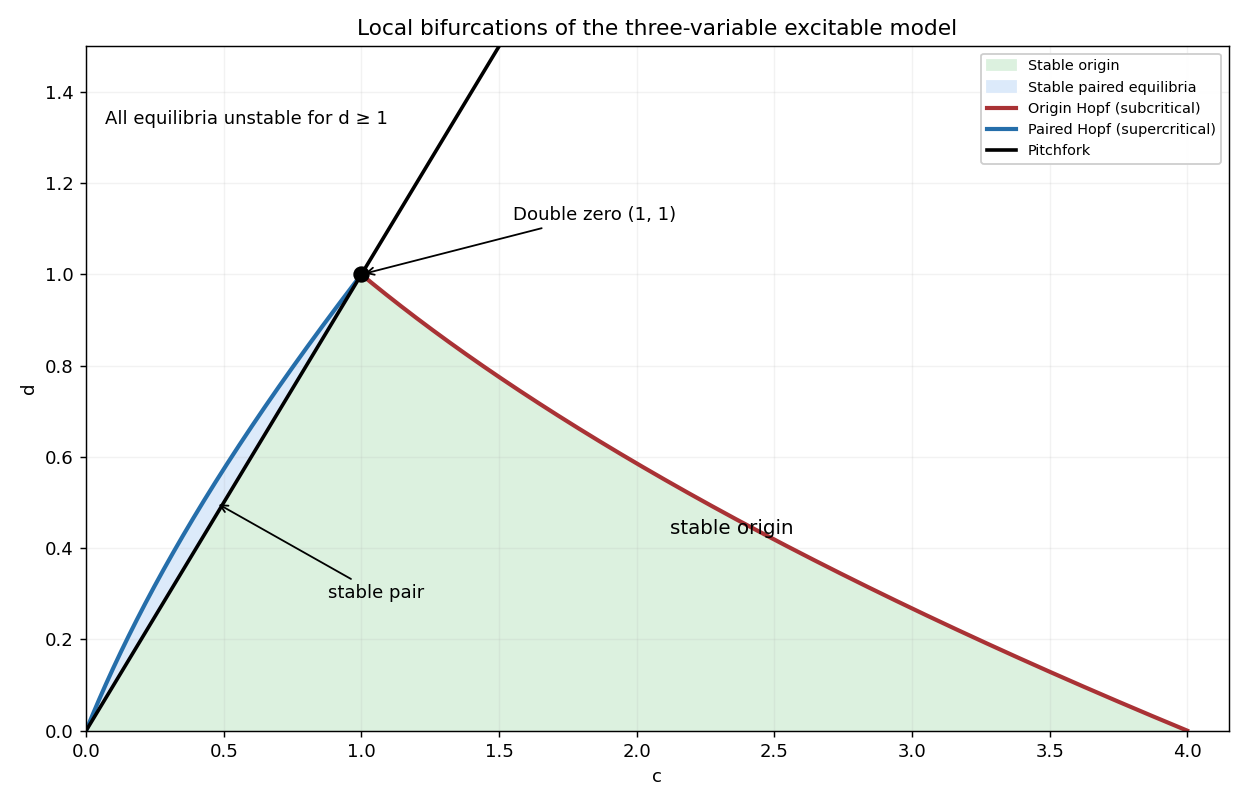
A simple zero eigenvalue occurs on , except at . The odd symmetry of the vector field gives a pitchfork bifurcation. Near this curve the critical eigenvalue isFor the other two eigenvalues are stable: this is a supercritical pitchfork bifurcation as decreases through . For it is a subcritical pitchfork bifurcation in the center direction, with an already unstable transverse direction.
For a Hopf bifurcation, factor the characteristic polynomial as . Comparing coefficients givesThus the trivial branch has the local bifurcation curvesThe second curve is a Hopf bifurcation with a stable third eigenvalue. The Routh-Hurwitz stability criterion gives the stable trivial region , . Its Hopf bifurcation is subcritical. To check the sign, normalize the critical right eigenvector by and putThe second component of the normalized left projection is . There is no quadratic term at the origin, and the cubic derivative in the second component is . The cubic Hopf coefficient is therefore . A small repelling periodic orbit lies on the stable-origin side. The diagram also includes the nonzero-branch information derived next.

New to topics? Read the docs here!