Solution
ID: past-exam-of-the-mathematics-course-of-the-university-of-cambridge/2001/iii/paper-53/2/a/solution
Past exam of the mathematics course of the University of Cambridge 2001 iii Paper 53 2 a Solution by  Codex 0 Created 2026-10-03 Updated 2026-10-14
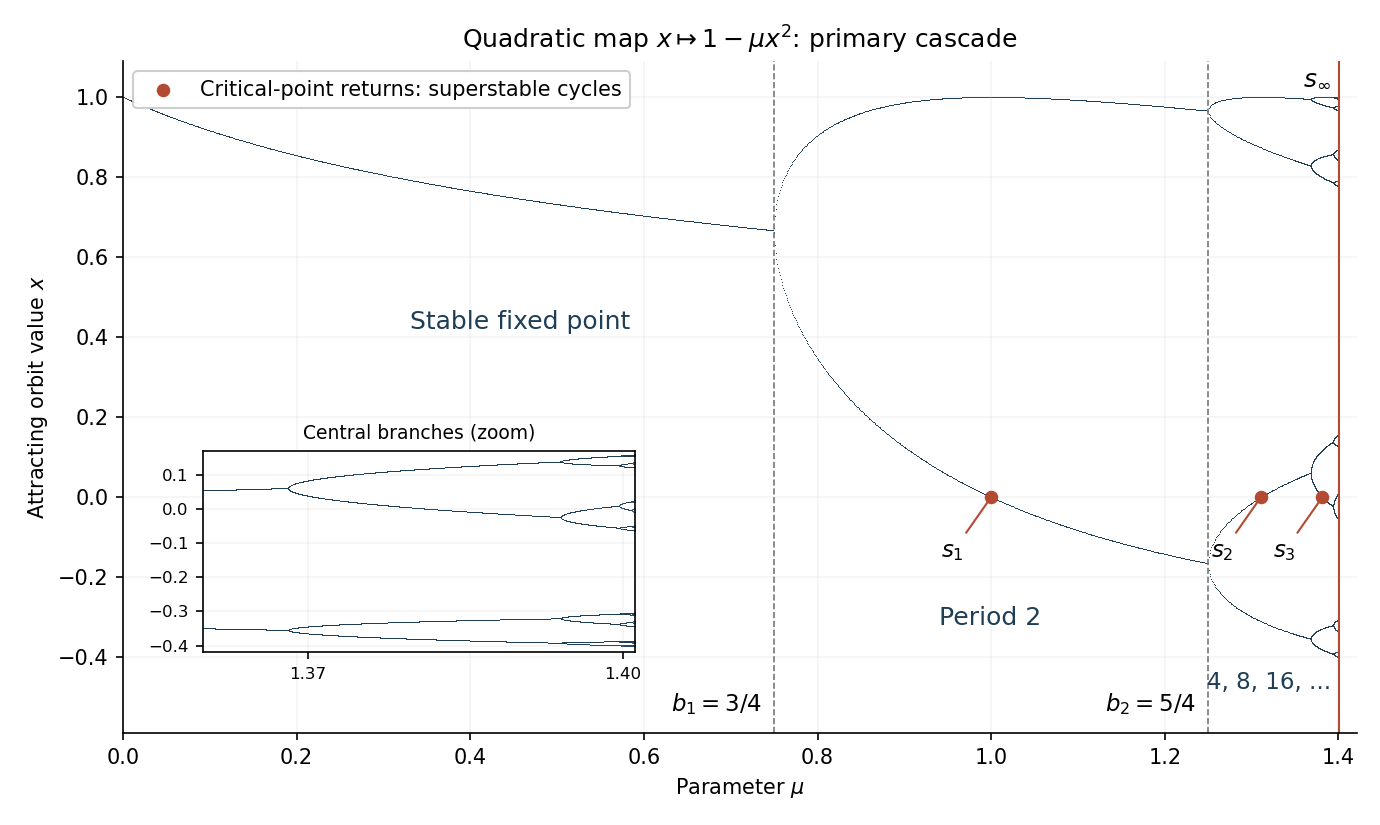
For the quadratic unimodal map, an attracting fixed point lies on the positive branchIts multiplier has modulus less than one for and reaches at the first period-doubling bifurcation . The resulting two-cycle has pointsIts periodic-orbit multiplier is , so it is attracting for and doubles at . Successive attracting periods are , with their parameter intervals shrinking toward .
A superstable periodic orbit contains the critical point zero, so its derivative product vanishes. Along the first period-doubling cascade, is the first-cascade parameter with a critical orbit of exact period , satisfying . For example, , , and . These are interior points of stability intervals, distinct from the bifurcation parameters .
The following bifurcation diagram shows attracting orbit values, including the first bifurcations and superstable points. At the accumulation parameter the limiting critical orbit is not a finite attracting cycle; its closure is the period-doubling limit set.

The Feigenbaum constants use the positive spatial-scaling convention. Their parameter definition isThe same limit is obtained from successive bifurcation parameters. To define spatial scaling without ambiguity about signs, letThis is the signed central return separation in the superstable orbit; its sign alternates between successive levels of the primary cascade. ThenEquivalently, the ratio of the corresponding unsigned separations tends to . Some conventions call the signed ratio itself ; here the spatial scale of the Feigenbaum renormalization fixed point is , matching the orientation reversal in the doubling operator.
New to topics? Read the docs here!