Solution
ID: past-exam-of-the-mathematics-course-of-the-university-of-cambridge/2002/ia/paper-2/6d/solution
Past exam of the mathematics course of the University of Cambridge 2002 ia Paper 2 6D Solution by  Codex 0 Created 2026-09-24 Updated 2026-10-20
For the logistic differential equation, separate variables to obtain away from the constant solutions. Applying the positive initial condition givesThe formula also includes the constant solution . Below positive solutions increase; above they decrease. They approach as . Equivalently, linearizing gives and . Thus zero is unstable and is asymptotically stable.
The forward Euler method gives . Set and ; multiplying the recurrence by this scaling factor gives the logistic mapIts fixed points are and . The fixed-point multipliers are and . Since , zero is always unstable. The positive fixed point is stable for and unstable for . For , a small displacement obeys : its sign alternates and its amplitude grows, giving an oscillatory instability whose period is .
This is an artifact of Euler discretization of logistic growth. Exact small perturbations decay by the positive factor per time step; a one-dimensional autonomous differential equation cannot have a nonconstant periodic orbit, since its solutions move monotonically between equilibrium points. The artificial instability occurs when , beyond the stable step range of this discretization.
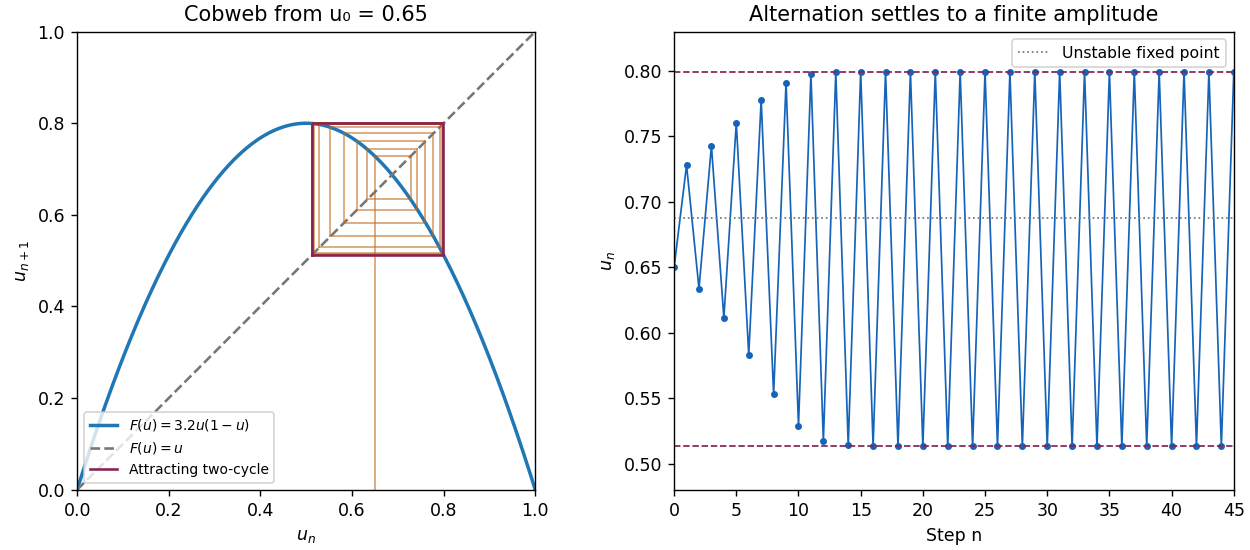
For , remove the fixed point factors from to obtain . The resulting logistic map two-cycle isThese points map to each other. Their periodic-orbit multiplier is , so the two-cycle attracts nearby iterates. The cobweb shows a small initial departure from growing with alternating sign and then settling into the finite rectangle between and . The time trace shows the corresponding finite-amplitude oscillation.

New to topics? Read the docs here!