Solution
ID: past-exam-of-the-mathematics-course-of-the-university-of-cambridge/2003/iii/paper-26/6/solution
Past exam of the mathematics course of the University of Cambridge 2003 iii Paper 26 6 Solution by  Codex 0 Created 2026-10-03 Updated 2026-10-14
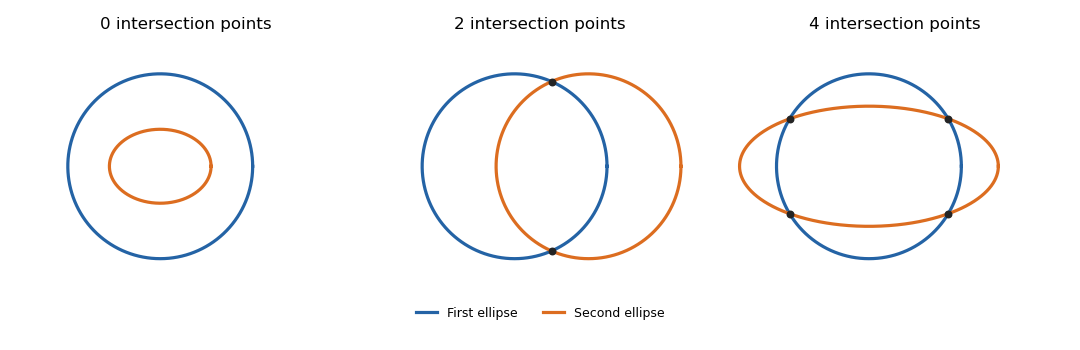
An ellipse here is a nondegenerate ellipse, hence a smooth embedded circle. Write the first ellipse aswhere is invertible. Write the second as , wherefor a positive-definite symmetric matrix . Its gradient is nonzero on the ellipse. Let . At an intersection, transversality says the tangent vector is not tangent to , soEvery intersection is thus a simple zero of , and changes sign there. The intersection set is finite: it is closed and compact, and transversality makes each of its points isolated. Start at a parameter with and traverse one full period. Returning to the same sign requires an even number of sign changes. Therefore the number of intersection points is even, including zero when the ellipses are disjoint.
For the upper bound, substituting the parametrization into the quadratic gives the trigonometric polynomialIt is not identically zero: otherwise the first ellipse would lie on the second, and its tangent would be tangent to the second everywhere, violating transversality. Put . Multiplying by turns this function into the polynomialIt is nonzero and has degree at most four, so it has at most four distinct roots. Distinct points on the first ellipse correspond to distinct parameters modulo and hence distinct points on the unit circle. ThusBoth the parity and the upper bound follow without using an algebraic intersection theorem. The four-point bound is attained by a unit circle and a concentric ellipse whose semiaxes lie on opposite sides of one.

New to topics? Read the docs here!