Solution
ID: past-exam-of-the-mathematics-course-of-the-university-of-cambridge/2004/ia/paper-2/7b/ii/solution
Past exam of the mathematics course of the University of Cambridge 2004 ia Paper 2 7B ii Solution by  Codex 0 Created 2026-09-24 Updated 2026-10-14
For both parameters the autonomous planar system is , . It has the conserved energyIndeed . At any equilibrium point the eigenvalues satisfy
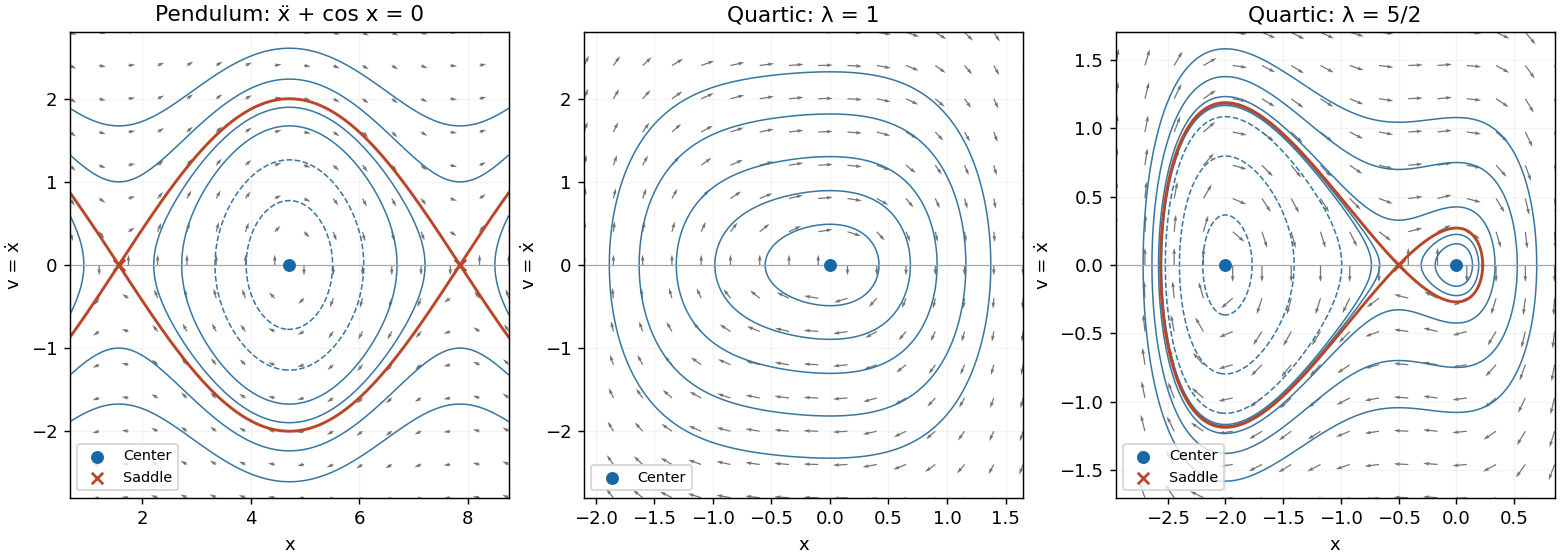
For , the quadratic is strictly positive, so the only equilibrium point is , with eigenvalues . Since has the sign of , has a unique strict minimum at zero and tends to infinity in both directions. All positive energy levels are closed curves surrounding this stable center equilibrium. They are clockwise: rightward when and leftward when .
For , factor . The three equilibrium points and their classifications areThe two center equilibria are stable but not asymptotically stable; the saddle equilibrium is unstable. At the saddle equilibrium the local unstable and stable directions are and .
The potential values are , , and . Consequently there are closed loops around the left center for , closed loops in both wells for , and a figure-eight pair of homoclinic orbits at . At the right center is a stationary point while the left well still has a closed orbit. For , each closed curve encircles both centers and the saddle.
The two homoclinic orbits satisfy . Their outer turning points can be located exactly fromEvery nonstationary energy curve is oriented to the right in the upper half-plane and to the left in the lower half-plane. The sketches show the closed curves, the separating orbits, the stable and unstable saddle directions and the direction of flow.

New to topics? Read the docs here!