Solution
ID: past-exam-of-the-mathematics-course-of-the-university-of-cambridge/2005/iii/paper-65/2/a/solution
Past exam of the mathematics course of the University of Cambridge 2005 iii Paper 65 2 a Solution by  Codex 0 Created 2026-10-03 Updated 2026-10-14
Write . The admissible equilibrium points are , when , and when . The Jacobian matrix isAt the eigenvalues are and ; at they are and . At a positive coexistence equilibrium point,It is therefore asymptotically stable. It is a node for , a focus for the reverse inequality, and has repeated real eigenvalues at equality. The node–focus change does not alter the attracting equilibrium point's topology.
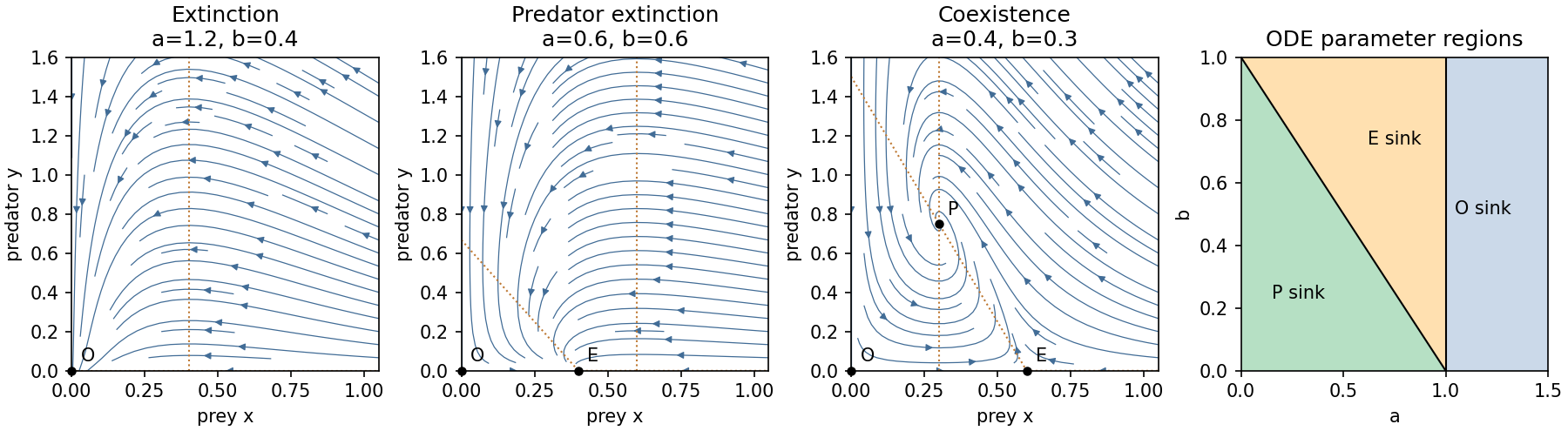
There are three open physical parameter regions:
The axes are invariant. On , decays exponentially; on , prey obey the logistic differential equation. Positivity follows because each right-hand side has its population as a factor. Also is bounded by logistic comparison, while satisfies , so all forward trajectories are bounded. The Dulac function has divergence in the interior, excluding periodic orbits by the Bendixson-Dulac criterion.
In the extinction region, , and then is eventually negative. In the prey-only region, the upper bound implies predator decay and convergence of interior prey to . In the coexistence region the Lyapunov functionhas . Its positive-quadrant sublevel sets are compact, and the only invariant subset with also has . The LaSalle invariance principle proves convergence of every interior trajectory to . These facts justify the complete qualitative phase portraits, not just their local arrows.
At , and meet in a transcritical bifurcation; positive prey decay algebraically. At with , and exchange stability. On its centre manifold, gives , so the physically positive side is still attracting. There is no interior Hopf bifurcation since the coexistence trace never vanishes.

New to topics? Read the docs here!