For an -by- square matrix over a field, its matrix trace is the sum of its diagonal entries:For example, has trace . Adding corresponding diagonal entries immediately proves linearity:Thus matrix trace is a linear functional on the vector space of -by- matrices.[ref]
Linear Algebra Done Right by Sheldon Axler (4th edition). Axler, Linear Algebra Done Right, fourth edition, §8D, definition 8.47 and result 8.56
The surprising point is that the sum is intrinsic to a linear operator, even though individual diagonal entries depend on the basis. The cyclic property of the trace gives, for any invertible matrix ,Hence matrix similarity preserves trace. For the example above, choose the change-of-basis matrix . ThenThe diagonal entries have changed but their sum has not. This makes trace useful for extracting a feature of the underlying linear operator without finding a preferred basis.
Over the complex numbers, or over the real numbers after allowing complex eigenvalues, the trace equals their sum with algebraic multiplicity:No diagonalizable matrix hypothesis is needed.[ref]
Linear Algebra Done Right by Sheldon Axler (4th edition). Axler, Linear Algebra Done Right, fourth edition, §8D, results 8.50–8.52
To see why, use triangularization over an algebraically closed field: an upper triangular matrix similar to has the eigenvalues on its diagonal, counted with algebraic multiplicity, because its characteristic polynomial is . Similarity preserves trace, so summing that diagonal proves the formula.For instance,There is only one independent eigenvector, since , so is not a diagonalizable matrix. Nevertheless its repeated eigenvalue contributes twice. For our earlier , the characteristic polynomial is , its eigenvalues are and , and their sum is . An inexpensive diagonal sum therefore gives spectral information before solving the characteristic polynomial.
The trace of a real matrix does not give that linear map's volume factor: that factor is the absolute value of its determinant. For example, has trace and area factor , but has trace and volume factor . Their occasional numerical agreement in two dimensions is a coincidence. The connection between trace and local volume change gives a geometric interpretation near the identity matrix, and describes the volume rate of a flow map generated by a linear system of differential equations.
For linear maps on a finite-dimensional vector space, the cyclic property of the trace gives . In matrix entries both traces are after exchanging indices. Thus the trace of a finite-dimensional Lie algebra representation vanishes on the derived algebra. In particular, for a perfect Lie algebra, every representing matrix has zero trace.
For an invertible matrix , the cyclic property of the trace gives . Thus the diagonal sum defining the trace does not depend on the choice of basis for an endomorphism. Cyclic permutation of factors is valid inside a trace; arbitrary permutation of factors need not be.
For any fixed real -by- matrix , as the real parameter tends to zero,The big O notation means the remainder is bounded in absolute value by for some constant near zero. The determinant stays positive for sufficiently small , so its oriented volume factor is also its ordinary volume factor. Thus the trace is the first-order fractional volume change, measured from the identity matrix.
A proof follows directly from multilinearity of the determinant. Each column of is . The constant term chooses all the standard basis columns and equals one. A term containing exactly one factor replaces just column by ; expanding that vector in the standard basis leaves only its component, , because every other choice repeats a column. Summing gives . Terms with two or more replacements have order or higher. This also proves the derivative of the determinant at the identity matrix.
This coefficient has a direct visual meaning. At the point , the linear map has component along direction . In a small step , these are the first-order changes of the square's or box's sides in their own directions. Summing them gives its fractional area or volume change; the off-diagonal entries initially change shape rather than contributing to this first-order total.
For the constant-coefficient linear system of differential equations , the exact linear flow is , using the matrix exponential. Its volume factor isThis is the matrix exponential determinant identity. One can derive it without diagonalization: set , whose matrix inverse is , and use in Jacobi's formula to get . The scalar differential equation with initial value one gives the displayed exponential function. Thus positive trace causes volume expansion, negative trace causes contraction, and zero trace preserves volume, even when individual directions behave differently.
In two dimensions, compare four generators at :The first and third diagonal matrices expand or contract both directions. The second expands horizontally and contracts vertically by reciprocal factors, making a rectangle of unchanged area. For the last nilpotent matrix, , so its matrix exponential is exactly ; it sends to , a shear mapping. Zero trace allows substantial shape change and does not mean the flow map is stationary.
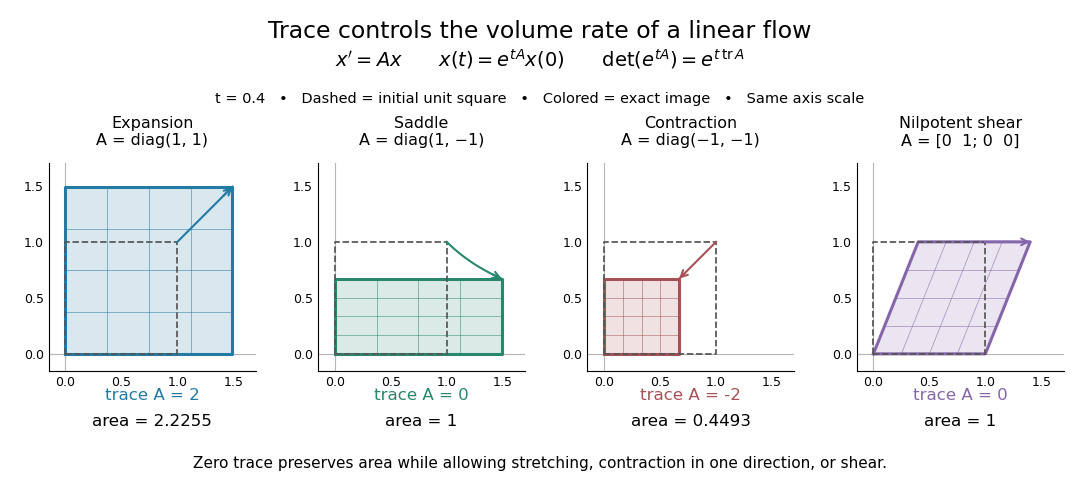
Four examples of a linear system of differential equations: trace controls area change while a saddle and a shear mapping preserve area
. Details. 
The first-order statement and the exact flow map should be distinguished. For , , whereas for all real . Zero trace eliminates the first-order change in the approximate step, and it preserves volume exactly in the matrix exponential flow. The examples use an abstract parameter and coordinate vectors; no physical units are assumed.
A two-by-two matrix with zero trace satisfies by the Cayley-Hamilton theorem. Over the complex numbers, either and its two distinct eigenvalues make it diagonalizable, or . A matrix commutator has zero trace, so this alternative applies to it. Diagonalization over the real numbers need not follow when .
For a complex by matrix, triangularization gives . The zero power sums force a finite complex multiset to vanish criterion makes every diagonal eigenvalue zero. A strictly upper-triangular by matrix has zero th power: every nonzero product entry would require strictly increasing index steps. Similarity then gives .
To prove it, let act by on the generalized eigenspace of of eigenvalue . Polynomial interpolation on eigenvalue differences, together with adjoint compatibility of additive Jordan decomposition, expresses as a polynomial in with zero constant term. Since maps into and preserves , this gives . Taking the matrix trace on each generalized eigenspace yields , so every eigenvalue is zero. This is the linear-algebra step behind the Cartan solvability criterion; need not be Lie subalgebras.
Over or , every linear functional on all matrices satisfying is a scalar multiple of the trace. The matrix units show that the functional vanishes off the diagonal and has equal values on every diagonal unit. The normalization fixes the scalar to one.
A traceless matrix is a square matrix whose trace is zero. Such matrices form the kernel of the trace linear functional.
Every commutator of square matrices is traceless by cyclicity of the trace. Conversely, off-diagonal matrix units and differences of diagonal units are themselves commutators and span all traceless matrices. This proves equality with the linear span of commutators, without needing a theorem about representation as one commutator.
If is an -by- matrix and is an -by- matrix over the same field, both products are square matrices andThe products can even have different sizes: for and , and , but both have trace .[ref]
Linear Algebra Done Right by Sheldon Axler (4th edition). Axler, Linear Algebra Done Right, fourth edition, §8D, result 8.49
Grouping all but one factor proves that is unchanged by a cyclic permutation whenever the cyclic products are defined and square. In particular, every commutator has trace zero, since by linearity.
Articles by others on the same topic
There are currently no matching articles.