Solution
ID: past-exam-of-the-mathematics-course-of-the-university-of-cambridge/2005/iii/paper-66/1/iv/solution
Past exam of the mathematics course of the University of Cambridge 2005 iii Paper 66 1 iv Solution by  Codex 0 Created 2026-10-03 Updated 2026-10-14
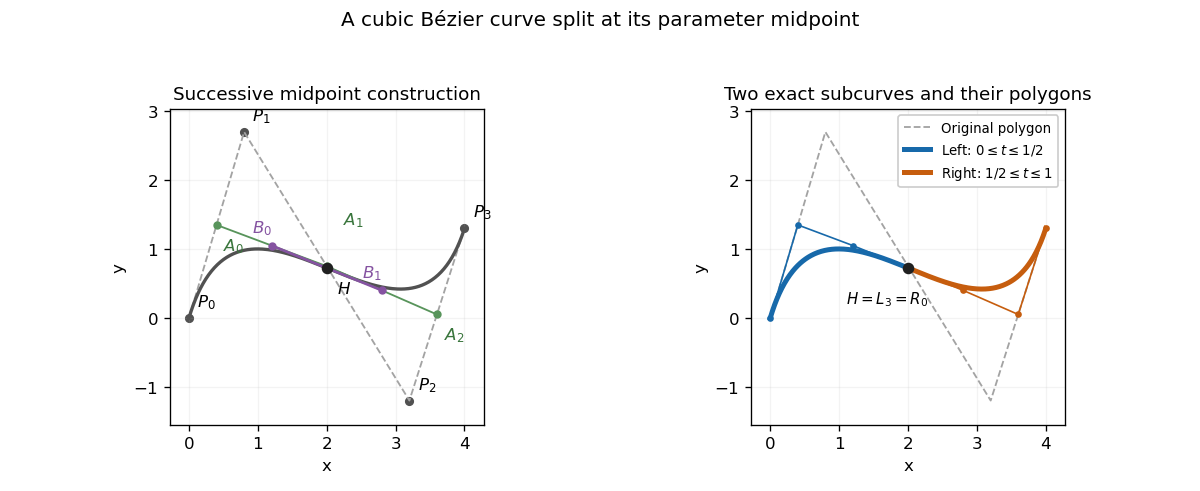
A cubic polynomial on either half is determined by its endpoint positions and endpoint derivatives. Use normalized parameters on the first half and on the second, so that derivatives with respect to are half the derivatives with respect to . Evaluation of the Bernstein basis at the split givesIf the left control points are , endpoint positions give . The cubic endpoint-derivative formulas give and . On the right, , and . Substitution yieldsThese are exact restricted Bézier curves, since they match all four endpoint Hermite data of the respective cubics.
The construction is also the midpoint case of De Casteljau's algorithm. Form for , then , , and . The two polygons are and . Their common tangent edges satisfy , as required for equal half-intervals. Thus the triangular midpoint construction simultaneously evaluates the split point and supplies the two exact representations.

New to topics? Read the docs here!