Solution
ID: past-exam-of-the-mathematics-course-of-the-university-of-cambridge/2006/iii/paper-85/1/b/solution
Past exam of the mathematics course of the University of Cambridge 2006 iii Paper 85 1 b Solution by  Codex 0 Created 2026-10-03 Updated 2026-10-14
The trace and determinant of the origin's linearization are and . Thus its open region of linear asymptotic stability isFor this means below the lower semicircle; for all negative lie in the open stable region. The origin is a saddle equilibrium inside the unit circle and a source outside it with positive .
For nonzero equilibrium points, put . Existence requires and . An equivalent region isInside the circle exactly one radius polynomial root is positive, giving two equilibrium points. Outside it, with and , both polynomial roots are positive, giving four. On with , the two radii coalesce in a saddle-node bifurcation at each antipodal point. On the circle a zero radius is the origin and is excluded from the nontrivial count. These distinctions are shown in the parameter sketch.
At the linearization has one simple zero and one negative eigenvalue, while the cubic centre manifold coefficient vanishes. The quintic coefficient is negative. It is a codimension-two bifurcation with a reflection-symmetric degenerate pitchfork bifurcation: a wedge of coexistence between an attracting origin and an attracting antipodal pair opens between a subcritical pitchfork bifurcation and the nearby saddle-node bifurcation curve. The intervening smaller-radius pair consists of saddles. Indeed at a nonzero equilibrium point, direct differentiation of the polar coordinates equations givesThe smaller-radius branch has negative determinant, while in the coexistence wedge the larger-radius branch has positive determinant and negative trace.
At critical boundaries the linear stability analysis test alone is inconclusive. The origin is nonlinearly attracting at a supercritical lower pitchfork bifurcation, at its stabilizing quintic endpoint, and at the supercritical Hopf bifurcation threshold, although decay is no longer exponential. It is unstable at the subcritical lower pitchfork bifurcation. The double-zero point is also attracting: the positive function hasnear the origin away from zero. Here and prove the bound. The other double-zero point has an unstable quartic potential, as the blow-up below shows. The shading records the open linear stability analysis regions; these boundary remarks distinguish nonlinear from exponential stability.
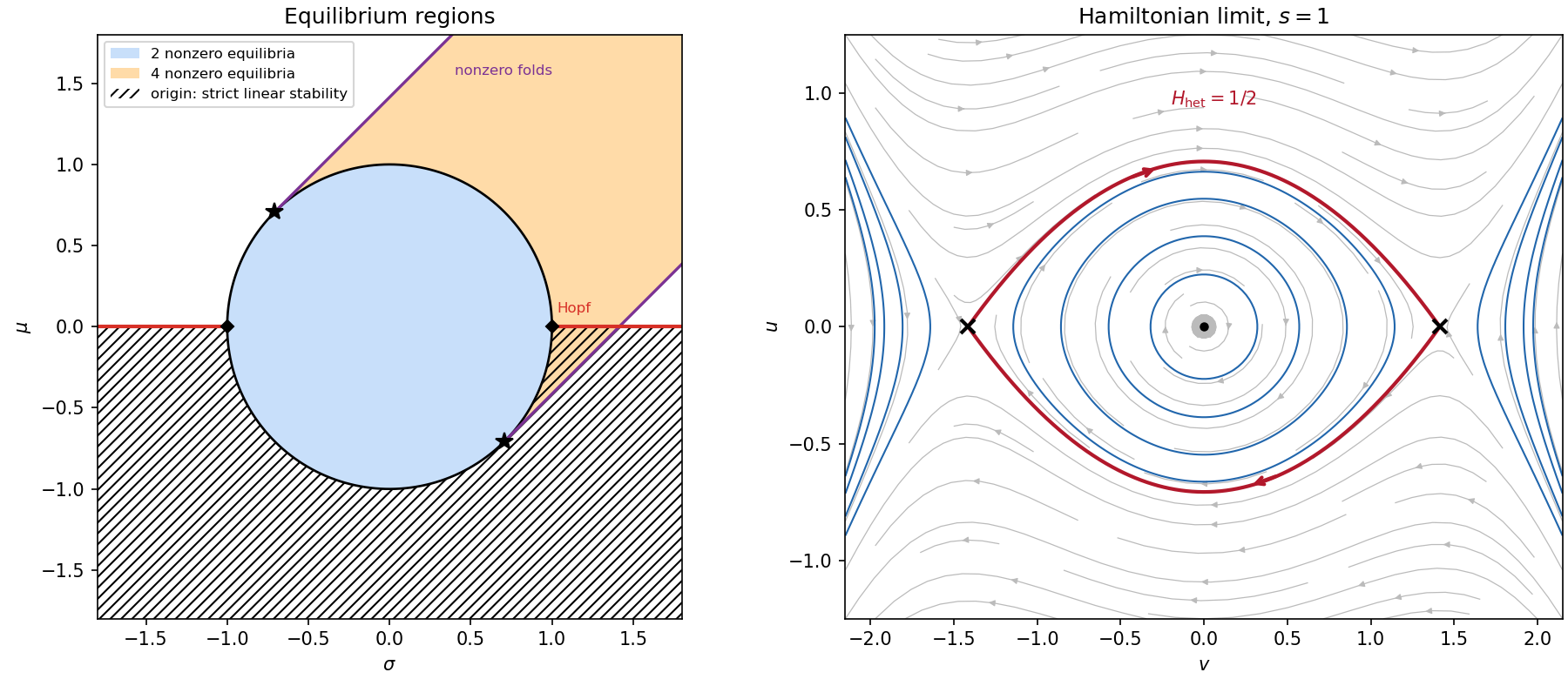
Origin stability, nonzero-equilibrium counts and the Hamiltonian separatrix of the cubic confinement model
. Details. 
New to topics? Read the docs here!