Solution
ID: past-exam-of-the-mathematics-course-of-the-university-of-cambridge/2008/ii/paper-2/7a/solution
Past exam of the mathematics course of the University of Cambridge 2008 ii Paper 2 7A Solution by  Codex 0 Created 2026-09-24 Updated 2026-10-14
At a stationary bifurcation, a real eigenvalue of the equilibrium linearization crosses zero; the critical motion has zero frequency. At a Hopf bifurcation, a conjugate pair crosses the imaginary axis at with , permitting a nearby limit cycle.
The Hopf normal form has a small cycle when . Its radial multiplier exponent is , while the origin's radial exponent is . Thus: for , there is an attracting spiral and no small cycle; for , a repelling spiral is surrounded by an attracting cycle; for , an attracting spiral is surrounded by a repelling cycle; for , there is a repelling spiral and no small cycle. Outside the repelling cycle in the third case the local radial flow points outward; a cubic normal form makes no global prediction about where it goes.
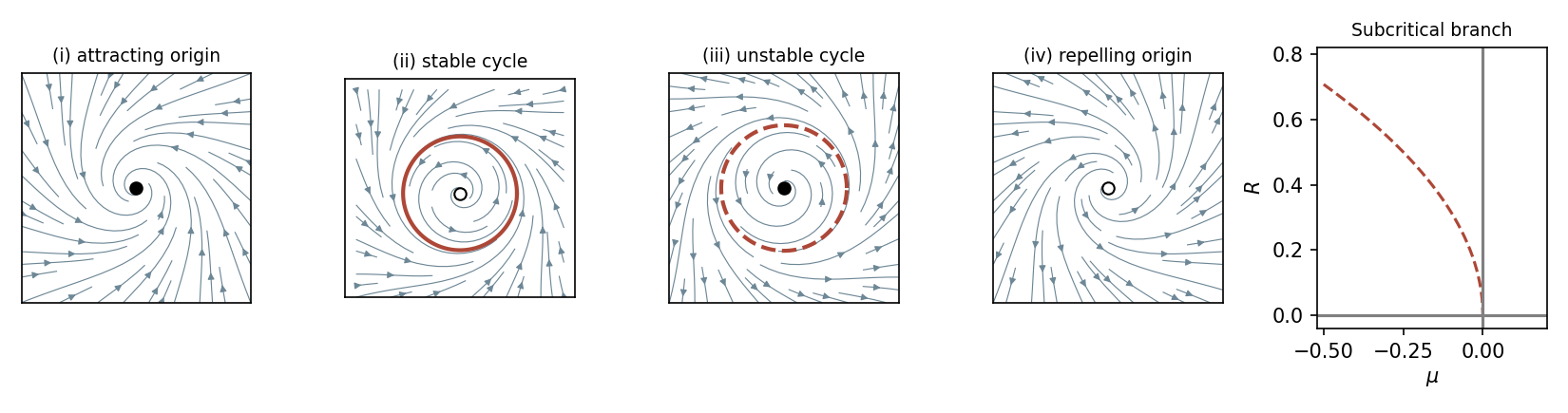
Four local Hopf phase portraits and the unstable subcritical radius branch
. Details. 
The subcritical bifurcation has and the unstable radius branch on , meeting the origin at . On either existing branch, the angular speed is , so
New to topics? Read the docs here!