The Hopf normal form is a local normal form of a dynamical system on the critical two-dimensional centre manifold. After shifting the equilibrium point and changing coordinates, its cubic truncation can be writtenwhere is the critical eigenvalue real part, , , and . Smooth parameter dependence of the cubic coefficients and higher-order terms are omitted in this truncation. The real coefficient controls radial saturation; the imaginary coefficient changes the angular frequency with amplitude. This finite-order reduction, rather than literal equality to a cubic equation everywhere, is the meaning of the Hopf normal form for a general system.[ref]
https://www.ma.imperial.ac.uk/~dturaev/bif_theory3.pdf. Dmitry Turaev's bifurcation-theory notes, section 3, parameter-dependent complex normal form
In the cubic truncation, whenever . Substituting into the angular equation gives . For the full smooth system, the leading normal form radius satisfies and the period tends to . The exact circle and exactly constant angular frequency of the special model , , are conveniences of that model. In the original coordinates the small periodic orbit need not be a circle. Radial scaling can normalize a nonzero to or , so is a normalized leading amplitude, not a universal physical radius.
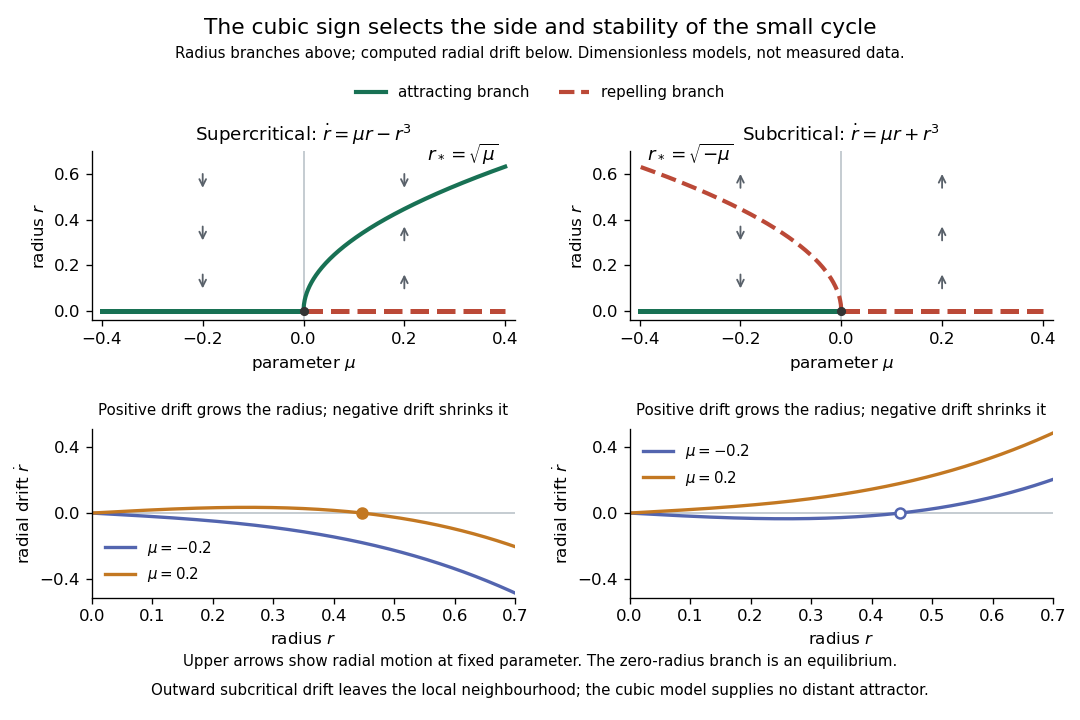
Computed radius branches and radial drift for the two Hopf criticalities
. The exact cubic Hopf normal forms and , with nonzero angular motion understood. The upper bifurcation diagrams distinguish attracting solid branches from repelling dashed branches; is an equilibrium point, while a nonzero constant radius is a periodic orbit. Vertical arrows show radial motion at fixed . Below, the sign of shows why the nonzero roots attract or repel. Stability is within the reduced plane. These are original dimensionless calculations, not measured data; continuation away from zero is a property of the chosen cubic equations, not a global prediction of the local Hopf bifurcation theorem. Details.
Articles by others on the same topic
There are currently no matching articles.