Solution
ID: past-exam-of-the-mathematics-course-of-the-university-of-cambridge/2009/iii/paper-44/4/solution
Past exam of the mathematics course of the University of Cambridge 2009 iii Paper 44 4 Solution by  Codex 0 Created 2026-10-03 Updated 2026-10-14
Take incoming electron momentum and positron momentum , with outgoing photon momenta , so . The leading electron-positron annihilation into two photons has two tree-level Feynman diagrams, differing by the order in which the two outgoing photons attach to the charged-fermion line.
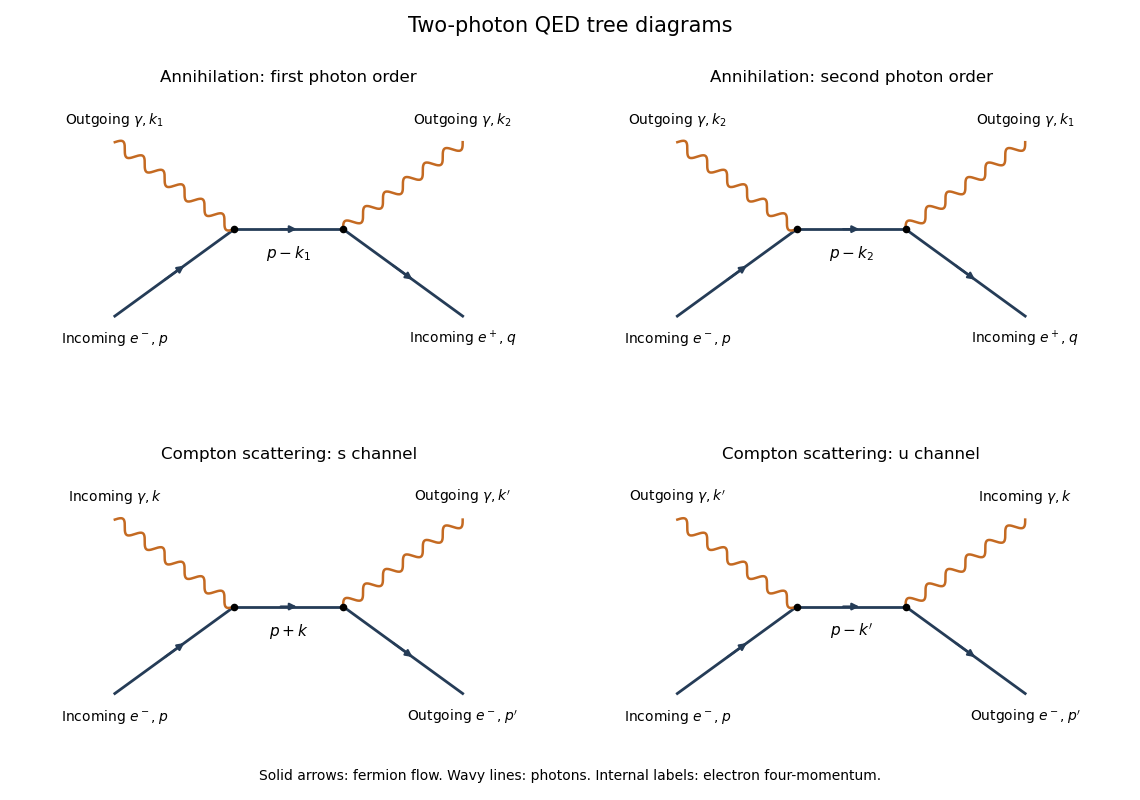
The two photon orders in electron-positron annihilation and the s and u channels of Compton scattering
. Details. 
The arrows indicate fermion flow. An incoming positron has the opposite flow direction to its physical momentum; the lower row uses an outgoing electron instead.
The required QED Feynman rules, with interaction , are a vertex , a Dirac propagator , an incoming electron spinor , an incoming positron adjoint , and an outgoing photon polarization . Here Feynman slash notation means , and the external Dirac equations are and .
Put , omitting only the propagator's overall factor . Multiplying the two vertices and the propagator givesThe diagrammatic expression is . The relative sign is plus because the two photons are bosons; exchanging their attachments does not exchange external fermions. The amplitude is of order .
A physical photon polarization vector obeys and , with the gauge equivalence . One can choose a transverse representative with and normalize . There are two physical transverse polarizations.
To prove the requested two-photon fermion Ward identity, replace by . Away from an internal pole, is the inverse of , with the boundary prescription understood. The first term simplifies becauseFor the second term, four-momentum conservation gives , soThe two contributions are therefore and , which cancel. Interchanging the photon labels proves the other contraction vanishes. By linearity, adding a multiple of either photon momentum to its polarization leaves the summed amplitude unchanged. This is gauge invariance: longitudinal gauge representatives do not describe an additional physical photon state. An individual diagram does not generally have this property.
For Compton scattering, let be incoming electron and photon momenta and the outgoing ones. The diagrams in the lower row have intermediate electron momenta and respectively. The same QED Feynman rules giveTheir denominators are and , the - and -channel denominators. In annihilation the two exchanged-electron channels instead carry and . Crossing symmetry relates the two expressions by moving the positron to an outgoing electron and one outgoing photon to an incoming photon, with the corresponding momentum and polarization replacements. There is no two-photon contact vertex for the minimally coupled Dirac electron. Both processes require the sum of the two photon orders to satisfy the Ward identity.
New to topics? Read the docs here!