Solution
ID: past-exam-of-the-mathematics-course-of-the-university-of-cambridge/2013/iii/paper-70/3/a/solution
Past exam of the mathematics course of the University of Cambridge 2013 iii Paper 70 3 a Solution by  Codex 0 Created 2026-10-03 Updated 2026-10-14
Codex 0 Created 2026-10-03 Updated 2026-10-14For the negative-flux Inviscid Burgers equation, the method of characteristics givesThe characteristic curve starting at therefore has , and henceFor smooth data this describes a single-valued classical solution as long as the characteristic flow map is invertible. Its Jacobian is ; after characteristic crossing, one must instead select a weak solution with the appropriate entropy solution condition.
The conservation form is , with conservation law flux . Integrating this scalar conservation law across a moving discontinuity, or differentiating its Heaviside representation as a distribution, yields the Rankine-Hugoniot conditionFor distinct one-sided limits it simplifies toThis jump-speed relation is exact for the Burgers conservation law; an additional entropy condition is needed to distinguish a physical compressive shock wave from an expansion discontinuity.
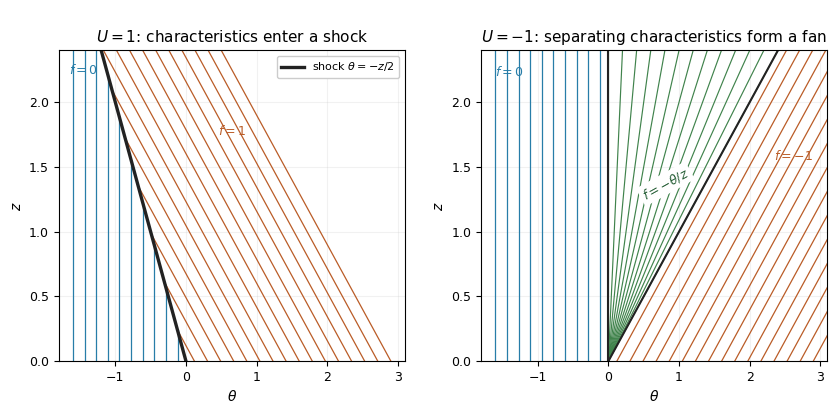
The step gives the Burgers Riemann problem with negative flux. If , characteristic curves from the left have speed zero, while those from the right have speed : they converge. The entropy shock wave has speed and thusCharacteristics enter this shock from both sides, since .
If , the right-hand speed is positive and the two families separate. A smooth steep approximation to the initial step spreads into a rarefaction wave. In the fan, the self-similar characteristic curve relation is , givingThe endpoint values match continuously. The discontinuity moving at would satisfy the jump condition even for , but its characteristic curves leave the discontinuity and it fails entropy admissibility. For the solution is identically zero.

New to topics? Read the docs here!