Solution
ID: past-exam-of-the-mathematics-course-of-the-university-of-cambridge/2016/iii/paper-118/1/c/solution
Past exam of the mathematics course of the University of Cambridge 2016 iii Paper 118 1 c Solution by  Codex 0 Created 2026-10-03 Updated 2026-10-14
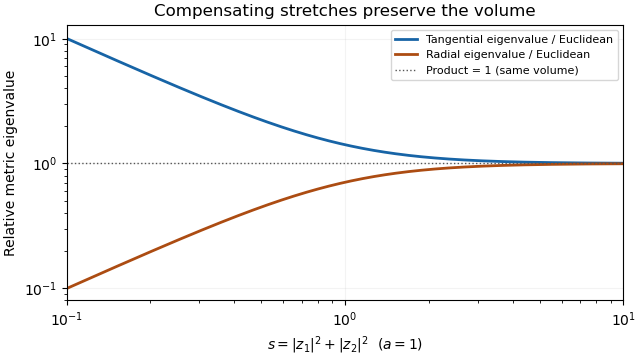
Use a radial geometric Kähler potential. Write and . The coefficient Hermitian matrix of isIts eigenvalues are in the complex tangential direction and in the complex radial direction. A Kähler metric is positive precisely when both are positive. The standard form has coefficient matrix , so equality of the Riemannian volume forms is the conditionIndeed, the volume form is and its coefficient is proportional to . Multiplying the determinant equation by gives , so we can takeAn explicit antiderivative isIt is smooth for . Its two eigenvalues areThe form is real and closed because it is of a real function, so it is a Kähler metric on the punctured space. Since , neither eigenvalue equals , and the metric differs from the Euclidean one. The radial and tangential stretches compensate exactly, preserving the volume form:This is a radial Kähler metric with Euclidean volume in complex dimension two.

New to topics? Read the docs here!