
An antiderivative recovers a function from its local rate of change. For a real-valued function on an open subset of the real line, a differentiable function is an antiderivative whenFor example, has the antiderivatives for every real additive constant . Their derivatives agree, while their values can differ. On an interval, the constant of integration describes the entire freedom in the answer. [ref]
https://openstax.org/books/calculus-volume-1/pages/4-10-antiderivatives. OpenStax Calculus 1, §4.10: antiderivatives and their families
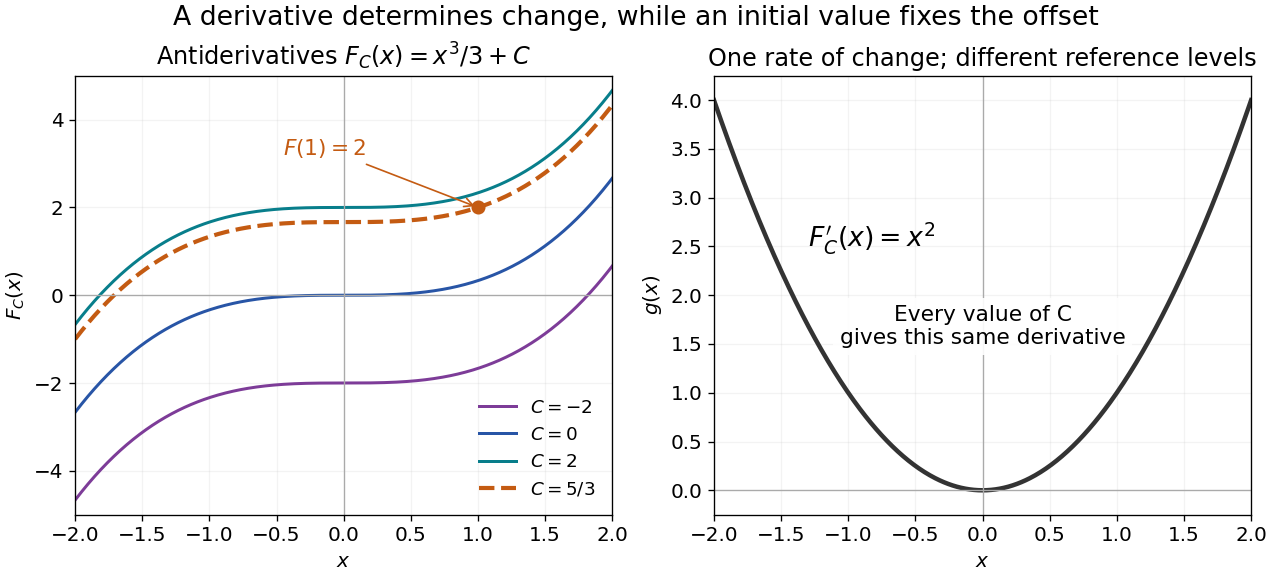

The indefinite-integral notation records this family on an interval. For the illustrated family, the extra condition selects . Thus reversing differentiation requires both a rate and a reference value if a unique function is wanted.
The fundamental theorem of calculus supplies a construction when is continuous on an interval . Choose and set ; then . Integrability alone does not guarantee a classical antiderivative. The Heaviside step function is Riemann integrable on bounded intervals, but cannot be a derivative throughout an interval containing its jump: Darboux theorem for derivatives requires every intermediate value. [ref]
https://www.jirka.org/ra/html/sec_mvt.html. Lebl, Basic Analysis I, §4.2.5: the intermediate-value property of derivatives
New to topics? Read the docs here!