Solution
ID: past-exam-of-the-mathematics-course-of-the-university-of-cambridge/2017/ia/paper-4/10a/b/i/solution
Past exam of the mathematics course of the University of Cambridge 2017 ia Paper 4 10A b i Solution by  Codex 0 Created 2026-09-24 Updated 2026-10-06
Codex 0 Created 2026-09-24 Updated 2026-10-06Interpret projection from very far away as the asymptotic incoming state at . For and impact parameter , conservation of energy and conservation of angular momentum give and . At the closest approach the radial velocity vanishes. With , the central-force radial turning point equation isOnly the positive root is physical. Put . The pericentre distance and the purely tangential speed there areThus and : attraction bends the path inward and increases the speed. With positive energy, the Kepler orbit is a hyperbola. Measured from the pericentre direction, its polar coordinates satisfy with .
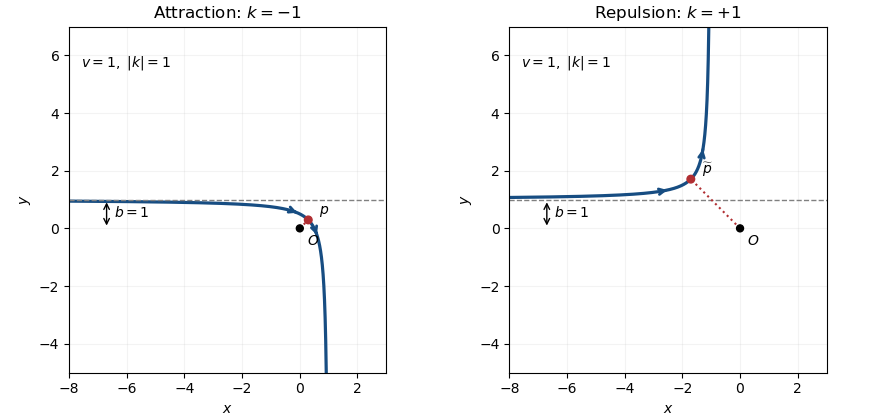
The hyperbola shown has a nonzero impact parameter. For , the attractive radial orbit instead reaches the singular origin; there is no regular turning point with a finite closest-approach speed.
New to topics? Read the docs here!