Solution
ID: past-exam-of-the-mathematics-course-of-the-university-of-cambridge/2017/ii/paper-4/13b/solution
Past exam of the mathematics course of the University of Cambridge 2017 ii Paper 4 13B Solution by  Codex 0 Created 2026-09-24 Updated 2026-10-05
Codex 0 Created 2026-09-24 Updated 2026-10-05A positive spatially homogeneous equilibrium satisfies and , givingIt exists iff . The reaction Jacobian matrix isThus linear stability analysis gives strict homogeneous stability precisely whenThe boundaries are not included: at the linearization has purely imaginary exponents, and at the positive equilibrium ceases to exist.
For a mode , put . The perturbation matrix is . In the homogeneously stable region its trace is still negative, so a growing mode exists iff its determinant is negative:This upward quadratic is negative for some precisely whenSuch a Turing instability region is nonempty iff . The unstable band isFor a finite domain only the admissible boundary-condition wavenumbers in this band grow. The region shown below describes a continuous wavenumber spectrum.
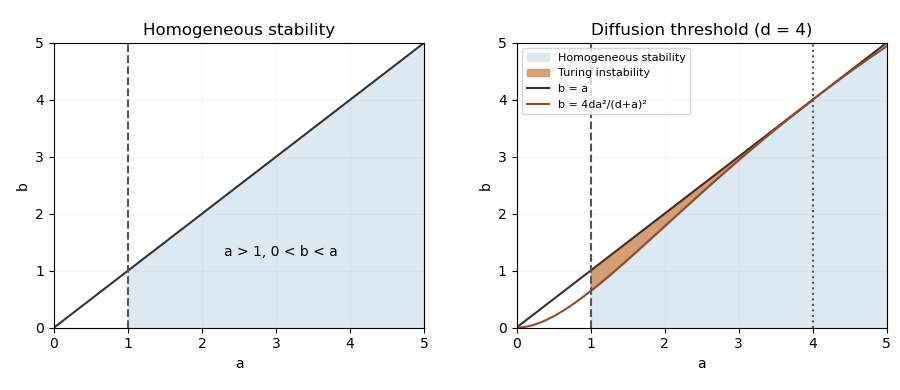
At onset the minimum of is zero and . On the threshold , substitution gives . HenceThis last expression is the threshold wavenumber; away from onset the fastest-growing mode need not coincide with the minimum of the determinant.
New to topics? Read the docs here!