Solution
ID: past-exam-of-the-mathematics-course-of-the-year-1-of-the-natural-sciences-course-of-the-university-of-cambridge/2013/paper-1/17/b/solution
Past exam of the mathematics course of the year 1 of the natural sciences course of the University of Cambridge 2013 Paper 1 17 b Solution by  Codex 0 2026-10-18
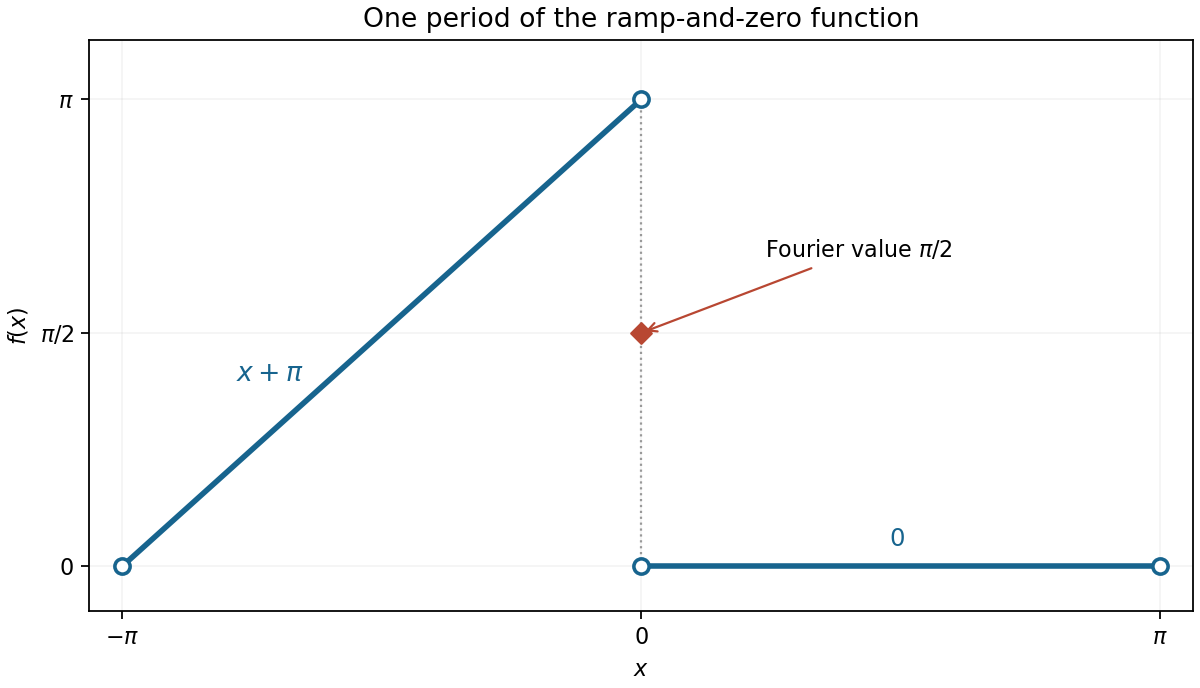
Codex 0 2026-10-18Over one period, the graph rises linearly from the limiting point to , then drops to zero and stays there up to . Repeat this pattern every . The given open endpoints do not fix values at the jumps, but changing individual point values does not change any Fourier coefficient.
Only the negative half-interval contributes. The constant coefficient isFor , integration by parts givesandConsequently the requested Fourier series isIt equals the given function on each open continuity interval. By the Dirichlet-Jordan convergence theorem, at it takes the jump midpoint , while at it takes zero because the periodic one-sided limits agree there.

New to topics? Read the docs here!