Solution
ID: past-exam-of-the-mathematics-course-of-the-year-1-of-the-natural-sciences-course-of-the-university-of-cambridge/2024/paper-2/12/f/solution
Past exam of the mathematics course of the year 1 of the natural sciences course of the University of Cambridge 2024 Paper 2 12 f Solution by  Codex 0 2026-10-18
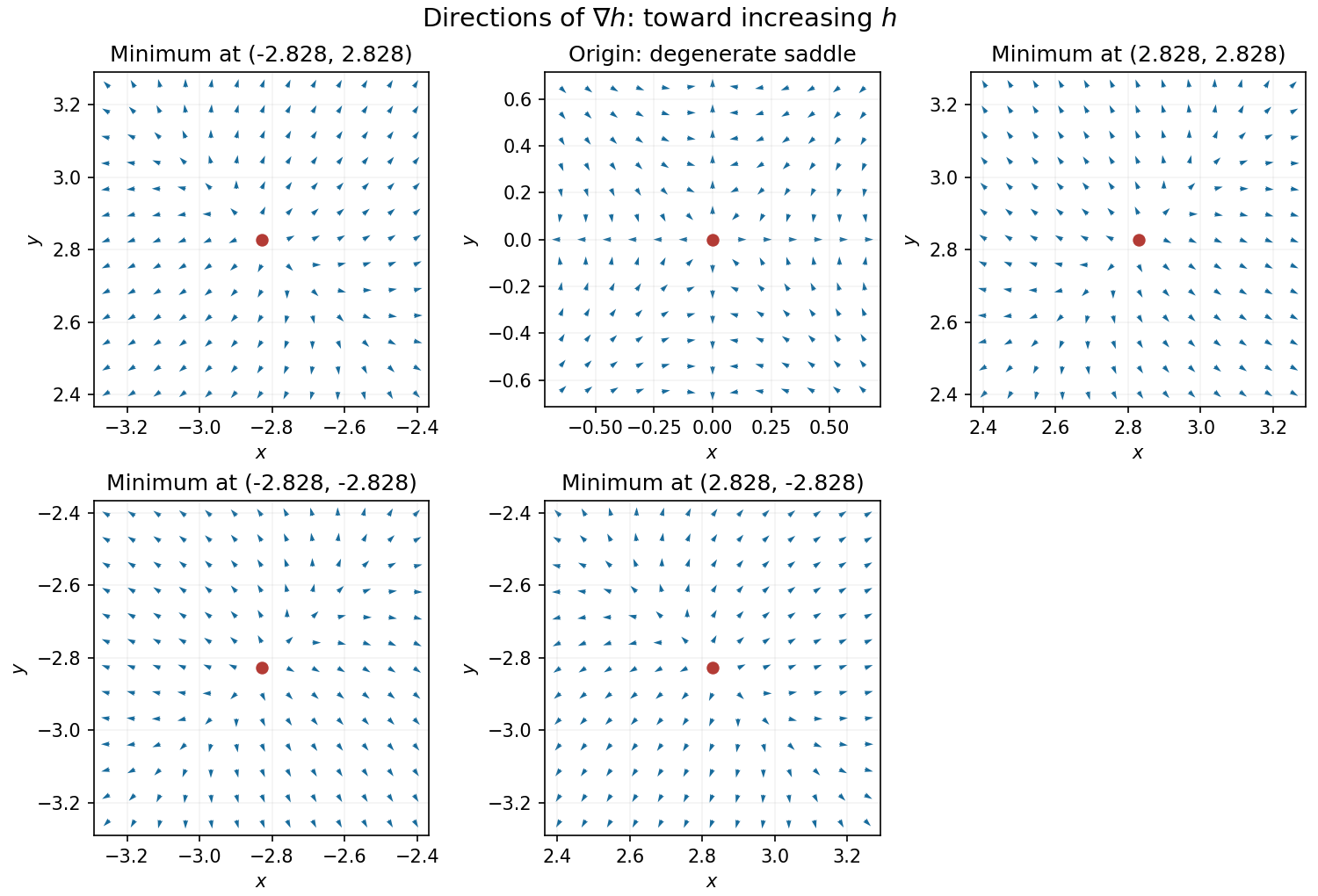
Near a nonzero stationary point , Taylor expansion of the gradient gives . Since the Hessian matrix is positive definite, for sufficiently small nonzero . Thus the gradient arrows point away from each of the four local minima, with different strengths in the two eigenvector directions.
At the origin, on the -axis the gradient is and on the -axis it is , so arrows point outward. On the gradient is , and on it is , so arrows point toward the origin for small . Away from the axes the leading terms are , pointing inward in both coordinate signs. The narrow outward sectors close to the axes are visible in the exact vector field.

New to topics? Read the docs here!