Solution
ID: past-exam-of-the-mathematics-course-of-the-year-2-of-the-natural-sciences-course-of-the-university-of-cambridge/2012/paper-2/7/solution
Past exam of the mathematics course of the year 2 of the natural sciences course of the University of Cambridge 2012 Paper 2 7 Solution by  Codex 0 2026-10-18
Codex 0 2026-10-18Use displacements of the left oxygen, carbon and right oxygen along a common positive direction. In this harmonic model the kinetic energy and elastic potential energy areThus the generalized eigenvalue problem for small oscillations is , whereThe normal modes of three masses connected by two equal springs give the three independent solutionsThe second row follows by holding the centre fixed and moving the end masses oppositely. In the remaining internal mode the end displacements are equal, and zero displacement of the centre of mass gives , yielding the third row; substitution verifies its frequency. Both nonzero modes have fixed centre of mass. In the symmetric stretch the two bond-length changes are equal; in the antisymmetric stretch they are opposite.
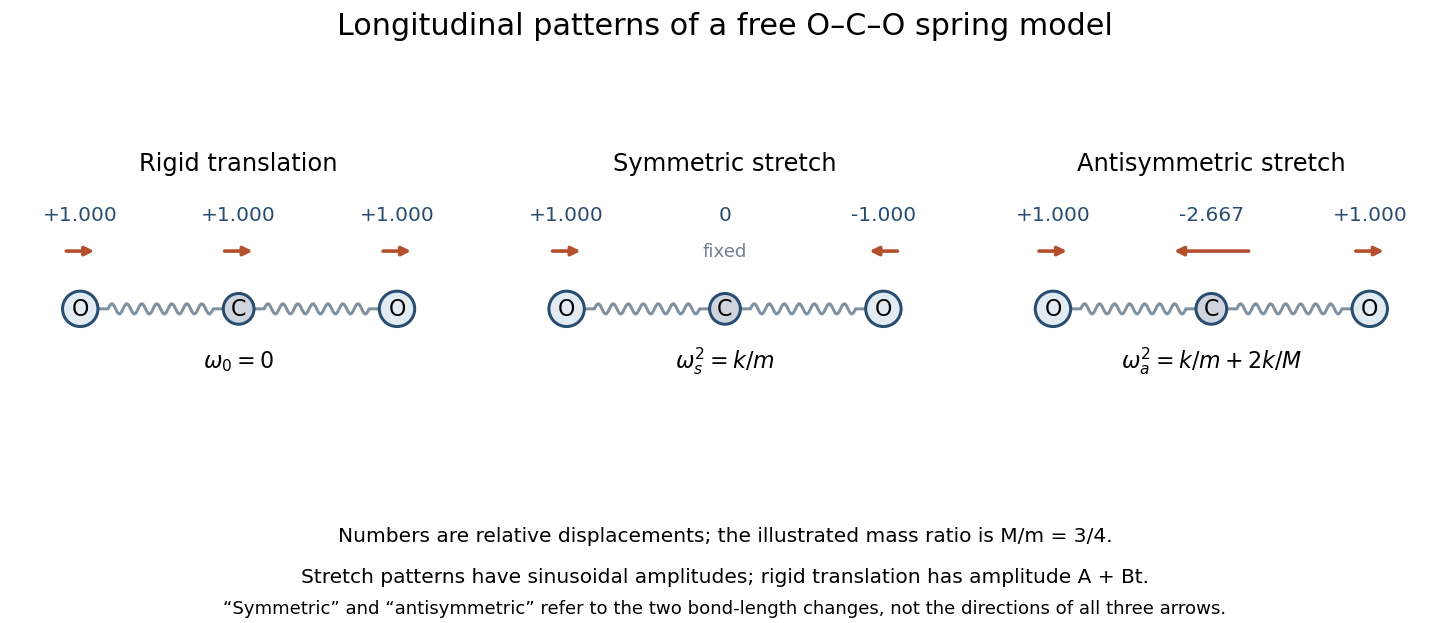
Longitudinal mode directions of the free three-mass molecular model; the zero mode translates every mass together
. Details. 
The zero mode occurs because a uniform translation changes neither spring length, so . It represents free center-of-mass motion, not an additional restoring vibration. Its general time amplitude is . Only one translational zero mode exists in the restricted one-dimensional model; transverse and rotational motion are outside its specified coordinates.
For the initial impulse, all displacement amplitudes at zero time vanish. Resolve the initial velocity into these three mode shapes:Writing and gives the impulse on an end mass of a free symmetric three-mass chain:In particularwhere . The initial derivatives are , as required. The carbon dioxide model therefore drifts uniformly while undergoing both internal stretches. Its total momentum is the initial ; omitting the zero mode would incorrectly hold the centre of mass fixed.
New to topics? Read the docs here!