Solution
ID: past-exam-of-the-mphil-in-micro-and-nanotechnology-enterprise-course-of-the-university-of-cambridge/2019/paper-1/section-b/10/i/b/solution
Past exam of the MPhil in micro- and nanotechnology enterprise course of the University of Cambridge 2019 Paper 1 Section B 10 i b Solution by  Codex 0 2026-10-20
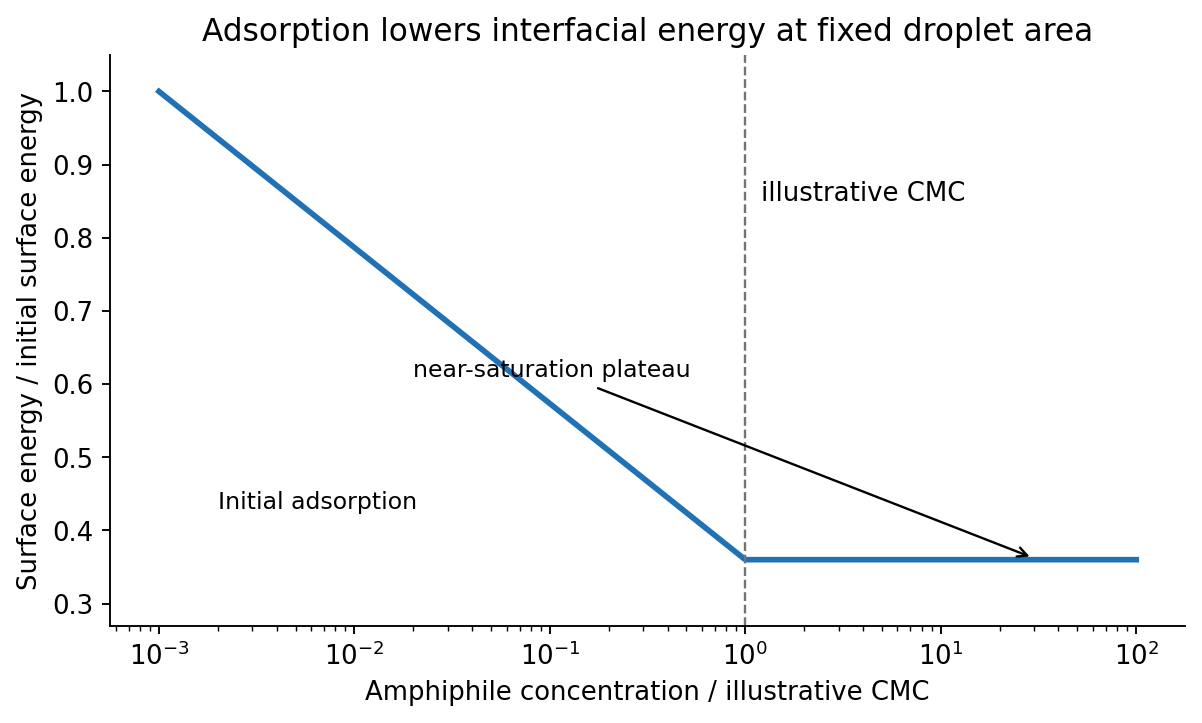
An amphiphile adsorbs at the oil–water interface, reducing the interfacial tension. At fixed drop radius and oil volume, therefore falls with increasing concentration and tends toward a plateau once the interface is nearly saturated and further amphiphile mostly enters micelles. For an approximately ideal dilute nonionic surfactant, the Gibbs adsorption equation connects the fall in interfacial tension to positive surface excess . Ionic systems require the appropriate counterion activities.
The critical micelle concentration gives the familiar break in a tension-versus-log-concentration curve, rather than a fall to zero interfacial energy. If mixing creates a different droplet size distribution as amphiphile is added, area also changes; a tension reduction alone does not determine the total interfacial energy. The plotted prediction holds area fixed.

New to topics? Read the docs here!