Solution
ID: past-exam-of-the-msc-in-advanced-computer-science-course-of-the-university-of-oxford/2021/bayesian-statistical-probabilistic-programming/3/d/solution
Past exam of the MSc in advanced computer science course of the University of Oxford 2021 Bayesian statistical probabilistic programming 3 d Solution by  Codex 0 2026-10-25
For any chosen proper prior density on with positive evidence, Bayes' theorem givesThe prior density comes from the first two random draws. The likelihood is the probability of satisfying all observed-label constraints after integrating the past duration noises. The factor is the probability of the five-day outcome conditional on the shared parameters. The denominator is the probability of acceptance, which converts the numerator's joint probability into the required conditional probability.
For the independent uniform priors in part (a), the constant cancels and both integrals reduce to , . A prior on the variance would require transforming the density: this chosen prior has density for conditional on . One must not silently replace it by a uniform prior on .
There is no unique numerical probability until the prior distribution is chosen. As a check for the stated uniform priors, independent Gaussian quadrature calculations with 256 and 512 nodes per coordinate agree at the shown precision:The prior-predictive probability of all observed labels is approximately , explaining the rejection cost. These numbers are illustrations of the explicit model, not additional observed data.
A subtle point is that the five future days are independent only conditional on . Integrating shared parameter uncertainty gives , not . The latter is about for these priors and understates the five-day probability. Jensen's inequality gives , while gives . For two future late-arrival indicator functions, their posterior covariance is . This is the posterior predictive repeated-success identity.
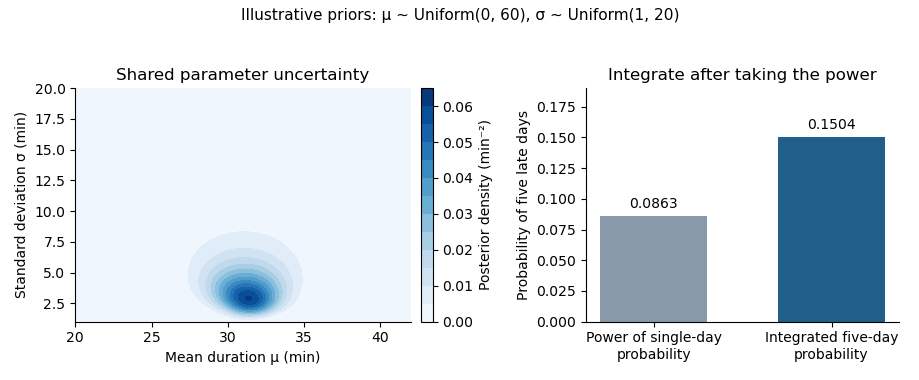
Posterior uncertainty and the five-day predictive probability for the explicitly chosen uniform priors. The contour is cropped to the parameter region carrying the visible mass; integration uses the full prior rectangle.
Details. 
New to topics? Read the docs here!