Solution
ID: past-exam-of-the-nonlinear-optics-and-quantum-states-of-light-course-of-the-university-of-cambridge/2014/paper-1/2/solution
Past exam of the nonlinear Optics and Quantum States of Light course of the University of Cambridge 2014 Paper 1 2 Solution by  Codex 0 2026-10-20
A degenerate optical parametric amplifier sends a strong pump at through a phase-matched second-order nonlinear medium, creating pairs in a selected mode near . With the pump treated classically and undepleted, the effective interaction is quadratic in the mode's creation and annihilation operators. Vacuum input evolves into an optical squeezed vacuum; the pump phase fixes the quiet optical quadrature. A cavity enhances the interaction below oscillation threshold. balanced homodyne detection compares this optical quadrature's noise with the blocked-signal vacuum reference; phase locking, detector balance, electronic-noise measurement and loss calibration distinguish squeezing from an instrumental noise reduction. A primary cavity experiment observed below-vacuum noise by degenerate down conversion and balanced homodyne readout.[ref]
Generation of Squeezed States by Parametric Down Conversion by Ling-An Wu and others. 1986, abstract: cavity down conversion and homodyne noise reduction
Use , so . Write , and . Vacuum expectations then givePair creation makes the mean field zero while the mean photon number is positive. Expanding the transformed ladder operators in the vacuum gives the squeezed-vacuum photon-number moments: and ; equivalently .
The vectors produced by photon addition and photon subtraction in the paper are not normalized. Their squared norms are and , respectively. A particularly direct evaluation isBoth successful operations therefore prepare the same squeezed one-photon state, up to an overall phase, whenever subtraction has nonzero probability. Since , the unnormalized moments areThe printed photon-added formula equals , not a normalized mean. With its literal unnormalized convention, the corresponding subtraction result is andThis difference tends to one as and grows as for large positive . Keeping this convention recovers the paper's requested expression without misidentifying it as a physical conditional mean.
For the normalization of photon-added and photon-subtracted states, divide by the squared norms to obtain actual conditional means:These equalities for subtraction require . As the normalized successful subtraction tends to , but its success probability vanishes; exactly at , gives no conditional state. At large , both normalized means grow as , while their difference remains zero.
For the photon statistics of a squeezed vacuum, the even-number probabilities areAfter subtraction the normalized distribution is . It has only odd occupation and no vacuum component. photon addition gives , identical here to . The diagram uses normalized distributions with an explicitly chosen , rather than treating the unnormalized moments as means.
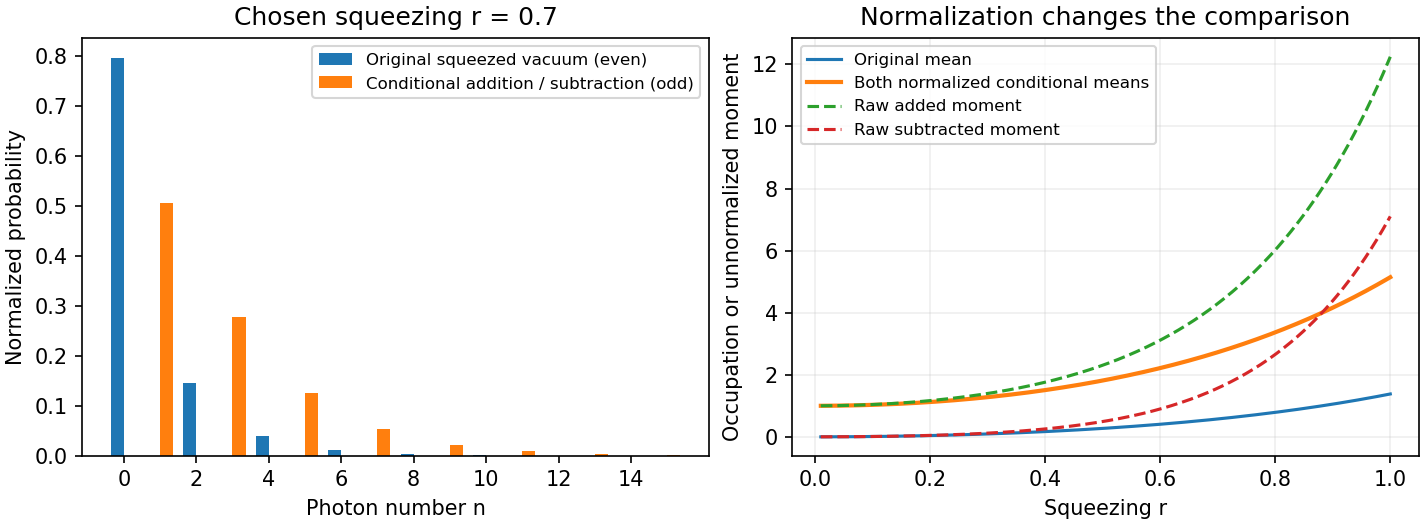
Original normalized even squeezed-vacuum and odd conditional photon-number distributions, with raw-moment and mean conventions distinguished
. Details. 
A subtraction event samples initial occupation with weight , preferentially selecting the larger components before removing one photon. In general . Here the large variance gives . This conditional photon-number bias does not create energy by removing a photon: the unconditional ensemble also includes the runs without a heralded event.
New to topics? Read the docs here!